
Lieferung heute & morgen

Qualitätsgarantie

Willkommens-Angebote freischalten: KOSTENLOSE Lieferung | Bis zu 80 % RABATT | Kostenlose 30-Tage-JoyPlus-Testphase
App herunterladen
An A5 notebook offers plenty of space for notes, sketches, to-do lists and journaling while remaining more manageable than an A4 writing book. This makes the format versatile for school students, university students, professionals and creatives alike. The choice may seem straightforward at first glance, but product descriptions often list features without explaining their practical benefits.
A notebook with “192 pages” does not automatically contain 192 individual sheets. One sheet has a front and a back. That is why several products specify 96 sheets and 192 pages. If you plan to file away documents or remove pages, you should also check for perforation, hole punching and binding.
The description high-quality notebook alone reveals very little. More useful details include paper weight, paper colour and specific manufacturer information. For the products featured here, the specifications range from 70 g/m² to 100 g/m², for example. Heavier paper may feel sturdier, but it is not automatically suitable for every type of ink. If you use a fountain pen, fineliner or marker, check the paper specifications carefully.
An A5 ruled notebook may feature classic lines, a brand-specific ruling or additional planning pages. According to the product specifications, the LAMY B3 uses LAMY ruled paper. The LAMY B7, by contrast, has unprinted pages and is better suited to sketches, mind maps or free-form journaling. The designation “A5” should also be verified: the standard DIN A5 format measures approximately 14.8 × 21 cm.
Paper weight is specified in grams per square metre. The LAMY A5 models are listed with 90 g/m², while several Jubiluu models use 100 g/m² offset paper. These figures describe the paper’s weight and thickness, but they do not guarantee compatibility with every writing instrument.
Pay attention to the following:
A hardcover notebook protects its pages more effectively in a backpack or work bag and provides a firmer writing surface when you are on the move. A softcover notebook is more flexible and adapts more easily to different bags. The right choice therefore depends on how and where you plan to use it, not just on its design.
A hardcover can be a sensible choice for the office or university if the notebook is frequently carried between different locations. If you mainly write at a desk or want to keep the weight down, a softcover may be worth considering.
An elastic-band notebook stays securely closed in your backpack. A notebook with a bookmark gives you quick access to your latest entries. A notebook with a pen loop is also practical if you want to keep the right ballpoint pen or fountain pen with the book at all times.
Before buying, it is worth running through this short checklist:
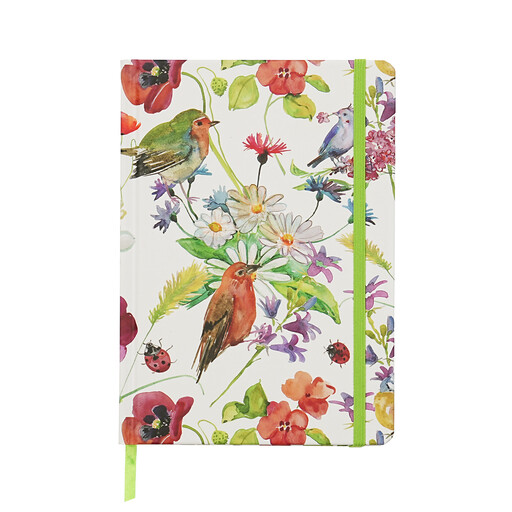
Why does it suit this profile? This ruled A5 journal combines a sturdy hardcover with a decorative design, making it suitable for school, the office or personal notes.
The specifications state 96 sheets or 192 pages, 100 g/m² offset paper, a bookmark and an elastic band.
A5 format, ruled pages, hardcover, 192 pages, plus an elastic band and ribbon bookmark.
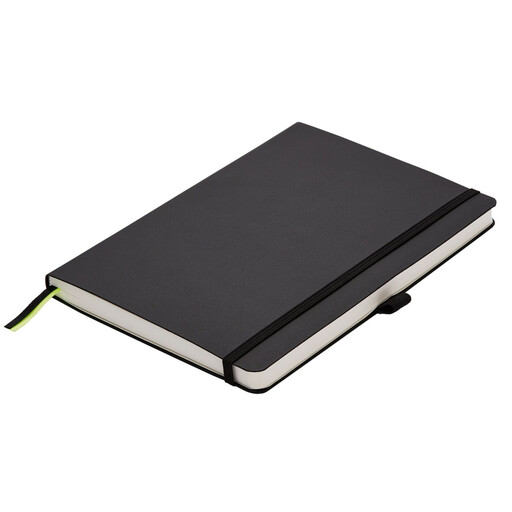
Why does it suit this profile? The LAMY notebook is designed for professional notes, university work and frequent writing, while its flexible cover makes it easy to carry.
The features are clearly specified: 192 pages, 90 g/m² paper, pen loop, two ribbon bookmarks, paper pocket and elastic closure.
Thread-sewn binding, ivory-coloured pages, two ribbon bookmarks and Made in Germany according to the product description.
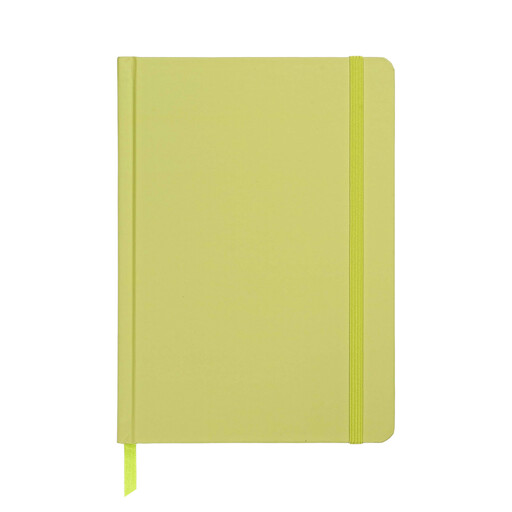
Why does it suit this profile? Its undated structure is ideal for flexible long-term planning, goal tracking and changing routines at university or work.
The product is explicitly undated, so there is no need to skip unused days when switching from one calendar year to the next.
Hardcover, 112 sheets or 224 pages, 100 g/m² paper, monthly and weekly overviews, plus dedicated note sections.
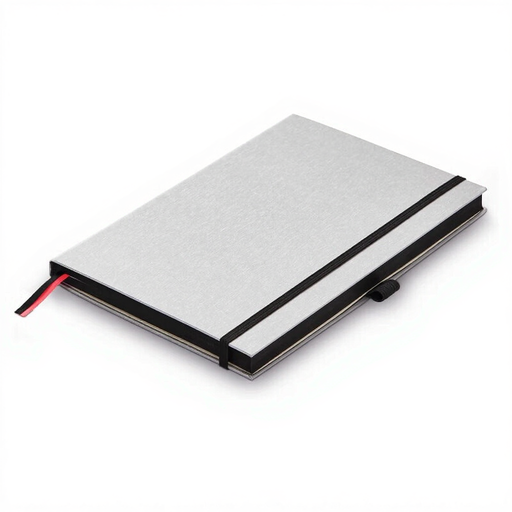
Why does it suit this profile? The unprinted pages leave plenty of room for sketches, diagrams, creative drafts and free-form journaling.
The pages are blank according to the product description. Anyone looking for a ruled A5 notebook should therefore choose another model.
A5 hardcover, thread-sewn binding and approximately 90 g/m² acid-free, ivory-coloured paper according to the product data.
We have put together a current selection of products that can be compared by format, paper, ruling and features.
Paper and covers should be stored in a dry place and protected from prolonged exposure to direct sunlight. A softcover should not be folded back 360 degrees on a permanent basis, as this can put strain on the binding. A hardcover can generally be cleaned with a dry or slightly damp cloth. Elastic bands, ribbon bookmarks and pen loops contain small parts and should be kept away from children under three years of age.
For taking notes, a ruled A5 notebook is generally the clearest option. Grid pages are also useful for tables, calculations and technical sketches. Blank pages are a good choice when you want to combine notes and drawings.
For occasional notes, 80 to 120 sheets may be sufficient. If you want to keep a writing journal for several months, look for at least 96 sheets or an undated planning structure. It is also important to consider whether you will write on both sides of each sheet.
That depends on how you use it. A hardcover offers greater protection for the contents during transport. A softcover is more flexible and often lighter. Both versions are suitable for carrying in a backpack, provided the binding, closure and paper meet your personal requirements.