
Lieferung heute & morgen

Qualitätsgarantie

Willkommens-Angebote freischalten: KOSTENLOSE Lieferung | Bis zu 80 % RABATT | Kostenlose 30-Tage-JoyPlus-Testphase
App herunterladen
An A5 notebook fits into many backpacks, work bags and briefcases. Measuring approximately 14.8 × 21 cm, it provides enough space for notes, to-do lists, journalling and sketches without being as bulky as a larger notebook. That makes the format a practical starting point for school pupils, students, professionals and creatives.
The choice may seem straightforward at first glance. However, marketing terms such as “premium paper”, “sustainable” or “particularly durable” reveal little about how suitable a product really is for everyday use. If you are looking for the right A5 notebook, you should pay particular attention to the ruling, paper weight, binding and closure before buying.
A smooth, cream-coloured or “high-quality” appearance is no substitute for specific details. Important factors include:
Paper weighing 90 or 100 g/m² may be suitable for many writing instruments. However, this does not automatically guarantee unrestricted suitability for markers, heavy ink application or wet fountain-pen ink.
A cork cover can differ from plastic or faux-leather covers thanks to its natural surface and material feel. However, this alone is not proof of any particular environmental certification. When choosing a sustainable cork notebook, you should therefore consider the material details, origin and any available certificates separately.
A fabric or paper cover is not automatically environmentally friendly either. Some products explicitly provide no details of specific environmental certifications. A considered purchase should therefore take the product as a whole into account, rather than relying only on the wording shown on the cover image.
A notebook with an elastic closure stays closed in your bag. A notebook with a bookmark makes it easier to find a page again. These features are useful, but they do not solve problems caused by an unstable binding or unsuitable ruling.
Also check whether a pen loop, document pocket, perforated tear-out sheets or punched holes genuinely suit the way you intend to use the notebook.
A lined A5 notebook is suitable for minutes, continuous text and note-taking. For maths, tables and technical sketches, a squared A5 notebook may be more suitable. A plain A5 notebook, on the other hand, provides open space for drawings, mind maps, diagrams and creative writing.
Ruling is particularly important for school and university. If you switch between text, sketches and calculations, you may prefer an A5 writing notebook with a suitable layout or an A5 exercise pad with removable pages.
Paper weight is given in grams per square metre. A higher value often means a sturdier sheet, but it is not the only deciding factor. For everyday use, consider the following:
Some of the models mentioned below provide specific paper details. The Jubiluu A5 Hardcover Notebook, for example, is listed with 100-g/m² offset paper and 192 pages across 96 sheets. The LAMY B3 Softcover A5 Notebook is described as having 90 g/m² paper and 192 pages.
An A5 hardcover notebook protects the pages more effectively in a fully packed bag and can provide a firm writing surface when you are writing on the go. A softcover is generally more flexible and can adapt more easily to the contents of your bag.
With an A5 spiral notebook, the pages usually lie flat, which is practical in meetings or lessons. Micro-perforations make it easier to tear out sheets neatly. Thread binding, on the other hand, can be well suited to a journal, particularly if the pages are intended to remain in the book permanently.
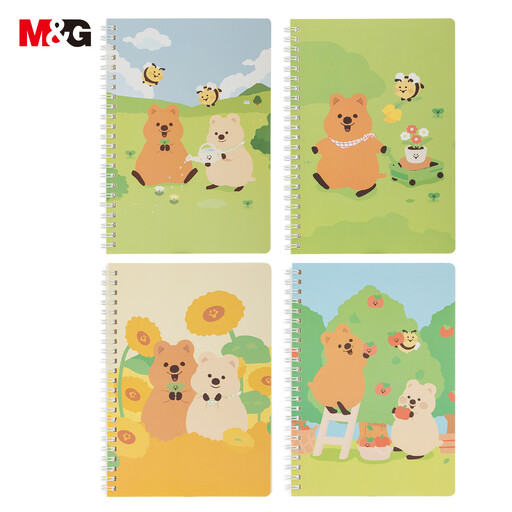
Why this product suits the profile: Four lined A5 spiral notebooks make it possible to organise school subjects, projects or personal notes separately.
The pack size and number of sheets per book are specified. This makes it easier to compare the overall quantity with your actual needs.
A5 format, lined pages, spiral binding and four separate notebooks.
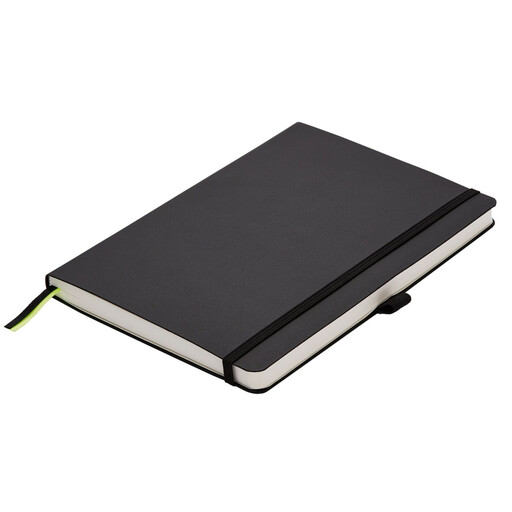
Why this product suits the profile: The black softcover with 192 pages, pen loop, two bookmarks, paper pocket and elastic closure is suitable for the office, university and regular meetings.
The description specifies the paper weight, binding type and particular additional features rather than relying solely on general quality terms.
Thread binding, 90-g/m² paper, pen loop, two bookmarks and a paper pocket on the back.
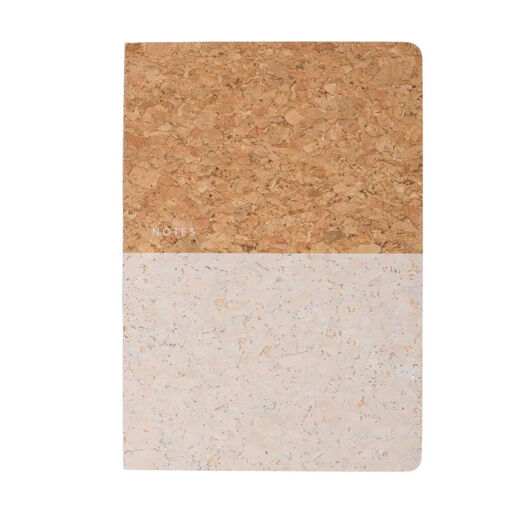
Why this product suits the profile: The cork cover is aimed at buyers looking for a tactile material for the office, lessons and taking notes on the go.
The material description explicitly states that it is cork. However, no specific environmental certification is claimed, so one should not be assumed.
A5 format, cork cover and smooth paper for ballpoint pens and gel pens, as well as fountain pens according to the manufacturer.
We have put together a complete, regularly updated list of products that fully meet these strict selection criteria and the safety regulations applicable in the EU.
Before ordering a notebook for school and the office, compare the following points:
For everyday notes, 80 to 100 sheets is a typical amount. If you record a lot of meetings or want to keep a long-term A5 journal, you may prefer 192 pages or more. A thinner notebook is lighter and can be replaced more quickly.
A hardcover protects the pages and provides a firm writing surface when you are writing on the go. A softcover is more flexible and may take up less space. The right choice depends on whether protection or low weight is more important to you.
For traditional journalling, lined pages are often the clearest choice. Creative users often choose a plain A5 notebook, while squared pages are suitable for structured planning, tables and sketches. The key factor is how you actually intend to use the notebook.