
Lieferung heute & morgen

Qualitätsgarantie

Willkommens-Angebote freischalten: KOSTENLOSE Lieferung | Bis zu 80 % RABATT | Kostenlose 30-Tage-JoyPlus-Testphase
App herunterladen
An A5 notebook fits into many rucksacks, work bags and drawers. Measuring approximately 14.8 × 21 cm, it offers more writing space than an A6 notebook while remaining more manageable than an A4 pad. Whether it is for school, the office, meetings, journalling or as a gift, not every model is suited to every purpose.
On product pages, terms such as “elegant”, “high quality” or “suitable for all writing instruments” may initially sound convincing. However, specific details about paper weight, page count, ruling and binding are much more useful.
A notebook with 60 sheets generally has 120 writable pages. Some sellers also state the page count, while others only provide the sheet count. Always compare both details. For example, an A5 writing notebook with 96 sheets contains 192 pages, provided that both sides can be used.
70 g/m², 80 g/m², 90 g/m² or 100 g/m² describe the paper weight, not automatically its suitability for every type of ink. Heavier paper may feel more substantial, but the surface, coating and amount of ink also affect the writing result. If you write with a fountain pen, marker or gel pen, check the manufacturer’s specific information and, if in doubt, test an inconspicuous page first.
A notebook with an elastic strap or ribbon bookmark is practical, but it is not equally important for every purpose. An elastic strap keeps the book closed, while a ribbon bookmark makes it easier to find a page again. For frequent page-turning, writing flat or removing notes, an A5 spiral notebook may be more suitable. Also check whether the spiral gets in the way in your bag or folder.
A lined A5 notebook is ideal for continuous text, notes and diary entries. Lines with sufficient spacing make longer entries easier. Squared paper is useful for tables, calculations and sketches. Plain pages offer greater freedom for drawings, mind maps and creative layouts.
For an A5 journal or A5 diary, the ruling is a matter of personal preference. If you combine text with small drawings, you may prefer a model with subtle ruling or plain pages. For a notebook for school and the office, structured lines or squares are often more practical.
An A5 hardcover notebook provides better protection against creases when it is carried around every day. Fabric, plastic and PU surfaces differ in feel and care requirements. Decorative embossing, foil details and textile covers can be visually appealing, but should be protected from moisture and heavy friction.
A softcover is generally more flexible and may sit more comfortably in a bag. When choosing, therefore, do not consider appearance alone. Ask yourself: will the book mainly be used at a desk, or regularly taken on the go?
Look out for the following details:
An elegant notebook does not automatically need to have lots of extras. What matters is whether its features suit the way you write.
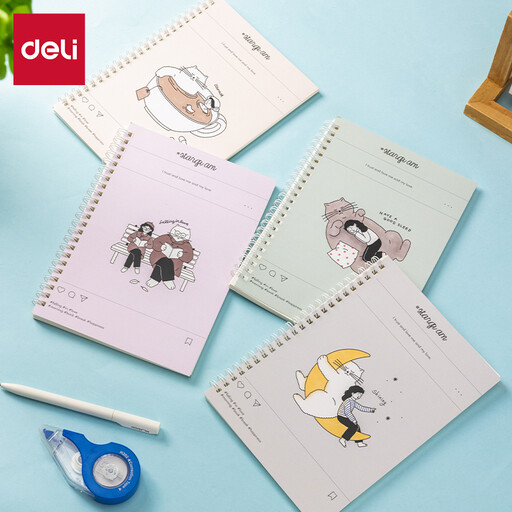
Why this product suits the profile: According to the product details, the set contains four A5 spiral notebooks, each with 60 sheets or 160 pages and 70-g/m² paper. This makes them useful for keeping subjects, projects or personal notes separate.
The sheet and page counts are clearly stated, making it easier to assess the amount of writing space before buying.
Four separate notebooks; spiral binding; A5 format for school, the office and journalling.
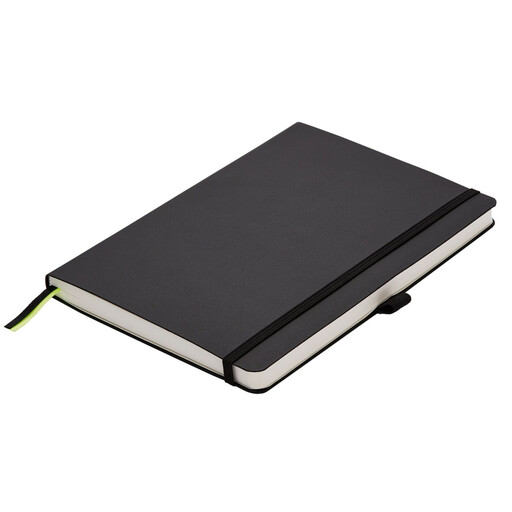
Why this product suits the profile: According to the product description, this model has 192 pages, 90-g/m² paper, a pen loop, two ribbon bookmarks, a pocket and an elastic strap.
The key features are clearly specified rather than being described only with general design terms.
Thread-sewn binding; 192 pages; pen loop, two ribbon bookmarks, pocket and elastic strap.
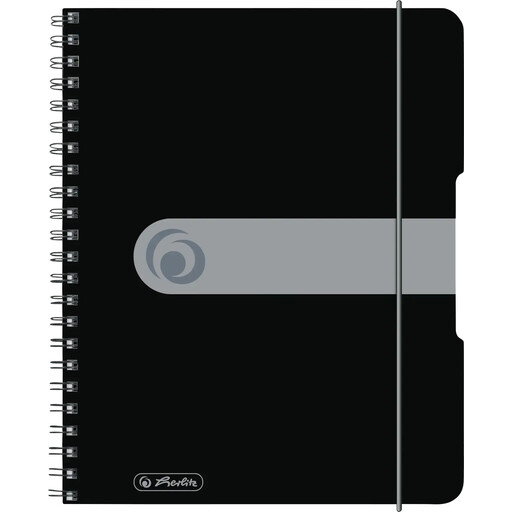
Why this product suits the profile: The squared pages with a white border, micro-perforation and six-hole punching are designed for users who want to remove and file their notes.
The binding is not simply described as spiral binding: the perforation and hole punching are also clearly stated.
160 pages per notebook; special squared ruling; micro-perforation and six holes for filing.
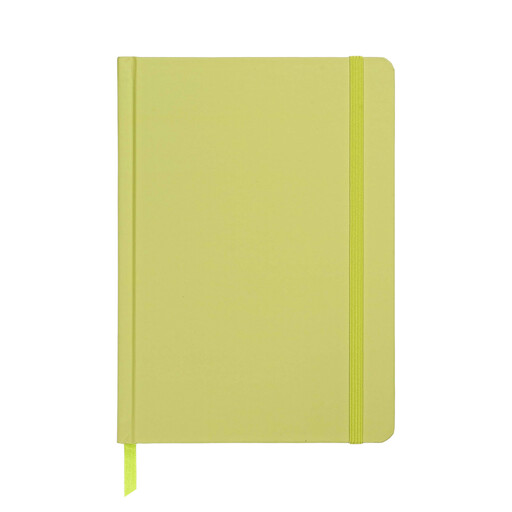
Why this product suits the profile: According to the product details, the undated layout includes 112 sheets or 224 pages with monthly and weekly overviews as well as space for notes.
An undated planner reduces the risk of losing unused pages because of a fixed calendar period.
224 pages; hardcover; undated monthly and weekly layouts with additional space for notes.
We have put together a complete, regularly updated list of products that fully meet these strict selection criteria and the safety regulations applicable in the EU.
A classic A5 writing notebook is ideal for free-form notes, minutes and longer texts. An A5 planner and calendar, on the other hand, provides dedicated sections for appointments, tasks and weekly overviews. If you only record appointments occasionally, an undated model gives you greater flexibility.
For school and university, several smaller notebooks or an A5 spiral notebook with different sections can be useful. People who work often benefit from a combination of a ribbon bookmark, pen loop and pocket. As a notebook gift, models with a hardcover and clearly stated additional features are a good choice, provided that the ruling and design suit the recipient.
The standard A5 format measures approximately 14.8 × 21 cm. Depending on the cover, spiral and manufacturer, the outer dimensions may vary slightly. For a bag, you should therefore check the exact product dimensions.
For short notes, 60 to 80 sheets are sufficient. If you want to keep an A5 diary, journal or workbook over a longer period, you may prefer 96 sheets or more. The key consideration is whether both sides can be written on and how thick the notebook becomes as a result.
Paper weighing 90 or 100 g/m² is often described as more robust than very lightweight paper. However, this alone does not guarantee the same writing result with every fountain pen. For demanding inks, pay attention to the manufacturer’s specific information about bleed-through and feathering.