
Lieferung heute & morgen

Qualitätsgarantie

Willkommens-Angebote freischalten: KOSTENLOSE Lieferung | Bis zu 80 % RABATT | Kostenlose 30-Tage-JoyPlus-Testphase
App herunterladen
An A5 notebook fits into many rucksacks, work bags and larger handbags. Measuring approximately 14.8 × 21 cm, it offers enough space for meeting notes, study materials, journaling and sketches without being unnecessarily bulky. However, there is plenty of choice: a lined notebook is ideal for continuous writing, while plain paper is better suited to drawing or mind mapping. The cover, paper weight and fastening also have a significant impact on everyday usability.
The Joybuy product recommendation team filters relevant information from product descriptions and highlights what pupils, students, professionals and creatives should consider when buying.
Notebook descriptions often confuse sheets and pages. A product with 96 sheets generally has 192 writable pages. A notebook with 60 sheets may therefore contain 120 pages. Before buying, check whether the stated number refers to sheets or pages.
A marketing description does not replace technical details. More useful information includes:
Whether a notebook with high-quality paper is suitable for a fountain pen, gel pen or marker depends on the specific paper and ink. Without reliable product information, claims about resistance to ink bleed-through should not be taken at face value.
An elegant cover is not automatically functional. For everyday use, an elasticated notebook, a notebook with a ribbon marker or a pen loop is often more useful than purely decorative details. The binding is also important: a spiral binding usually allows the notebook to lie flat, while thread-sewn binding can provide stable support when it contains a large number of notes.
Paper weight is stated in grams per square metre. 90 g/m² is a commonly used weight for writing paper and may be sufficient for ballpoint pens, pencils and many fountain pens. 100 g/m² provides a slightly more substantial paper base, but it does not replace checking the manufacturer’s specific information on ink compatibility.
When choosing the ruling, consider the following:
An A5 journal is often lined or plain. If you are looking for a sketchbook, pay particular attention to the paper texture and its suitability for pencils, fineliners or markers.
A hardcover notebook protects the pages better when it is frequently carried in a rucksack or work bag. The firm cover can also be used as a writing surface. However, a hardcover is generally less flexible and may add a little extra weight.
A softcover notebook is easier to stow away and handle flexibly. It is suitable for people who regularly take their notebook with them and prefer a smaller pack size. With both options, it is worth checking the binding: thread-sewn, spiral and glued bindings differ in how they open and whether pages can be removed.
The following details are practical for a notebook for school and the office:
Not every extra is necessary for every purpose. If you mainly write in lessons, you may benefit from a spiral binding and removable pages. For meetings or journaling, a sturdy cover, ribbon markers and a pocket are often more suitable.
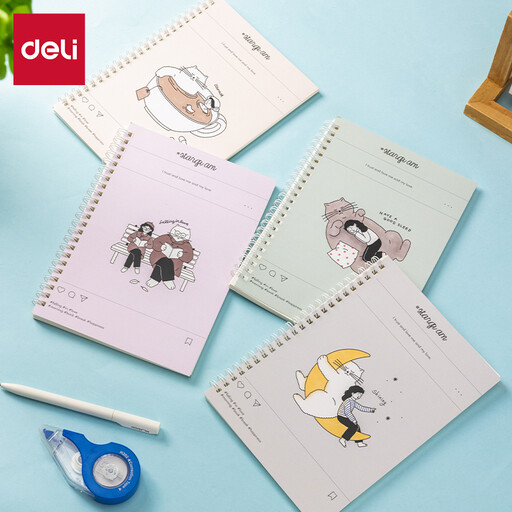
Why this product suits the profile: The four-pack provides several A5 notebooks for different subjects, projects or first attempts at journaling. The spiral binding makes it easy to turn the pages in everyday use.
The product name specifies the format, sheet and page count, as well as the number of notebooks included. This makes it easier to understand the actual contents of the delivery before buying.
A5 format, lined pages and four notebooks in one set; suitable for school, the office and multiple subject areas.
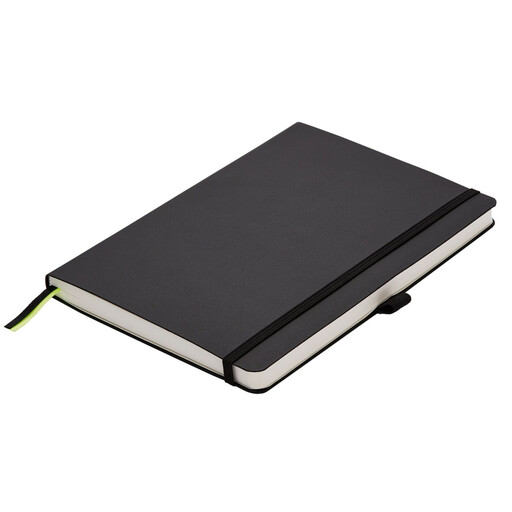
Why this product suits the profile: This A5 softcover combines 192 pages with 90-g/m² paper and features designed for regular note-taking at university or work.
The paper weight, page count and ruling are clearly specified. The description also lists thread-sewn binding, an elastic closure, a pen loop and a pocket.
192 pages, 90 g/m² ivory paper, two ribbon markers, a paper pocket and a pen loop; according to the product description, made in Germany.
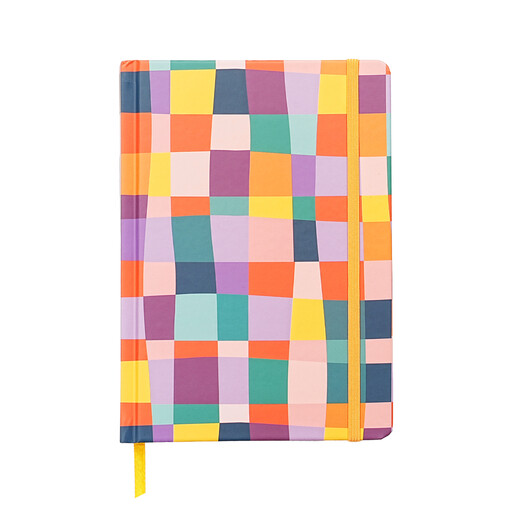
Why this product suits the profile: The firm PU leather cover and 192 pages of 100-g/m² paper are designed for regular writing, journaling and everyday transport.
The features are more than decorative: the ribbon marker, elastic closure and pen loop are all explicitly listed. The paper weight is stated as 100 g/m².
96 sheets or 192 pages, lined cream-coloured 100-g/m² paper, hardcover, ribbon marker, elastic closure and pen loop.
Paper and covers are sensitive to moisture, intense heat and direct sunlight. An A5 notebook should be stored in a dry place and not kept heavily bent for extended periods. For a hardcover notebook, clean the cover with a soft, slightly damp cloth. The product should then be allowed to dry completely.
Lifespan mainly depends on how often the notebook is used, how it is transported and the type of binding. A notebook with many pages may last longer, but it is not automatically suitable for heavy markers or wet ink. For important documents, check whether the pages can be removed, punched or archived.
We have put together a complete, regularly updated list of products that fully meet these strict selection criteria and the safety regulations applicable in the EU.
Yes. A5 offers a good balance between writing space and portability. For detailed minutes or extensive documents, A4 may be more practical. For note-taking, to-do lists and journaling, A5 is often easier to carry around every day.
That depends on how you intend to use it. For short projects or individual school subjects, 120 to 160 pages may be sufficient. If you want to keep a long-term journal or a substantial writing notebook, compare the sheet and page counts carefully. For example, 96 sheets can provide 192 pages.
A hardcover offers better protection for the pages during transport and retains its shape. A softcover is lighter and more flexible. Actual durability also depends on the binding, paper, protection from moisture and the demands of daily use. Both options are suitable for frequent carrying, provided their features match the intended use.