
Lieferung heute & morgen

Qualitätsgarantie

Willkommens-Angebote freischalten: KOSTENLOSE Lieferung | Bis zu 80 % RABATT | Kostenlose 30-Tage-JoyPlus-Testphase
App herunterladen
Echoey video calls, hard-to-follow recordings or distracting reflections while gaming are often not caused by your microphone or headphones, but by a room that is acoustically unbalanced. Acoustic panels can reduce sound reflections on walls, making speech and audio playback clearer. However, they do not replace structural soundproofing against neighbours or traffic noise.
Before buying, it is worth taking a close look at the area, material and fixing method. Product names like "Sound Absorbing", "Noise Reduction" or "Echo Control" do not automatically indicate a specific measured performance. What matters are verifiable details about the construction and the intended use.
A wall sound absorber element absorbs part of the sound energy that hits it and reduces reflections in the room. This primarily helps against reverberation and can reduce echo. However, it will not usually stop voices, music or traffic noise from travelling through a thin wall.
If you are looking to reduce noise between rooms, you should also consider structural measures such as wall construction, sealing gaps and proper insulation.
A single decorative panel can look good, but it will only have a limited effect on room acoustics. So check the total area in square metres, not just the number of elements. For example, a set of four panels each measuring 60 × 30 cm covers 0.72 m². A set of 20 panels of the same size covers 3.6 m².
For a home office, treating the wall behind your desk or opposite a hard surface is often sufficient. In a studio or podcast room, the distribution of acoustic panels should be planned across several reflective surfaces.
A wood-look finish alone does not absorb any meaningful sound. With wood acoustic panels, the construction is what matters: typical 3D wooden slats sit on a felt layer, while the MDF core, distance from the wall and additional absorbers can all influence the effect.
Also look out for:
Labels like "eco-friendly" or "healthy" should not be taken as technical proof without verification. What counts are specific product documents and certifications.
The right choice depends on whether you mainly want to make speech clearer, reduce reflections when listening to music, or decorate a larger wall area. The models below differ mainly in format, surface, set size and installation options.
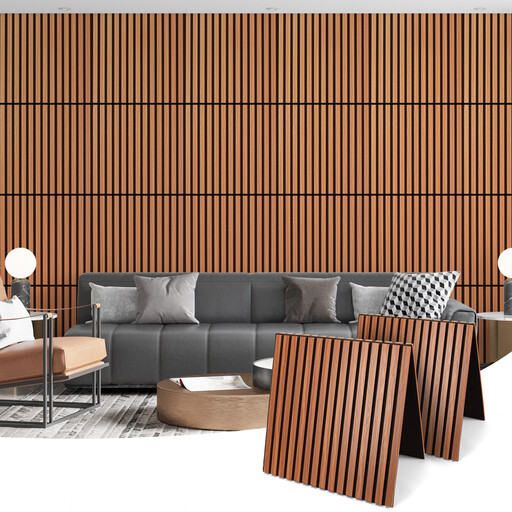
Why this product fits the profile: Two large-format panels, each measuring 120 × 60 cm, are ideal for a clearly defined area in a home office, podcast room or gaming room. The teak wood-look combines wall decoration with acoustic treatment.
The stated size makes the wall coverage easier to assess than relying on the number of panels alone. The foldable 3D construction is designed for wall mounting according to the product description; however, check the surface and accessories before installation.
Two panels with a combined nominal area of 1.44 m²; wood surface and foldable format for targeted wall design.
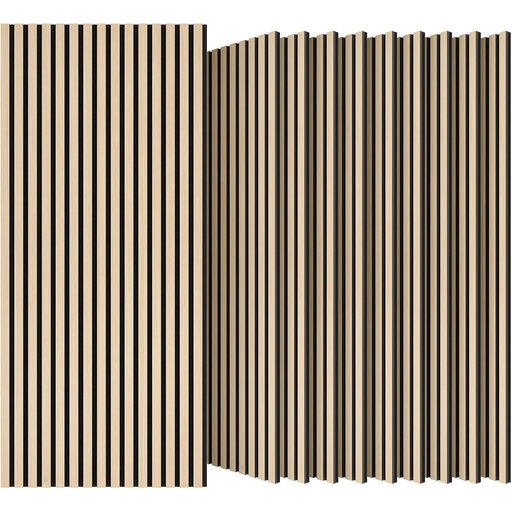
Why this product fits the profile: This set is designed for a larger continuous area. The product description mentions an MDF core, oak veneer and acoustic felt as part of the construction. It suits a home office, studio, conference room or living room.
The total area of 3.6 m² is clearly stated. This allows you to compare the material needed with your wall size before buying, rather than just relying on the word "set".
20 elements, each 60 × 30 cm; oak-look finish and felt backing; fixing with adhesive or screws according to the product information.
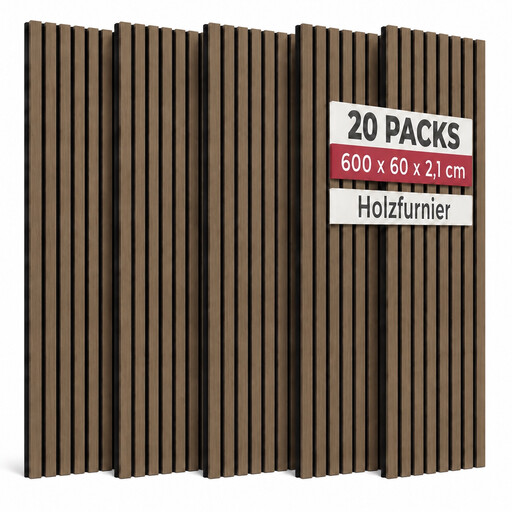
Why this product fits the profile: The 3.6 m² surface area is ideal for users who regularly record, stream, take video calls or want to decorate a larger wall area. The dark walnut look is designed for modern work and media rooms.
The large set area prevents the acoustic treatment from consisting of just a small decorative element. For rented rooms, check in advance whether adhesive mounting could damage the surface.
20 panels, each 60 × 30 cm; MDF with walnut veneer and felt backing; mounting options with adhesive or screws according to the product description.
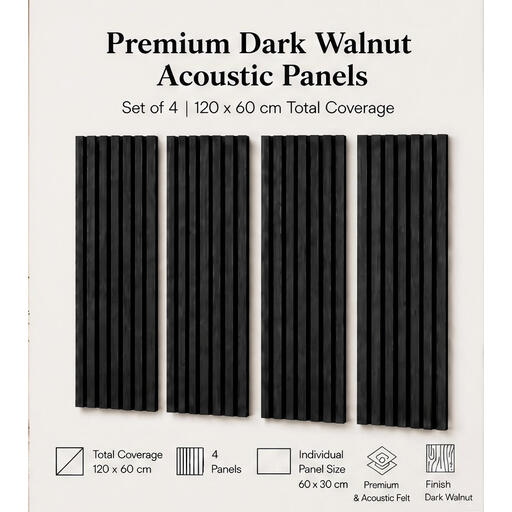
Why this product fits the profile: The compact set with 0.72 m² can be used for a single reflective surface or as an addition. The product information mentions both adhesive and screw fixing, which suits different living situations.
The number of pieces is backed up by specific individual and total dimensions. This helps you avoid buying a set whose actual wall coverage is too small for your room.
Four panels, each 60 × 30 cm; grey oak veneer, MDF core and acoustic felt according to the product description.
We have put together a full, regularly updated list of products that fully meet these strict selection criteria and the safety regulations in force in the EU.
For clear speech and recordings, hard, parallel surfaces are often the main sources of reflections. So do not place sound-absorbing wall panels based purely on aesthetics.
A practical approach:
Acoustic panels for a home office, studio or gaming room should also be installed so that plug sockets, radiators and doors remain accessible. For a larger area, a scale drawing before ordering is recommended.
That depends on the room size, furniture, wall material and the effect you want. For a small workstation, a targeted area may be enough. In a studio or a very echoey living room, a larger, distributed treatment is usually more effective. Calculate based on the actual panel dimensions, not just the set name.
The lifespan depends on the material, UV exposure, humidity, mechanical stress and the fixing method. MDF and veneer should be kept dry; felt should be carefully vacuumed regularly. A general figure in years is not reliable without specific manufacturer conditions.
Acoustic panels normally do not require electricity and therefore incur no ongoing energy costs. You only need to consider cleaning, possibly replacing the fixings, and any repairs to the surface or felt. Compare the purchase cost based on the price per square metre covered.