
Lieferung heute & morgen

Qualitätsgarantie

Willkommens-Angebote freischalten: KOSTENLOSE Lieferung | Bis zu 80 % RABATT | Kostenlose 30-Tage-JoyPlus-Testphase
App herunterladen
The search for a suitable 4K action cam can quickly become overwhelming. Manufacturers advertise impressive specs and features, but not all of them live up to their claims. Many buyers only discover after their first use that the advertised image quality is disappointing, the camera fails in wet conditions, or the footage is unusably shaky despite "stabilisation" claims. This guide will help you identify the crucial features and avoid marketing traps.
Before we dive into the key technical specifications, you should be aware of three common marketing promises that often lead to disappointment:
To make an informed decision, you should focus on three core features that directly impact video quality and usability.
A high-quality camera with image stabilisation is essential for action shots. Look for models with multi-axis gyroscopic stabilisation (Gyro-EIS). This system uses a gyro sensor to analyse camera movement and digitally corrects shakes in real time. Unlike basic software stabilisation, Gyro-EIS delivers significantly smoother results that are impressive even during fast movements, such as those experienced with a motorcycle helmet camera. Features like a horizon lock (Horizon Lock/Horizon Steady) also keep the image level even when the camera is tilted heavily.
Check the waterproofing specifications carefully. A crucial detail is the waterproof rating without an additional housing. Models that are waterproof to 10 metres or more out of the box offer more flexibility and better audio quality underwater. If you plan to dive deeper, a housing will be necessary. In that case, look for a robust build and reliable seals. For use in extreme sports, general shock resistance and cold resistance (e.g., down to -20°C) are also important factors.
Image quality depends less on the sheer megapixel count and more on the size of the image sensor. A larger sensor (e.g., 1/1.3-inch) can capture more light, resulting in better low-light footage and less image noise. For smooth slow-motion shots, high frame rates (frames per second, fps) are crucial. A good 4K action cam should offer at least 60 fps at 4K resolution, while 120 fps or more at 2.7K or 1080p is ideal for extreme slow motion. The video bitrate (measured in Mbps) determines how much data is saved per second. A higher bitrate leads to more detailed and clearer videos, which is especially important for capturing fast motion.
Based on the criteria above, we have identified a few models for different needs and budgets.
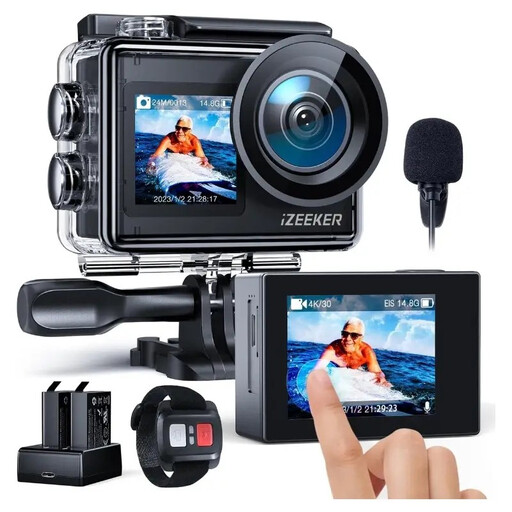
Why It's a Match: Ideal for users who want to get started with action cameras without a large investment. The comprehensive accessory bundle covers many use cases, from cycling to snorkelling, eliminating the need for additional purchases. The front display is handy for selfies and vlogs.
The camera clearly communicates that its 40-metre waterproof rating requires the included housing. The EIS function is solid for the price, providing adequate stabilisation for casual activities.
Extensive accessory kit including a remote control and various mounts. Features a port for an external microphone to improve audio quality.
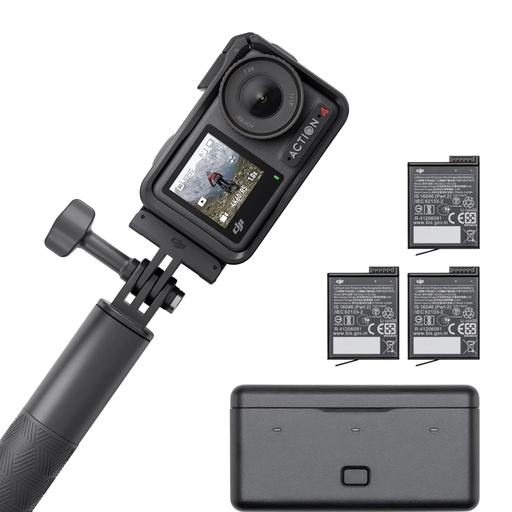
Why It's a Match: This vlogging camera is tailored to the needs of content creators. Its large 1/1.3-inch sensor delivers high-quality images in low light, and the 10-bit D-Log M colour profile offers flexibility in post-production. The magnetic quick-release system allows for rapid changes between mounts.
The camera delivers true 4K at up to 120 fps and features class-leading image stabilisation (360° HorizonSteady). It is waterproof down to 18 metres without a case, exceeding its marketing claims without compromising audio quality.
Excellent low-light performance and professional colour options. The Adventure Combo includes three batteries and a charging hub for extended recording sessions.
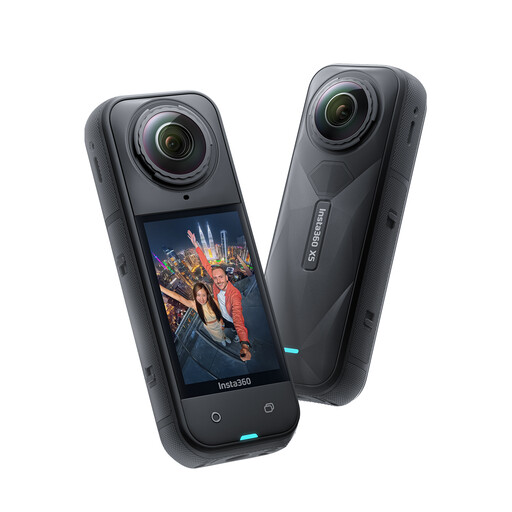
Why It's a Match: For anyone who wants more than just a standard perspective. As a 360-degree camera, it captures the entire environment in 8K. Users can then choose the perfect frame in post-production (reframing). The "invisible selfie stick" effect enables third-person shots that look as if they were filmed by a drone.
This model completely solves the problem of image composition by simply capturing everything. Its FlowState Stabilisation and 360° Horizon Lock are among the leading technologies on the market, guaranteeing incredibly smooth video.
Maximum creative freedom thanks to 360° capture and post-production reframing. Replaceable lens guards increase the camera's durability and longevity.
We have compiled a complete, up-to-date list of products that fully meet these strict selection criteria.
Yes, a high-speed memory card is essential for recording 4K video. Look for a microSD card with a UHS Speed Class 3 (U3) or Video Speed Class 30 (V30) rating. These ratings guarantee a sufficient write speed to record high-resolution video without interruptions or errors.
Battery life varies depending on the model, resolution, and ambient temperature. On average, you can expect 60 to 90 minutes of continuous 4K recording at 30 or 60 fps. However, some models offer extended batteries or bundles with multiple batteries that allow for significantly longer recording times, such as the SJCAM C300 with up to 460 minutes.
GoPro is considered the pioneer of the action camera market and offers a very mature ecosystem of cameras, accessories, and software. A GoPro alternative from brands like DJI, Insta360, or SJCAM often provides comparable core features, such as 4K resolution and image stabilisation, at a competitive price. In some cases, these alternatives even introduce innovative and unique features, such as 360-degree capture, larger sensors, or modular designs, making them particularly appealing to specific user groups.