
Lieferung heute & morgen

Qualitätsgarantie

Willkommens-Angebote freischalten: KOSTENLOSE Lieferung | Bis zu 80 % RABATT | Kostenlose 30-Tage-JoyPlus-Testphase
App herunterladen
Choosing the right action cam can quickly become overwhelming given the abundance of models and technical specs. Many buyers invest in features they never use or overlook crucial characteristics that are essential for their needs. As your Joybuy Product Recommendation Officer, I'll help you cut through the marketing hype and make an informed decision. In this guide, we focus on the most common pitfalls and the key criteria for selecting the right action camera.
Before we dive into the technical details, it's important to understand the typical mistakes that often lead to disappointment.
To make the right choice, you should focus on a few, but decisive, technical features.
Image stabilisation is perhaps the most important feature of an action cam. It ensures that your footage remains smooth and watchable even with vibrations, such as during mountain biking or skiing.
These two values determine the detail and smoothness of your videos.
An action cam needs to withstand a lot. Pay attention to the waterproofing specifications.
Instead of making a one-size-fits-all recommendation, we have selected models that suit specific user profiles.

Why This Fits Their Persona: Ideal for vloggers and content creators who value ultra-smooth footage and ease of use. The compact design and rotatable screen make filming yourself straightforward.
Avoids the "stabilisation misconception" with an integrated mechanical 3-axis gimbal that provides superior stabilisation without image cropping—a clear advantage over purely electronic systems.
Large 1-inch CMOS sensor for good image quality even in low light; rotatable 2-inch touchscreen for flexible framing control.
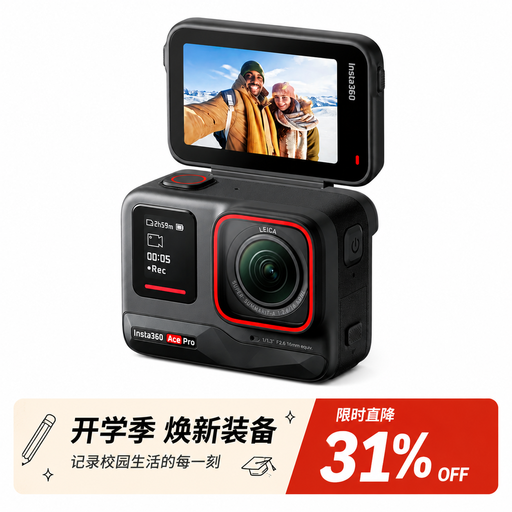
Why This Fits Their Persona: For adventurers and filmmakers who refuse to compromise on image quality. The combination of a large sensor and high-quality optics delivers convincing results even in challenging lighting conditions.
Sidesteps the "megapixel trap" by focusing on a large 1/1.3-inch sensor and a lens co-engineered with Leica. This ensures high image quality that isn't solely dependent on sheer resolution.
PureVideo mode for low-light recording; large 2.4-inch flip-up touchscreen for easy operation and preview.
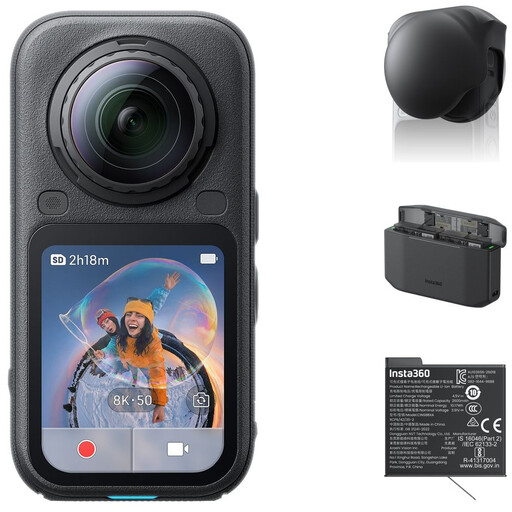
Why This Fits Their Persona: For users seeking maximum creative freedom. With a 360-degree camera, everything around you is recorded, and you decide on the final crop later in the editing process.
Solves the problem of finding the perfect frame, as the camera captures everything. The 8K 360° video recording provides enough resolution overhead to extract high-quality flat 4K videos (reframing).
Ability to use the camera as a traditional single-lens action cam; interchangeable lenses for increased durability.
We have compiled a complete, real-time list of products that fully satisfy these strict selection criteria and UK safety regulations.
1. How important is image stabilisation in an action cam? It's crucial. Without good stabilisation, footage from sports activities or even just walking quickly becomes shaky and unwatchable. High-quality electronic or mechanical stabilisation is one of the most important features worth investing in.
2. Do I need 4K resolution for my action camera? Not necessarily. For viewing on smartphones or sharing on social media, 1080p (Full HD) is often sufficient and saves significant storage space and battery life. 4K offers more detail and flexibility in post-production, such as the ability to zoom into the image without losing quality. Consider whether you need this extra overhead for storage and editing.
3. What is the difference between an action cam and a normal digital camera? Action cams are specifically designed for use in harsh conditions. They are typically smaller, more robust, and waterproof. Their wide-angle lens is designed to capture a broad field of view, which is ideal for sports and action. Normal digital cameras often offer more manual controls and zoom lenses but are less resilient.