
Lieferung heute & morgen

Qualitätsgarantie

Willkommens-Angebote freischalten: KOSTENLOSE Lieferung | Bis zu 80 % RABATT | Kostenlose 30-Tage-JoyPlus-Testphase
App herunterladen
An action camera should capture reliable footage while you’re cycling, hiking, riding a motorbike, travelling or enjoying water sports. In practice, however, high resolution alone doesn’t guarantee usable videos. Battery life, mounting options, memory card compatibility and the right level of water protection often determine whether a camera works well in everyday use.
A 4K action camera or 8K action camera can capture particularly detailed footage. However, 8K videos need more storage space, more powerful hardware and often more battery power. When filming fast-moving action, frame rate and stabilisation are also crucial. A 4K mode at 60 or 120 frames per second can be more practical for sports footage than a high-resolution mode with a lower frame rate.
So look at how resolution, frame rate, sensor size and lighting conditions work together. A larger sensor can make a difference at dusk or indoors, while a high frame rate is useful for slow motion and fast-moving action.
The term waterproof camera usually refers to the camera itself and a specified depth rating. Ports, the battery compartment and the memory card slot must all be fully closed. After using the camera in salt water, rinse it with fresh water and dry it.
An underwater housing can increase the permitted depth. Before buying, check whether it’s included or needs to be purchased separately. If you’re choosing an underwater camera, make sure the seals are clean, undamaged and fitted correctly.
A camera on its own won’t be enough for many filming situations. Depending on how you plan to use it, you may need mounts for a helmet, bicycle or motorbike, spare batteries, a charger, a fast microSD card or an underwater housing. A selfie stick can also be useful with a 360-degree camera.
So compare the complete package, not just the camera body. An Adventure or Starter Bundle can be more practical for regular use if it already includes essential accessories.
For travel videos, vlogs and everyday sports footage, 4K is a popular starting point. 4K/60fps is suited to smooth action, while 4K/120fps enables slow-motion footage on compatible models. 8K gives you more flexibility to crop and reframe, but creates larger files.
For 360-degree footage, the resolution is spread across the entire view. An 8K 360-degree camera can therefore be especially useful if you want to choose your preferred framing later.
A camera with image stabilisation reduces visible shake when cycling, hiking or filming on a motorbike. Electronic systems such as FlowState, RockSteady and HyperSmooth use software and may change the field of view, depending on the mode.
Horizon lock keeps the horizon as level as possible when the camera rotates. Check which resolutions and fields of view support this feature. A wide field of view is also useful for a helmet- or chest-mounted POV camera, while a vlogging camera with a flip screen makes it easier to check your shot.
Manufacturers’ battery life figures are based on specific recording modes and conditions. High resolution, high frame rates, stabilisation and cold temperatures can all reduce battery life. Replaceable batteries or a bundle with multiple batteries are useful for longer trips.
Also check the maximum microSD capacity and the required speed class. For vlogging, a microphone input or wireless audio connection may be important. If you use social media regularly, portrait modes, app transfers and automatic editing features can make your workflow easier.
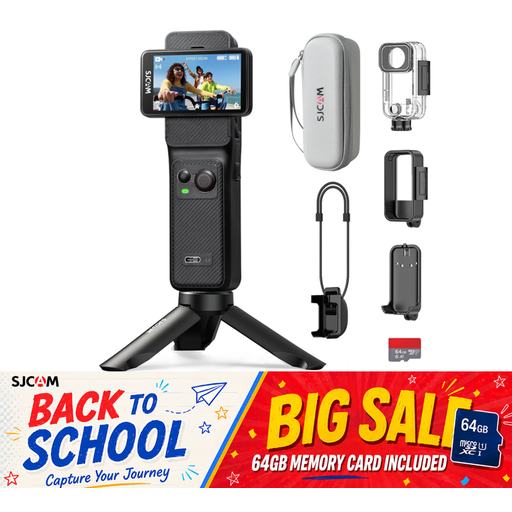
Why this product suits this type of user: The camera combines 4K recording, two touchscreens, 6-axis stabilisation and an accessory kit with a 64 GB card. It’s a straightforward way to get started with travel, cycling and outdoor footage.
The package includes storage and basic mounts, making typical start-up costs easier to plan for.
4K at 30fps, 1080p at 120fps, waterproof to 30 metres with the housing, and a stated battery life of up to 437 minutes with the additional battery and grip.
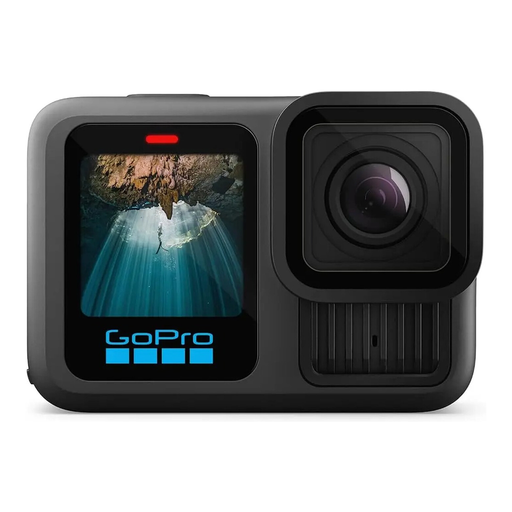
Why this product suits this type of user: This camera is designed for users looking for high frame rates, a rugged build and an expandable lens system for sports and travel footage.
The specifications list specific modes, battery type, water resistance and compatible HB lenses, rather than relying on general claims about quality.
5.3K at 60fps, HyperSmooth 6.0, 10-bit colour options and water resistance to 10 metres without a housing, according to the product specifications.
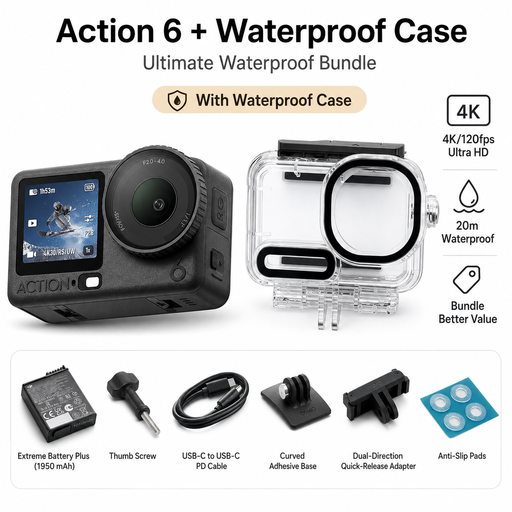
Why this product suits this type of user: For water sports, diving, cycling and longer outdoor trips, key features include 8K, 4K/120fps, electronic stabilisation and a separate waterproof case.
The product description distinguishes between the camera’s own water resistance and the additional protection provided by the included housing.
8K video, 4K/120fps, RockSteady 3.0, HorizonSteady, and the camera and waterproof case included in one bundle.
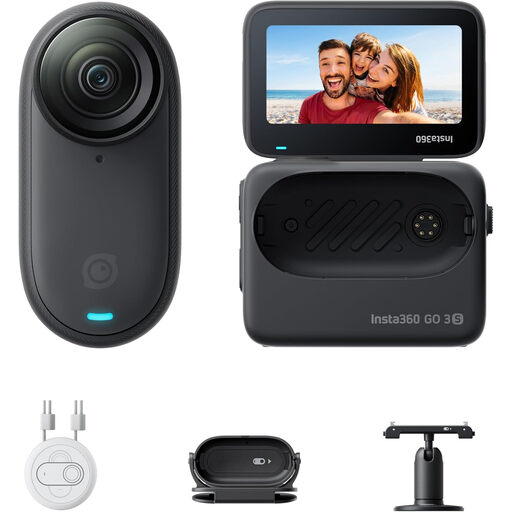
Why this product suits this type of user: Weighing just 39 grams, with magnetic mounting, an Action Pod and POV recording, it’s well suited to hands-free travel and everyday footage.
The built-in 128 GB of storage and the Action Pod make it clear what accessories you’ll need before you buy.
4K recording, FlowState stabilisation, a stated battery life of 140 minutes and IPX8 water protection for the camera.
We’ve put together a complete, regularly updated list of products that fully meet these strict selection criteria and the safety regulations in force in the EU.
Look for effective image stabilisation, a secure handlebar or helmet mount and a suitable battery solution. Horizon lock can be useful on bends and uneven terrain. For longer rides, spare batteries or USB-C power are worth considering.
Battery life depends on resolution, frame rate, display, stabilisation, temperature and wireless connectivity. Manufacturers’ figures are based on set conditions and won’t necessarily apply to every recording mode. For longer outings, consider bringing extra batteries, a power bank or a bundle with multiple batteries.
That depends on the camera’s stated water resistance and the depth you plan to dive to. For snorkelling, the camera itself may be sufficient, provided all the covers are properly closed. For diving or more demanding conditions, a compatible underwater housing offers extra protection. After contact with sea water, rinse the camera with fresh water and dry it completely, following the manufacturer’s instructions.