For a fixed speaking position, a handheld recorder is a good choice: you can place it close to the voice and monitor the recording straight away. If you’ll be moving around, a wearable lavalier microphone is a suitable alternative. To record the voice and room ambience separately, consider a recorder with an external microphone and the right inputs. Shure explains that a microphone cannot separate direct speech from room reflections that have already reached it. That makes microphone placement and a test recording more important than simply choosing a higher bit depth.
Which solution suits you?
Speakers recording from a fixed position
If you’re speaking from a fixed position, you can place the recorder securely and close to your voice. Shure explains why the distance from the microphone and its position matter when it comes to the balance between direct speech and room reflections.
Speakers on the move
If you’re moving around or making big gestures, a microphone clipped close to your body is more likely to stay near your voice than a recorder left in one place. Zoom describes the F2 as a recorder designed for use with a lavalier microphone.
Creators recording voice and ambience
If you want to shape or edit the voice and room ambience separately, you’ll need a suitable microphone set-up and, if necessary, separate inputs. Tascam and Zoom list XLR/TRS inputs on their respective multitrack recorders.
What to look for when buying
Handheld recorder with built-in microphones
A good fit if: you’re recording from a fixed position and can place the device close to your voice.
Consider: The recorder’s position determines where its microphones are placed, so listen to a test recording in the actual room.
Wearable recorder with a lavalier microphone
A good fit if: you move while speaking and can clip the microphone to your clothing.
Consider: Make sure the clip and cable work with your clothing, and check for rustling. A mono WAV format is no substitute for separately recorded stereo room ambience.
Multitrack recorder with an external microphone
A good fit if: you want to position an external microphone precisely in front of the speaker and, if needed, record several sources separately.
Consider: The microphone, connections, power supply and, if needed, phantom power must all suit your planned set-up. Extra tracks won’t correct poor microphone placement.
| Priority |
What to check before buying |
Who is this important to? |
| Clear speech despite room echo |
Position the recorder or external microphone where you’ll be speaking, then listen to a test recording. |
If I want clear dialogue despite audible echo, I need to be able to test the microphone position in the room itself. Around 40% of consumers would put dialogue clarity first. |
| Quiet and loud character lines |
Test quiet speech and the loudest line you plan to record; check the recording format and monitoring options. |
When recording whispers and loud takes, I want to check both volume levels before a longer session. Around 30% of consumers would make handling changes in character volume their top priority. |
| Microphone placement while moving |
Decide whether a device in a fixed position will do, or whether you need a lavalier microphone; test the clip and cable. |
If I gesture or move while playing the character, the microphone needs to stay close to my voice. Around 20% of consumers would choose freedom of movement as their main priority. |
| A straightforward recording and file workflow |
Check the storage medium, power supply, headphone socket, file transfer options and what’s included with the specific offer. |
If I want to start recording, save and transfer files without any fuss, a suitable workflow matters more to me than extra connections. Around 10% of consumers would put ease of use first. |
Avoiding common buying mistakes
-
Confusing 32-bit float or high resolution with echo removal
The recording format can’t remove room reflections that have already reached the microphone. Shure explains that a microphone cannot separate direct speech from reflected sound after the fact.
First, test the microphone distance and position with a recording in the room. Then choose a format to suit your editing needs.
-
Buying more inputs without planning your microphone set-up
XLR/TRS inputs are only useful if the connected microphone, its position and the power supply suit your planned set-up.
Before buying, decide where each sound source will be placed and which connections and, if necessary, phantom power you’ll need.
-
Treating an earlier ranking as proof of suitability or availability
The audio recorder list published by Testberichte.de is dated 06/2026. A position in the list doesn’t tell you whether a model will suit your reverberant room or whether a specific offer meets your needs.
Check the model, condition and what’s included with each offer. Don’t make your decision based on an earlier ranking alone.
Brands and model ranges to consider
Zoom
The range spans the H1essential handheld recorder, the F2 with a lavalier microphone and the H4essential, which offers additional inputs.
- Zoom describes the H1essential as a USB microphone for connecting to computers and mobile devices, while also recording to an SD card.
- 32-bit float and extra inputs won’t remove room echo. Microphone placement and your planned set-up are still key.
Tascam
The DR-05XP is a handheld recorder with built-in microphones. The DR-40XP adds adjustable microphones, XLR/TRS inputs and four recording tracks.
- Tascam lists built-in omnidirectional microphones for the DR-05XP, while the DR-40XP adds inputs for an external microphone set-up.
- If the room echo is audible, take care when choosing where to place the DR-05XP. External microphones used with the DR-40XP need a suitable overall set-up.
OM SYSTEM
The LS-P5 is a compact recorder with internal storage and adjustable microphone directionality.
- OM SYSTEM lists 16 GB of internal storage and adjustable directionality for the LS-P5.
- A narrower directional pickup won’t automatically compensate for poor microphone distance or a reverberant room.
Sony
The PCM-A10 is a compact Linear PCM recorder with internal storage.
- Sony lists 16 GB of internal storage and Linear PCM recording for the PCM-A10.
- Recording resolution and features alone don’t prove that a device will reduce room echo.
Joybuy products to consider
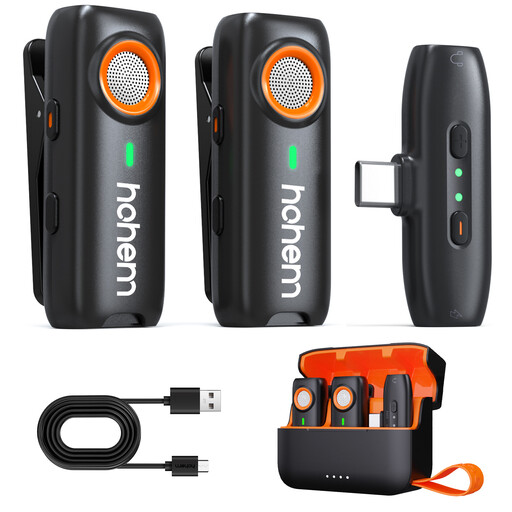
For a single voice on the move: a wearable lavalier microphone with local recording.
 No product image available
hohem Wireless Lavalier Microphone
This could suit a single voice on the move if you want to clip the microphone close to your body and use its local recording function.
The product details list three DSP noise-reduction modes and local recording to a TF card. The TF card isn’t included, so you’ll need to buy one separately to use this recording function.
View on Joybuy
Frequently asked questions
Does 32-bit float help with audible room echo?
No. The recording format won’t remove room echo. Shure explains that a microphone cannot separate direct speech from room reflections that have already reached it. So, start by testing the microphone position with a recording.
What should I test before a longer take?
Place the recorder securely where you plan to use it, or clip the lavalier microphone to the clothing you’ll actually be wearing. Check the storage, power supply and a short recording of both quiet and loud speech through headphones. If you’re using an external microphone, make sure its connection and, if necessary, phantom power are compatible with the recorder.
Who should I contact in Germany if my recorder is faulty?
For your statutory consumer rights, contact the seller. These rights are separate from any voluntary guarantee. The Verbraucherzentrale states that goods are generally covered by a two-year statutory guarantee, with repair or replacement as the first remedy for a fault.
Can I record conversations involving other people?
You must not do so without authorisation if the words were spoken privately by other people. The Federal Court of Justice cites this prohibition in § 201 para. 1 StGB. This rule applies to other people’s voices recorded in addition to your own; it does not create a special recorder licensing requirement for recording your own voice.


