Active speakers are a better fit if you listen directly from your computer and have limited space; passive bookshelf speakers are worth considering if you already have a suitable amplifier or plan to buy one. Compare recordings you know well from your intended listening position: Genelec points out that the room and speaker placement affect what you hear, while technical specifications alone cannot tell you how your brass band recordings will sound.
Who are the different types of speakers suited to?
Desk listeners with limited space
If you mainly listen at your computer, both speakers need to fit beside your screen and workspace. Check the cabinet dimensions and connections, and make sure you can position them properly for stereo. Genelec’s placement guidance emphasises that the room also affects what you hear.
Brass band music enthusiasts
If you want to assess recordings you know well, compare them from a fixed listening position. Technical specifications alone cannot tell you whether you’ll like the sound in your room.
Listeners with an existing hi-fi system
If you already have an amplifier or are planning to add one, passive bookshelf speakers could fit into your system. Check the amplifier requirements for the specific model and allow space for the speakers and cables.
What should you look for when buying?
Active stereo pair for your computer
A good fit if: Both speakers fit beside your screen and you want to listen from your computer without a separate amplifier.
Things to consider: Connections vary by model. A compact design doesn’t tell you whether you’ll like the sound of your recordings.
Passive bookshelf speakers with an amplifier
A good fit if: You already have a suitable amplifier, or want to add one to your system, and have enough space.
Things to consider: The amplifier is part of your overall signal chain, so check that it’s suitable for the specific speaker model.
| What matters when buying |
What to check |
Who should consider this? |
| Sound from your listening position |
Compare the same familiar recordings from where you plan to sit, and check that you can position both speakers properly. |
If I want to listen to brass band music closely, what matters to me is how it sounds from my actual listening position. Around 33% of consumers put listening comparisons in that setting first. |
| Space |
Measure the available width and depth for both cabinets. Also check whether the listing is for one speaker or a pair. |
If you share your desk between a screen and workspace, you need room for two speakers. Around 25% of consumers prioritise space. |
| Connections and amplifier |
Match your source’s outputs to the speaker inputs. With passive models, also check the amplifier you have. |
If I want to connect my computer directly or reuse an existing amplifier, the connections and system need to work together. Around 25% of consumers give this the highest priority. |
| Total cost |
Factor in how many speakers you need and any other equipment your setup is missing, such as an amplifier for a passive system. |
If you’re weighing up the cost of a complete stereo system, don’t consider the price of a single speaker alone. Around 17% of consumers put total cost first. |
Avoid common buying mistakes
-
Assuming a single monitor is the same as a stereo pair
Genelec lists one 8010A monitor per pack, while PreSonus describes the Eris 3.5 2nd Gen as a pair. What’s included affects how many speakers you still need for stereo.
Check the quantity and full contents of the specific listing.
-
Forgetting to include an amplifier with passive speakers
KEF describes the Q1 Meta as passive and specifies an amplifier requirement; ELAC also publishes amplifier specifications for the passive DB53. Without a suitable amplifier, your signal chain is incomplete.
Plan your source, amplifier and speakers together, and check that your amplifier is suitable for the specific model.
-
Comparing frequency specifications measured in different ways
Kali Audio lists 39 Hz at −10 dB and 54 Hz at ±3 dB for the LP-UNF; Genelec lists 67 Hz at −6 dB for the 8010A. These manufacturers’ figures are based on different measurement conditions and aren’t directly comparable.
When comparing models, check the measurement conditions for each specification and listen to your recordings from your intended position.
-
Relying on room adjustment instead of careful placement
Genelec explains that the room and speaker positioning affect what you hear. So, speaker adjustment options don’t remove the need to plan where both cabinets will go.
Plan your speaker placement first, then use any available adjustment options to suit that position.
Notable brands to consider
ADAM Audio
The active D3V pair is designed for compact computer workspaces with a compatible USB-C audio source or analogue TRS outputs.
- ADAM Audio lists USB-C and two balanced TRS inputs, along with detachable stands and room adjustment switches.
- According to ADAM Audio Support, the D3V doesn’t automatically switch to the connected source. Check the input; this doesn’t provide an independent assessment of sound quality.
Kali Audio
According to the manufacturer, the active LP-UNF is designed for very close listening at a desk.
- Kali Audio lists USB-C, Bluetooth, RCA and TRS, as well as settings for different desk and wall positions.
- The manufacturer’s 39 Hz figure is measured at −10 dB, so it isn’t directly comparable with frequency limits based on a different measurement method.
PreSonus
According to the manufacturer, the Eris 3.5 2nd Gen is an active pair for compact workspaces with analogue sources.
- PreSonus lists TRS, RCA and 3.5 mm inputs, along with a front-mounted headphone output.
- No USB-C audio input is listed for this specific model. Don’t confuse it with the older Eris E3.5 or the Bluetooth version.
KEF
According to KEF Germany, the Q1 Meta is a passive bookshelf speaker for a system with an amplifier.
- KEF Germany lists an amplifier requirement of 10–150 W.
- This specification alone doesn’t confirm whether a particular amplifier is suitable or what the speakers will sound like at a desk.
ELAC
The passive Debut 3.0 DB53 is an option for a system with an amplifier and enough space for larger cabinets.
- For the DB53, ELAC lists a front-firing bass reflex port, a nominal impedance of 6 Ω and a recommended amplifier power of 20–120 W.
- These manufacturer specifications don’t prove that the DB53 reproduces brass band music better than an active pair.
Joybuy products for your desk
The Joybuy products below include an active computer speaker model and a passive bookshelf speaker. You’ll need a suitable amplifier for the passive model.
 No image available
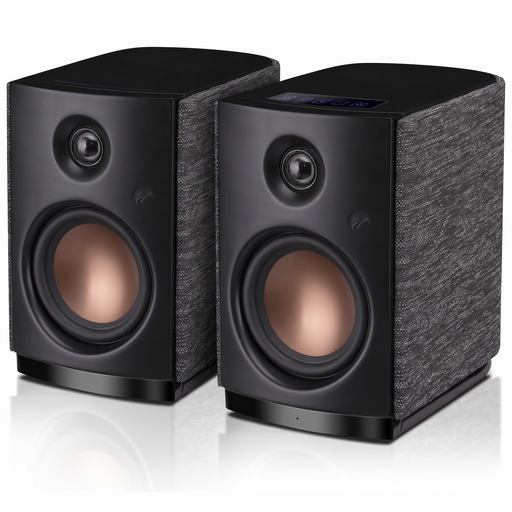
HiVi-Swans OS-10 active computer speakers
This active model is described as being designed for a computer workspace. Bluetooth 5.0 and an Aux input may suit you if they’re compatible with your source.
Listed in the product name: 4-inch woofer and 62W RMS.
View at Joybuy
 No image available
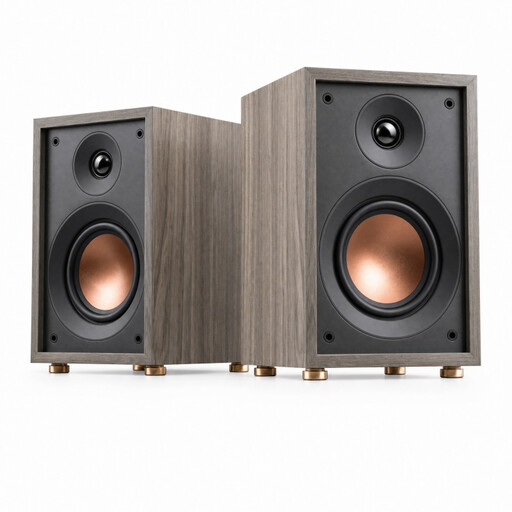
HiVi-Swans Oasis passive bookshelf speaker
If you have or plan to buy a compatible amplifier, this model, described as a passive bookshelf speaker, could suit your system.
Listed in the product name: 2-way bass reflex, 4-inch woofer, 20 mm dome tweeter, 60 Hz–20 kHz, 4 Ω and recommended amplifier power of 10–50 W. A compatible amplifier is required.
View at Joybuy
Frequently asked questions
How should you position two speakers for listening to music at your desk?
Position both speakers as symmetrically as possible, facing your listening position. Genelec describes the stereo triangle as a guide for monitor placement. The room and positioning affect what you hear, but they can’t guarantee a particular sound.
Can you connect passive bookshelf speakers directly to your computer’s USB-C port?
No. Passive speakers such as the KEF Q1 Meta need a suitable amplifier in the signal chain. USB-C inputs are listed for active models such as the ADAM Audio D3V and Kali Audio LP-UNF; even so, check that the connections are compatible with your source.
What are your rights in Germany if a speaker is faulty?
For standard sales contracts covering movable goods, claims for defects under Section 438 of the German Civil Code (BGB) generally expire two years after delivery; statutory exceptions may apply. The Federal Ministry of Justice and the Federal Office of Justice list this provision in the BGB. A voluntary manufacturer’s guarantee is separate; if you have a specific claim, discuss the circumstances of the purchase and the fault with the seller.
Can old active speakers go in household rubbish in Germany?
No. The German Environment Agency explains that waste electrical and electronic equipment must be collected separately from unsorted municipal waste. Local collection points, such as recycling centres, offer a free way to dispose of it.


