If your TV is your main source and you don’t want a separate amplifier, an active stereo pair with a suitable TV connection is a natural place to start. Passive bookshelf speakers are a better fit if you already have, or are planning to buy, a receiver – especially if you may want to add a dedicated centre channel later. In either case, positioning the speakers for your listening spot and choosing bass that suits your home matter more than the wattage alone.
Who are the different options best suited to?
TV and film sound without a receiver
You want to hear soundtracks and dialogue from your TV through two separate bookshelf speakers, without setting up a separate amplifier. The key things to check are your TV’s output, the speakers’ input and their position on either side of the screen. Teufel and KEF both document a TV connection for the active systems covered here.
Soundtrack listening in an open-plan living space
You mostly listen from one spot, with your living and dining areas flowing into each other. A well-planned stereo set-up, the effect of the room and bass you can control are especially important. Genelec’s placement guidance stresses keeping conditions as similar as possible on both sides of a stereo pair.
Home cinema upgrade with a receiver
You own a suitable amplifier or are planning a system that could later accommodate a centre speaker, surround speakers or a subwoofer. That means comparing the whole set-up, not just a pair of speakers. A passive model such as the HiVi-Swans D3.1MKII needs an external amplifier.
What should you look for when buying?
Active stereo pair connected to your TV
A good fit if: your TV is your main source and you want to listen without a separate amplifier.
Trade-off: A stereo pair does not replace a physical centre channel.
Passive speakers with an AV receiver
A good fit if: you already have a suitable receiver or plan to get one for a future upgrade.
Trade-off: You’ll need to plan for the amplifier, extra speakers and the space they’ll take up.
| Buying consideration |
What to check before buying |
Who is it most relevant to? |
| TV connection |
Check that your TV’s audio output matches an input on the specific speaker model, and take the connection between the speakers into account too. |
If I want to listen to film sound directly from my TV without an extra receiver, the connections need to work with both devices. Around 33% of consumers prioritise a direct TV connection. |
| Stereo placement |
Check the available space and your listening position. Both speakers should be positioned as similarly as possible in relation to where you sit. Genelec highlights similar reflection conditions on the left and right as important for stereo imaging. |
If I usually listen from one spot, I want to be able to position both speakers sensibly in an open-plan room. Around 27% of consumers put speaker placement for their listening spot first. |
| Bass and neighbours |
Start by assessing the stereo pair from your usual listening spot. If you may want to expand the system later, check for a documented subwoofer output or an approved add-on. When it comes to noise affecting neighbours, Germany’s Federal Environment Agency refers to state law, local rules and house rules. |
If I want to hear bass in soundtracks while being considerate of neighbouring homes, I need to be able to plan the bass response around my living situation. Around 20% of consumers prioritise controllable bass and consideration for neighbours. |
| Adding a receiver |
Check that your existing amplifier and speaker connections are compatible with the specific passive model. Also plan space for any centre and surround speakers you may add. |
If I already have a receiver or want to add more channels later, the speaker pair needs to fit into my planned system. Around 20% of consumers prioritise the option to expand with a receiver. |
Common misconceptions
-
“Wireless” means the speakers don’t need to be connected to each other
The KEF LSX II LT uses a C-Link cable between the speakers. Its route can affect where you can place the second speaker.
Measure the planned cable route before you buy, and check which connection is required for that exact model.
-
Passive bookshelf speakers can connect directly to a TV
Passive speakers such as the HiVi D3.1MKII need an external amplifier or AV receiver.
First decide whether you already have a suitable amplifier or need to include one in your plans. For extra surround channels, you’ll also need additional speakers and space to position them.
-
More bass means better film sound everywhere
The room and speaker placement affect how sound is reproduced. In homes where sound carries easily, even everyday TV noise can disturb the neighbours.
Start by assessing the stereo pair from your usual listening spot, then decide whether adding more bass is suitable for your home and the rules that apply.
Key brands at a glance
Teufel
The ULTIMA 25 AKTIV 2 is an active pair of bookshelf speakers with an HDMI connection for TV and music. It doesn’t need a separate amplifier.
- In its review of the ULTIMA 25 AKTIV 2, HIFI.DE highlights its bass for film sound and its ability to handle high volumes. Teufel documents a Virtual Centre mode and specific expansion options.
- HIFI.DE notes that the reviewed model offers less transparency with music. A Virtual Centre is not a physical centre speaker, and these details do not apply across all models or generations.
KEF
The LSX II and LSX II LT are compact active stereo systems. KEF documents HDMI ARC and a subwoofer output for the LSX II LT.
- In its review, HIFI.DE rated the LSX II LT’s sound on a par with the LSX II it tested.
- According to HIFI.DE, the LSX II LT has no analogue input. Make sure to allow for the C-Link cable documented for the LT when planning where to place it.
ELAC
The Debut ConneX DCB61 is an active system with several documented wired inputs, including a connection for a TV.
- ELAC’s manual lists HDMI ARC, an optical input, Phono/Line and a subwoofer output.
- Bear the rear bass reflex port in mind when positioning the speakers. The manufacturer’s claims about sound or bass are not an independent comparison for a specific living space.
DALI
The KUPID is a compact passive bookshelf speaker for a set-up that includes an amplifier.
- DALI lists a supplied wall bracket as a placement option.
- You’ll need an amplifier to use it. TV connectivity and the option to add surround sound depend on your other components.
HiVi-Swans
The D3.1MKII is a passive two-way bookshelf speaker model for a set-up with an external amplifier.
- The manufacturer lists the D3.1MKII as a passive model.
- A passive pair of speakers is not an active solution that you can use directly with a TV. The manufacturer’s information is no substitute for an independent listening test.
Joybuy products
This selection includes an active stereo pair for direct connection to a TV and passive bookshelf speakers for use with an amplifier.
 No image available
Lemega Active 40W bookshelf speakers, pair
For film sound directly from your TV, if you’re looking for an active stereo pair with HDMI ARC.
HDMI ARC, plus optical, USB, AUX and RCA inputs; Bluetooth, bass and treble controls, and a remote control according to the product name.
The passive speaker connects to the active one via speaker cable; according to the product description, the active speaker should be placed on the right.
View at Joybuy
 No image available
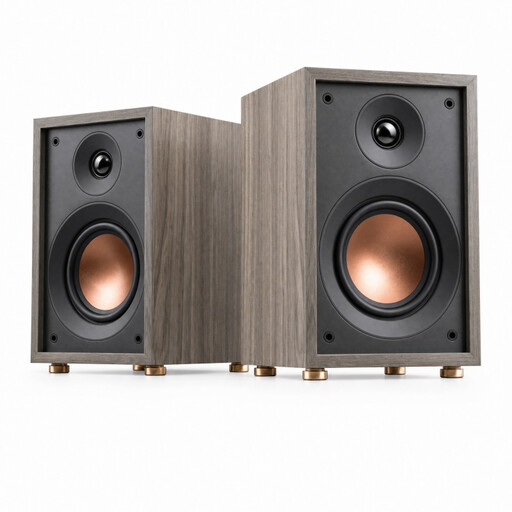
HiVi-Swans Oasis passive two-way bookshelf speaker
For watching films and listening to music with a compatible amplifier; this is a passive model.
Two-way bass reflex design, 4-inch woofer and 20-mm dome tweeter; rated at 60Hz–20kHz, 4Ω and 10W–50W.
View at Joybuy
Frequently asked questions
Do I need a subwoofer or surround speakers for soundtracks?
No. If you mainly want to listen to stereo from one spot, you can start with speakers positioned to suit your room. If you then find you need more bass or extra channels, check the documented expansion connections or consider a suitable AV receiver, and make sure you have space for the additional speakers.
Why is there no sound over HDMI ARC?
First check that the TV connection you’re using supports ARC and matches the input on your specific speaker system. KEF’s model FAQ recommends checking the cable and connection, among other things, if there’s no HDMI connection. The relevant TV settings depend on your device.
How loud can I play speakers and a subwoofer in a German home?
There is no single time or volume limit that applies to every home. For noise from people’s behaviour that affects neighbours, Germany’s Federal Environment Agency refers to state law, local regulations and house rules. Check the rules that apply to your home and be considerate of your neighbours.
What are my rights when buying online or if the speakers are faulty?
In Germany, online purchases generally come with a 14-day right to cancel. You need to notify the retailer or other contracting party that you wish to cancel. The consumer advice centre distinguishes between your statutory rights when goods are faulty and a voluntary guarantee. Which applies in your case depends on whether you want to cancel the purchase or report a fault.


