If you don’t own an amplifier and want to connect your source directly, an active stereo pair is a natural place to start. With a suitable amplifier, you can also choose passive bookshelf speakers. The key things are compatible connections, space for both speakers and how they’re positioned in your listening area. Manufacturer specifications alone can’t tell you how natural a guitar recording will sound in your room.
Who are these speakers for?
Listeners who want to assess guitar recordings carefully
If you want to hear the attack and stereo imaging from your listening position, you’ll need to consider where to place both speakers. Genelec notes that similar reflection conditions on the left and right are important for precise stereo imaging.
Listeners without a separate amplifier
If you want to connect your existing source as directly as possible, look at an active pair and check its inputs. For example, Edifier lists Bluetooth, line-in, optical and coaxial inputs for the R1280DBs.
Listeners with an existing hi-fi system
Passive bookshelf speakers are an option if you have a suitable amplifier. Make sure its requirements match the specific model; ELAC and KEF list amplifier specifications for their individual models.
What should you look for when buying?
Active speaker pair
A good fit if: you don’t have a separate amplifier and can connect your source to one of the available inputs.
Bear in mind: connections and sound specifications apply to the specific model; they don’t prove how a guitar recording will sound in your room.
Passive speaker pair
A good fit if: you already have a suitable amplifier or want to choose your amplifier and speakers separately.
Bear in mind: the amplifier, signal path and, where necessary, speaker cables all need to work with your complete set-up.
| What matters to you |
What to check before buying |
Who is this important to? |
| Guitar sound and stereo imaging |
Check whether you can position both speakers appropriately for your listening area. Compare familiar recordings at a similar volume if possible; Genelec highlights the importance of similar reflection conditions on the left and right. |
If I want to assess the attack and stereo imaging of my guitar recordings, I focus on how they sound from my listening position. Around 33% of consumers put guitar sound and stereo imaging first. |
| Connections and amplifier |
Match your source’s outputs to the inputs on an active model, or check whether your amplifier is suitable for the passive model. |
If I don’t want to add an amplifier, I need a compatible connection between my source and the active speaker. For around 27% of consumers, direct connectivity or their existing amplifier is the main consideration. |
| Space and positioning |
Measure the space for both speakers, taking into account their dimensions, the intended mounting method and the positioning advice for the specific model. |
If you need to find two practical spots in a small living room, make sure the speakers suit your room and listening position. Around 27% of consumers prioritise space and positioning. |
| What’s included in the system |
Check whether an offer includes one speaker or a pair, and what other components you’ll need for your set-up. |
If I want to put together a complete stereo system, I need to consider the number of speakers included alongside the components I already own. Around 13% of consumers focus on what’s included and the overall cost of the system. |
Common buying mistakes
-
Planning for a passive pair without a suitable amplifier
Passive speakers such as the KEF Q1 Meta and ELAC DB63 require an external amplifier. Without a suitable amplifier, your set-up won’t be complete.
Plan your source, amplifier and speakers as one system, and check the requirements of the specific model.
-
Confusing a single speaker with a stereo pair
What’s included can vary between offers: Teufel describes the ULTIMA-20 model reviewed as a pair, while Nubert lists the nuBoxx B-30 as a single speaker.
Before comparing offers, check how many speakers are included and what you need for your stereo set-up.
-
Judging how they’ll fit based on cabinet size alone
A compact cabinet doesn’t guarantee that you’ll be able to position two speakers appropriately for your listening area in a small living room. Positioning and reflections can affect how they sound.
Measure the available spaces and try the arrangement with familiar recordings before assuming that the specifications or cabinet dimensions tell you how the speakers will sound in your room.
Key brands to consider
Edifier
Active bookshelf speakers for a set-up without a separate amplifier; the R1280DBs is one specific model to consider.
- Edifier lists Bluetooth, line-in, optical and coaxial inputs for the R1280DBs.
- These specifications don’t independently show how naturally the model reproduces acoustic guitar recordings.
ELAC
Passive bookshelf speakers for use with a suitable amplifier you already own or plan to buy; the Debut 3.0 DB63 is one example.
- ELAC lists a nominal impedance of 6 Ω, a recommended amplifier power of 20–140 W and a front-facing bass reflex port for the DB63.
- The amplifier requirements need to match your existing amplifier; this doesn’t mean the speakers will sound better with guitar recordings.
KEF
Passive Q Series speakers for a hi-fi system assembled from separate components; the Q1 Meta is a compact example.
- KEF describes the Q1 Meta as passive and lists an amplifier requirement of 10–150 W.
- This specification doesn’t automatically make every amplifier suitable, nor does it prove that the speakers have a particular sound with acoustic guitar.
Teufel
Passive ULTIMA bookshelf speakers; the model reviewed is the ULTIMA 20 Mk4, also known as the UL 20 Mk4 25.
- Teufel lists shelf, stand and wall mounting as positioning options for this model.
- The older ULTIMA 20 Mk3 is a different generation. Check the exact model name when comparing speakers.
Nubert
Passive compact speakers for an existing or planned hi-fi system; Nubert describes the nuBoxx B-30 as suitable for small rooms.
- Nubert lists a 150-mm mid-bass driver for the B-30.
- A manufacturer’s description of a wide listening area isn’t an independent listening comparison. Also check whether the specific offer includes one or two speakers.
Joybuy products for active and passive set-ups
The products below include active bookshelf speakers and passive models for use with a suitable amplifier. For passive speakers, check that the stated package contents are right for your stereo set-up.
 No image available
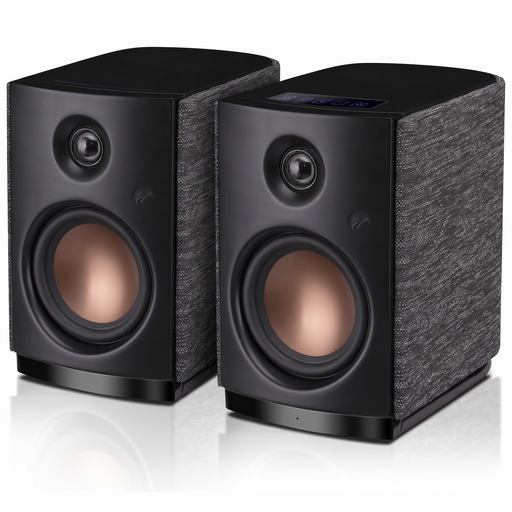
Lemega active bookshelf speakers, 40 W, pair
For an active set-up without a separate amplifier; check that the inputs match the connections on your source.
Connections listed in the product title: Bluetooth, HDMI ARC, optical, USB, AUX and RCA. Also listed: bass and treble controls and a remote control.
View at Joybuy
 No image available
HiVi-Swans OS-10, active hi-fi stereo speakers
For an active stereo set-up; check that the connection options listed in the product title suit your source.
The product title lists Bluetooth 5.0, a 4-inch woofer and 62 W RMS.
View at Joybuy
 No image available
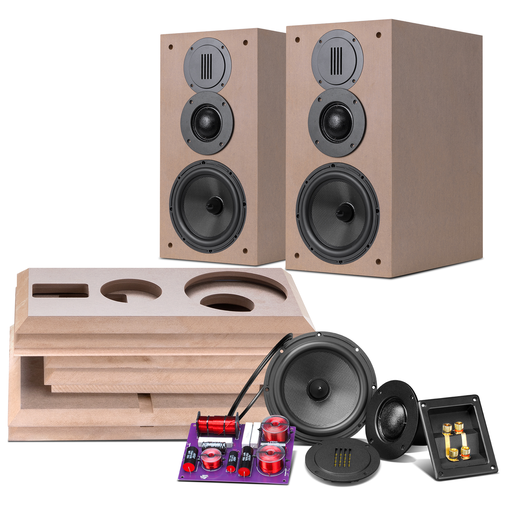
HiVi-Swans DIY3.1, passive bookshelf speakers, pair
For a stereo set-up with a suitable amplifier; make sure you also plan the right signal path.
The product title lists a pair of 6.5-inch speakers.
View at Joybuy
 No image available
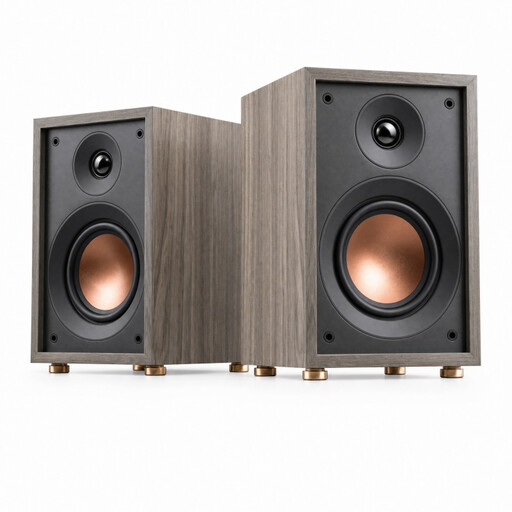
HiVi-Swans Oasis, passive two-way bookshelf speaker
For use with a suitable amplifier; check the impedance and power specifications in the product title.
Specifications listed include a 4-inch woofer, a 20-mm tweeter, 60 Hz–20 kHz, 4 Ω and 10–50 W.
View at Joybuy
 No image available
HiVi D3.1MKII, passive hi-fi bookshelf speakers
For a set-up with a suitable amplifier; check the amplifier requirements and think about where you plan to position the speakers.
The product title lists a 6.5-inch mid-bass driver, a 28-mm tweeter, a rear-facing bass reflex port, 8 Ω and 10–120 W.
View at Joybuy
Frequently asked questions
Can I connect passive bookshelf speakers directly to my mobile phone?
No. Passive speakers need a suitable amplifier and a compatible signal path from your source to the amplifier. If you want to connect directly to the speaker, check the inputs on an active model.
What should I check first after setting the speakers up?
Start by checking the position of both speakers relative to your listening area, and aim for similar conditions on the left and right. Genelec’s monitor positioning advice explains the effect of reflections and symmetry; the studio layout described there isn’t a rule that every living room has to follow.
How can I compare what’s included in a speaker offer?
Check whether the offer includes one speaker or a pair, and which components you already own. Passive speakers also need a suitable amplifier.
What are my rights when shopping online in Germany if I change my mind or find a fault?
Online consumer purchases generally come with a 14-day right to cancel, subject to the specific legal conditions. Verbraucherzentrale distinguishes the statutory right to cancel and statutory consumer rights for faulty goods from a voluntary guarantee; also check the terms of the specific offer.


