Who are the different options suitable for?

Jazz listeners at their desk

If you want to hear how voices and instruments are positioned in the soundstage from a fixed listening spot, you should be able to position the two speakers in comparable locations. Genelec says that similar reflective conditions on the left and right help create a precise stereo image.

Computer listeners without a separate amplifier

Active speakers are worth considering if you want to connect them directly to your computer or use its existing analogue outputs. Available inputs vary by model, as the specifications from ADAM Audio, Edifier and KEF show.

Listeners with a hi-fi amplifier

If you want to keep using a suitable amplifier, passive speakers are an option. ELAC lists a nominal impedance of 6 Ω and a recommended amplifier power of 20–120 W for the Debut 3.0 DB53. Check these model specifications against your amplifier.

What should you look for when buying?

A compact active pair for your computer

A good fit if: You mainly listen at your desk and don't want to use a separate amplifier. According to the manufacturer, the ADAM Audio D3V has USB-C and balanced TRS inputs.

Things to consider: The Edifier MR4 has analogue TRS, RCA and AUX inputs, so check which output your computer provides. According to ADAM Audio, the D3V's documented USB signal path operates internally at 48 kHz and 16 bit.

Passive bookshelf speakers with an amplifier

A good fit if: You already have a suitable amplifier or want to choose your speakers and amplifier separately.

Things to consider: Your planned system will need an amplifier, a way to connect your sources and speaker cables. ELAC lists a nominal impedance of 6 Ω and a recommended amplifier power of 20–120 W for the Debut 3.0 DB53.

Active speakers for multiple sources

A good fit if: You want to connect devices other than your computer or use streaming. KEF lists USB-C, HDMI ARC, an optical connection and network features among the LSX II LT's specifications.

Things to consider: The KEF LSX II LT needs a connection between the two speakers. The Q Acoustics M20 has computer USB and Bluetooth, according to the manufacturer. Also bear its rear bass reflex ports in mind when positioning it.

Buying priority What should you look for? Who is this most relevant to?
A spacious soundstage Check that you have two places for the speakers, that they can be positioned at a similar height and angle towards your listening position, and that conditions are comparable on the left and right. Genelec recommends keeping the surroundings of both speakers as similar as possible. If I want to hear how voices and instruments are positioned from my regular spot at the desk, I look for a comparable setup. Around 36% of consumers put a spacious soundstage first.
The right connection Make a note of your computer's audio outputs and check that they match the inputs on the specific speaker model. If I want to connect my computer using a particular signal path, I first check that the output and input are compatible. Around 29% of consumers prioritise connectivity.
Desk space and positioning near a wall Measure both speaker locations, allowing room for the connections, and follow the positioning advice for the specific model. If space is limited, I need to find two suitable spots without obstructing the speakers. Around 21% of consumers put available space first.
Using an existing amplifier Check your amplifier's specifications against the impedance and manufacturer information for the passive speakers. Remember to allow for source connections and cables, too. If I want to keep using my hi-fi amplifier, I check its specifications against those of the passive speakers. Around 14% of consumers prioritise using an existing amplifier.

Which buying misconceptions should you avoid?

  • Assuming passive speakers can be connected directly like active speakers

    Passive speakers such as the ELAC Debut 3.0 DB53 need a suitable amplifier. Buying the speakers alone doesn't give you a complete audio chain from your computer to both speakers.

    Plan the signal path from your computer, through the amplifier and on to the speakers, and check the amplifier's specifications against the manufacturer's recommendations.

    Passive speakers may also require a suitable amplifier and compatible connections.

  • Treating a bass or hi-res specification as proof of how speakers will sound at your desk

    A single measurement doesn't tell you how spacious a live recording will sound from your listening position. According to ADAM Audio Support, the ADAM Audio D3V's USB signal path operates internally at 48 kHz and 16 bit. This describes the signal path; it isn't an independent assessment of the sound.

    Check the specifications for the specific model and consider how it will be positioned in your intended listening spot.

  • Assuming “wireless” means there are no cables between any of the components

    The KEF LSX II LT requires a connection between the two speakers; its wireless features don't replace this connection.

    Check the power supply, source connection and link between the left and right speakers separately.

    Depending on your setup, you may also need a connection cable that's suitable for the intended positioning.

Key brands to consider

ADAM Audio

The active D3V is an option for listening at close range to your PC, with USB-C or balanced analogue inputs.

  • ADAM Audio lists removable desk stands and switches for adapting the speakers to their position.
  • According to ADAM Audio, the USB signal path operates internally at 48 kHz and 16 bit. This isn't an independent assessment of its suitability for live jazz.

Edifier

The active MR4 is designed for desks with analogue audio sources.

  • Edifier lists TRS, RCA and AUX inputs, a front-facing headphone output and switchable listening modes.
  • Check that the available analogue inputs match your computer's outputs.

ELAC

The passive Debut 3.0 DB53 is an option for a home office listening spot with a suitable separate amplifier.

  • ELAC lists a nominal impedance of 6 Ω, recommended amplifier power of 20–120 W and cabinet dimensions of 172 × 311 × 267 mm.
  • Allow for a suitable amplifier and check that the dimensions work for both speaker locations.

KEF

According to KEF, the active LSX II LT offers a range of connection options for your desk and other home devices.

  • KEF lists USB-C, HDMI ARC, an optical connection and streaming features.
  • The two speakers need to be connected to work as a pair.

Q Acoustics

The active M20 is an option if you want to use computer USB and other sources.

  • Q Acoustics lists USB audio, Bluetooth and rear-facing bass reflex ports.
  • Take the rear-facing ports into account when positioning the speakers near a wall.

Speakers for your desk and home office

The Joybuy products below include active speakers for your desk and passive bookshelf speakers for a separate amplifier setup. Before buying, pay particular attention to the inputs, the space available and the connection between the speakers.

Lemega active bookshelf speakers, 40 W, Bluetooth

Lemega active bookshelf speakers, 40 W, Bluetooth

For a desk setup with several possible audio sources; the description also mentions bass and treble controls.

The product specifications list HDMI ARC, optical, USB, RCA and AUX inputs, as well as Bluetooth. According to the description, the passive speaker connects to the active one using a speaker cable.

View at Joybuy
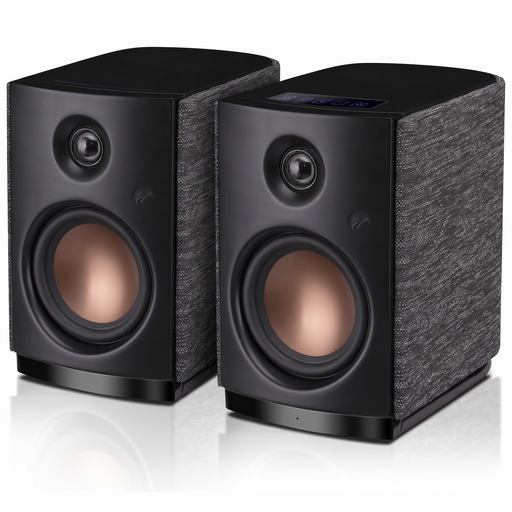
HiVi-Swans OS-10 active computer speakers with 4-inch woofer

HiVi-Swans OS-10 active computer speakers

For listening at your computer, if an active pair with Bluetooth or an analogue AUX input suits the devices you already have.

The product title lists a 4-inch woofer and 62 W RMS; the description lists Bluetooth 5.0 and AUX.

View at Joybuy
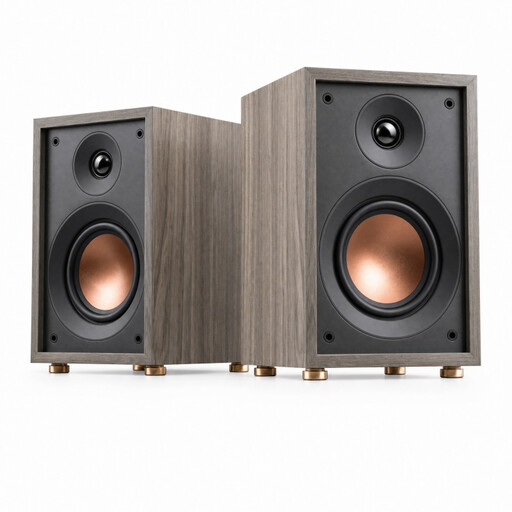
HiVi-Swans Oasis passive two-way bookshelf speakers

HiVi-Swans Oasis passive two-way bookshelf speakers

For a home office listening spot, if you have a suitable separate amplifier as part of your system.

The product specifications list 4 Ω, 10–50 W and a frequency range of 60 Hz–20 kHz. As passive speakers, they need a suitable amplifier.

View at Joybuy
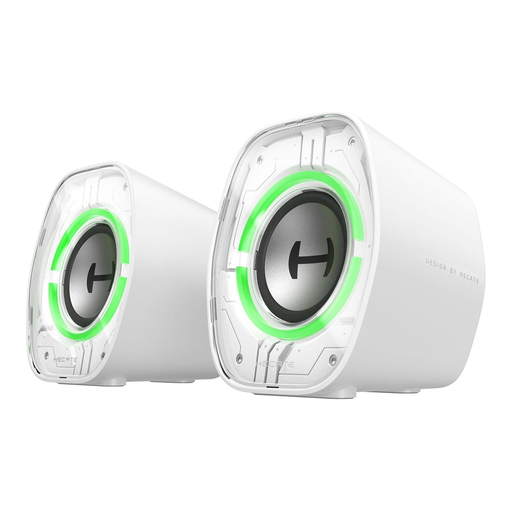
Edifier G1000 II desktop speakers

Edifier G1000 II desktop speakers

For listening to your computer at your desk, if compact desktop speakers suit your space better than traditional bookshelf speakers.

The product title lists USB-C, AUX, Bluetooth 5.4 and a 2.5-inch full-range driver.

View at Joybuy

Frequently asked questions

How can I tell whether active or passive speakers will work with my computer?

Active speakers such as the ADAM Audio D3V and Edifier MR4 have built-in amplification, but their inputs differ. The D3V has USB-C and TRS, according to the manufacturer; the MR4 has analogue TRS, RCA and AUX inputs. Passive speakers such as the ELAC DB53 need a suitable amplifier. Check the actual outputs on your devices against the signal path supported by the specific model.

How should I position a stereo pair for live recordings?

Angle both speakers towards your listening position and aim for a similar height and environment on the left and right. For a precise stereo image, Genelec recommends comparable reflective conditions for both speakers. This is a guide to positioning, not a guarantee of a particular sound in your home office.

What rights apply when buying speakers online in Germany?

For distance purchases from business sellers, the EU consumer portal generally describes a 14-day withdrawal period starting from delivery. Under EU rules, faulty goods are generally covered by a minimum two-year legal guarantee from the seller. A voluntary manufacturer's warranty is separate from this.

What should I check when buying electrical or wireless speakers?

Check the specific product listing for the required product and manufacturer information, instructions and warnings, as well as the declaration of conformity. The Bundesnetzagentur monitors electrical and wireless products as part of its market surveillance activities, among other things. Its guidance explains that the manufacturer uses the CE marking to declare, under its own responsibility, that the product meets the relevant legal requirements. CE is not an independent mark of sound or quality.