What should you look for when buying?
Start with your listening position and placement options, then check that the connections and amplification are compatible with your existing system.
| Buying priority |
What to check before buying |
Who is this important for? |
| Spatial imaging |
Check that there is room for both speakers, and that they can be positioned at the same height and at similar distances from your listening position. |
If I want to follow the positions of the instruments in a live recording, I need a fixed listening position and two speakers that can be angled appropriately. Around 33% of consumers put spatial imaging first. |
| Placement and bass |
Check the cabinet depth and possible positions in your furnished room; if you plan to add a subwoofer, look for a suitable output. |
If I listen in different parts of an open-plan living space, the placement and bass need to work with the available positions. Around 25% of consumers prioritise room placement and bass. |
| Connections and controls |
Compare the inputs on the exact model with the connections on your sources. |
If I want to connect my existing music sources, I need to know which inputs are available on the specific model. Around 25% of consumers prioritise connections and controls. |
| Amplifier and total cost |
For passive models, check the amplifier requirements and compare the cost of the complete system. |
If I want to keep using my amplifier, it needs to be compatible with the passive speakers; otherwise, I want to compare the cost of a complete system. Around 17% of consumers focus on their existing system and the total cost. |
Joybuy: bookshelf speakers to consider
The products listed include active bookshelf speakers and passive models for a system with a separate amplifier. Before buying a passive model, check whether the listing includes a pair or a single speaker.
 No image available
Lemega active bookshelf speakers, 40 W pair
For shoppers looking for an active stereo pair with several source connections.
Features listed in the product title: Bluetooth, HDMI ARC, optical input, USB, AUX and RCA, plus bass and treble controls and a remote control.
View at Joybuy
 No image available
HiVi-Swans OS-10 active Hi-Fi stereo speakers
For shoppers looking for an active stereo system for a compact desktop setup.
Features listed in the product title: Bluetooth 5.0, 4-inch woofer, 62 W RMS and touch controls.
View at Joybuy
 No image available
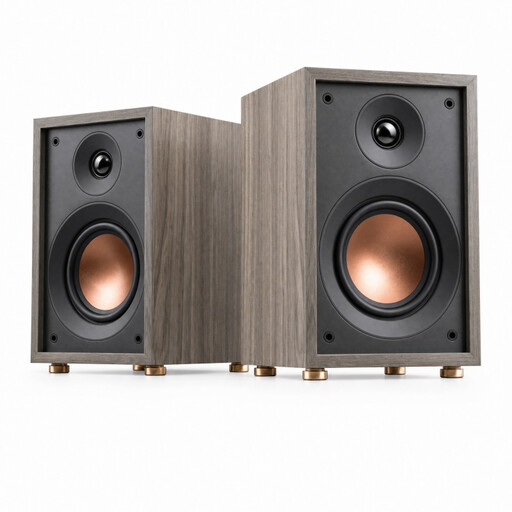
HiVi-Swans Oasis passive bookshelf speaker
For shoppers who want to use passive bookshelf speakers with a separate amplifier; check what’s included and the amplifier requirements before buying.
Features listed in the product title: two-way bass reflex, 4-inch woofer, 20-mm dome tweeter, 60 Hz–20 kHz, 4 Ω and 10 W–50 W.
View at Joybuy
Frequently asked questions
How should you position a stereo pair for a fixed listening position?
Start by positioning both speakers at roughly the same distance from your listening position and at a similar height, with comparable conditions on either side. Genelec’s guide to studio monitors explains why reflections and different distances affect the stereo image; it doesn’t prove that every Hi-Fi model will sound better in a particular position.
Can you connect passive bookshelf speakers directly to a laptop?
No, passive speakers need a suitable amplifier. When choosing one, check the specifications for your specific pair of speakers and the connections on your source.
Is a manufacturer’s guarantee the same as your statutory consumer rights?
No. Your statutory consumer rights apply against the seller, while a guarantee is an additional voluntary service governed by its own terms. According to Verbraucherzentrale, online purchases also usually come with a 14-day right to cancel; check the time limit and applicable terms for your specific purchase.
What should you check to make sure a Bluetooth or Wi-Fi speaker complies with regulations?
The Bundesnetzagentur lists checks including CE marking, product identification, manufacturer details, German-language instructions and declarations of conformity. These are requirements to check for the specific device on offer; a model description alone doesn’t confirm that a particular listing is compliant.
Can an old electric speaker go in your household rubbish?
No. The Umweltbundesamt says that old electrical equipment must be collected separately; local collection points are one way to return it. Removable batteries must be disposed of separately.


