Choose a pair of speakers that will fit your space and connect to your existing audio source. Active speakers don’t need a separate amplifier, whereas passive models do. For vinyl, you may need a phono preamp; if space is tight, the right placement or wall brackets can make all the difference. Wattage alone won’t tell you how a pair will sound in your room.
Who are the different options for?
Blues listeners with a dedicated listening spot
If you want to position two separate speakers towards a fixed listening spot, plan for both the space they’ll take up and where they’ll go. KEF describes positioning the speakers in relation to your listening spot as an important factor.
Listeners with a CD or vinyl collection
If you want to keep using your existing players, check that their outputs match the inputs on your speakers or amplifier. With a turntable, you’ll also need to check where the phono preamp stage takes place. Teufel explains the signal processing needed before a line input.
Listeners short on space and extra equipment
If your speakers need to sit close to a wall or on a piece of furniture, the available space and the dimensions of the specific model matter. Wall brackets included with a speaker can be an alternative to a shelf, as with the DALI KUPID; active models save you from needing a separate amplifier.
What should you consider when buying?
First, compare the space you have and your existing audio sources with the connections and equipment needed for each speaker pair.
| What matters when buying |
What to look for |
Who will find this especially important? |
| Stereo and placement |
Check there’s space for both speakers and your listening spot; take KEF’s advice on positioning speakers in relation to your listening spot into account. |
If I want to position two speakers to suit my listening spot, I need to consider the space they’ll take up and their distance from the walls. Around 36% of consumers would put placement and stereo first. |
| Connections for your collection |
Check the outputs on your CD player, turntable or digital source against the inputs on the specific model; remember that vinyl needs a phono signal. |
If you want to connect existing CD, vinyl or digital sources, you’ll need the right inputs and a complete signal path. Around 29% of consumers would make connecting their collection their top buying priority. |
| Complete system |
Check whether you need an amplifier and whether any of your sources require extra equipment or cables. |
If I want to put together a system without overlooking extra equipment, I need to consider everything I’ll need, not just the pair of speakers. Around 21% of consumers would put this first. |
| Room to expand later |
Plan for any extras you actually need and check that the specific model has the right connections for them. |
If you might want to connect more components later, check now for the connections or compatible accessories you’ll need. Around 14% of consumers would prioritise the option to make changes later. |
Common buying mistakes
-
Assuming passive speakers are ready-to-play like an active system
A passive pair of speakers needs a suitable amplifier. Even with an active pair, you may still need a phono preamp for a turntable if the source doesn’t output a suitable line signal.
Check the whole connection chain against your existing equipment before choosing a model.
Depending on your system, you may need extra equipment such as an amplifier, cables or a phono preamp.
-
Planning to use Line-In on the Sonos Era 100 without an adapter
According to Sonos, the Era 100 needs an input adapter for a wired line source. Line-In is disabled when it’s used as a home cinema surround speaker.
Before buying, check the signal path you have in mind and how you plan to use the speaker.
To use Line-In on the Era 100, you’ll need a compatible Sonos adapter and an audio cable.
-
Assuming the position of the bass reflex port determines whether a speaker can go near a wall
The position of the port alone doesn’t tell you whether a speaker will sound good in a particular spot. Wall distance and the room affect placement; KEF points out that rear-facing ports don’t automatically rule out placing speakers close to a wall.
Follow the guidance for the specific model and check that you can position the speakers sensibly in the spaces available.
Key brands at a glance
Edifier
The active R1280DBs pair could suit listeners looking for separate stereo speakers with several connection options and no need for a separate amplifier.
- Edifier lists RCA, optical and coaxial inputs, Bluetooth, a sub-out and a front-facing bass reflex port for this model. Each speaker measures 146 × 234 × 196 mm.
- The manufacturer’s 42 W RMS rating won’t tell you how the speakers will sound in your listening spot.
DALI
The passive KUPID is a compact option if you’re considering wall mounting it with the bracket supplied.
- DALI includes a wall bracket.
- As a passive speaker, the KUPID needs a suitable amplifier. Also check that the planned installation will work in your room.
KEF
The passive Q1 Meta is aimed at listeners who already have a suitable amplifier or want to choose one separately.
- KEF sells the Q1 Meta as a pair and specifies an amplifier requirement of 10–150 W.
- Your amplifier and the space available need to suit your setup; wattage alone doesn’t prove that a speaker will sound better with blues.
Teufel
The active ULTIMA 25 AKTIV 2 pair could be a good option if you want to connect a TV via HDMI ARC/eARC as well as listen to music.
- Teufel lists Bluetooth, AUX and HDMI among the connections on this model. The manufacturer says it doesn’t need a separate amplifier.
- To connect a turntable to the AUX input, you’ll need a phono preamp unless the source provides a suitable line signal.
Sonos
Two Era 100 speakers could suit you if digital playback and an app- and network-focused stereo pair are your priorities.
- According to Sonos, you can pair two Era 100 speakers for stereo sound.
- To connect external line sources, you’ll need an input adapter and a cable, and you’ll need to set everything up in the app. Line-In is disabled when the Era 100 is used as a home cinema surround speaker.
Bookshelf speakers at Joybuy
The selection includes active bookshelf speaker pairs and one passive bookshelf speaker. Check what audio source you have, whether you’ll need an amplifier, and whether the listing is for a pair or a single speaker.
 No image available
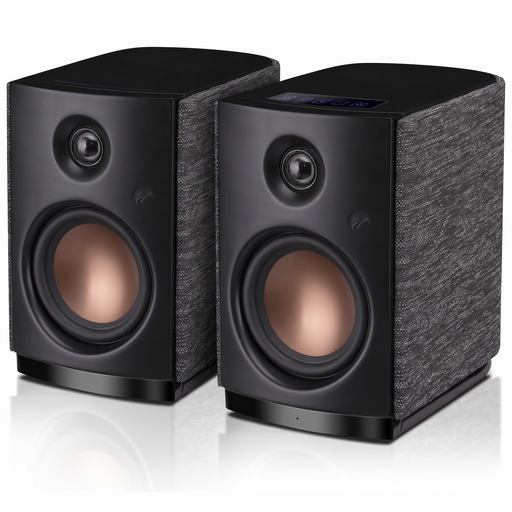
Lemega active bookshelf speakers, 40 W, pair
This active pair is an option if you want to get started without a separate amplifier.
40 W; Bluetooth, HDMI ARC, optical, USB, AUX and RCA inputs; LED display; bass and treble controls; remote control included according to the product name.
View at Joybuy
 No image available
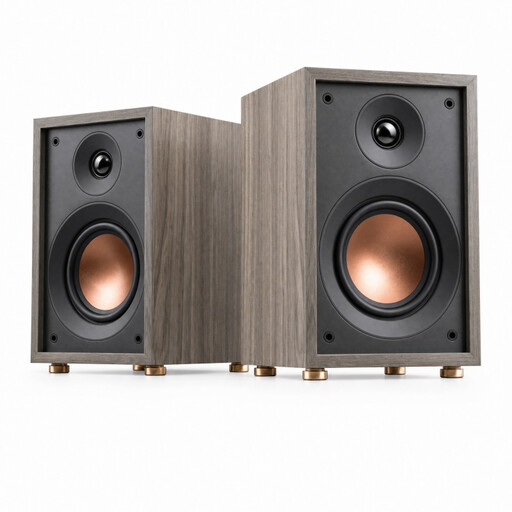
HiVi-Swans OS-10 active Hi-Fi stereo bookshelf speakers
This active model could suit you if you want to use Bluetooth or an AUX input for your music source.
Bluetooth 5.0; AUX input; 4-inch woofer; 62 W RMS; touch controls.
View at Joybuy
 No image available
HiVi-Swans Oasis passive 2-way bookshelf speaker
This passive speaker is designed for use with an existing amplifier system; you’ll need a suitable amplifier to use it.
4-inch woofer; 20 mm dome tweeter; 60 Hz–20 kHz; 4 Ω; recommended amplifier power 10–50 W. The product name refers to one speaker, so check how many you’ll need for stereo.
View at Joybuy
Frequently asked questions
Do I need an amplifier for passive bookshelf speakers?
Yes. Passive speakers such as the KEF Q1 Meta or DALI KUPID need a suitable amplifier; active pairs such as the Edifier R1280DBs have amplification built in. For a passive model, check the specific speaker’s requirements and the connections on your system.
Can I connect a turntable directly to a Line or AUX input?
Only if the input receives a suitable line signal. If neither the turntable nor the equipment it’s connected to has a suitable phono preamp, you’ll need to add one; a standard line input can’t do the job. Teufel explains this signal path for connecting a turntable.
How should I position two speakers in a small living room?
Start by positioning both speakers to suit your listening spot, then see how changing their distance from the walls affects the setup. KEF emphasises the importance of positioning speakers in relation to your listening spot, while also pointing out that general distance recommendations aren’t minimum requirements for every model and small room. Follow the instructions for your speakers.


