
Lieferung heute & morgen

Qualitätsgarantie

Willkommens-Angebote freischalten: KOSTENLOSE Lieferung | Bis zu 80 % RABATT | Kostenlose 30-Tage-JoyPlus-Testphase
App herunterladen
Adhesive hooks create extra storage space without tenants having to reach for a drill. They are suitable for towels, keys, kitchen utensils, lightweight decorations or curtains. However, not every no-drill hook stays equally secure on every wall. If you focus only on a high load capacity or a cheap pack size, you may end up having to buy twice.
The most common purchasing problems arise from three typical pitfalls:
The load capacity should not only match the weight of the item, but also any pulling movements it may be subjected to. A towel that is removed regularly puts different demands on a wall hook than a lightweight bunch of keys.
Look out for the following information:
According to the product information, tesa Powerstrips Hook Small is designed for a maximum load of 1 kg per hook. The surface should be clean, dry and sufficiently solid. Heavy, valuable or potentially hazardous items should never be attached to adhesive hooks.
Self-adhesive hooks require surfaces that are as smooth and load-bearing as possible. Tiles, glass, metal or smooth painted surfaces are often more suitable than coarse woodchip wallpaper, porous plaster or damaged paint. The manufacturer’s instructions take precedence over general recommendations.
Before mounting:
Particular care is advisable with delicate wallpaper or freshly painted walls. Testing the hook in an inconspicuous area can help you assess the risk of damage.
Wall hooks without drilling can broadly be divided into three groups:
Curtain hooks are a special case. The shape of the hook, curtain pole and weight of the curtain must all be compatible. According to the product description, tesa Powerstrips Curtain Hooks are designed for standard curtain poles and are supplied as a set of four white hooks with adhesive strips. The stated maximum load is 1 kg.
The right solution depends on whether you prioritise the simplest possible installation, an attractive appearance or flexible use.
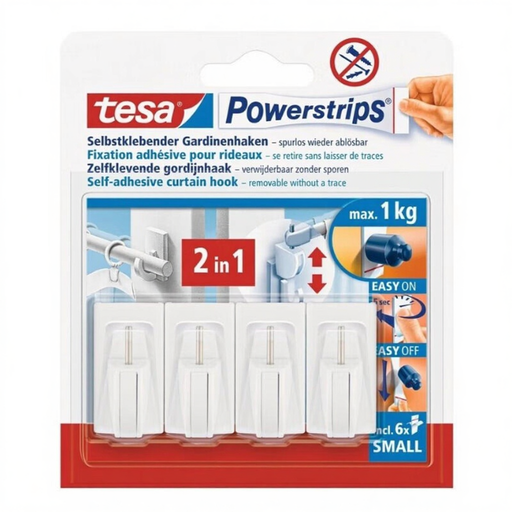
Why this product suits this profile: This small plastic hook is designed for everyday lightweight hanging tasks and can be fitted without tools. Its size makes it suitable for keys, lightweight kitchen utensils or small towels.
The load limit of 1 kg per hook is clearly stated. Unsuitable surfaces, such as textured or freshly painted surfaces, are also explicitly excluded.
Plastic construction, tool-free installation and, according to the product information, residue-free removal when used correctly.
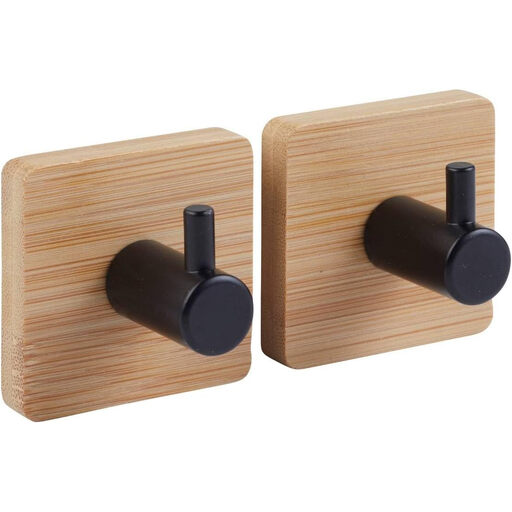
Why this product suits this profile: Bamboo and steel combine an attractive appearance with practical indoor mounting. The two hooks are suitable for areas such as hallways, bathrooms or kitchens.
The product information specifies the materials, quantity, dimensions and indoor use. This makes it easier to check whether the set is right for the intended space.
Bamboo and steel construction, two hooks per set and compact dimensions of 4.5 × 4.5 × 3.6 cm.
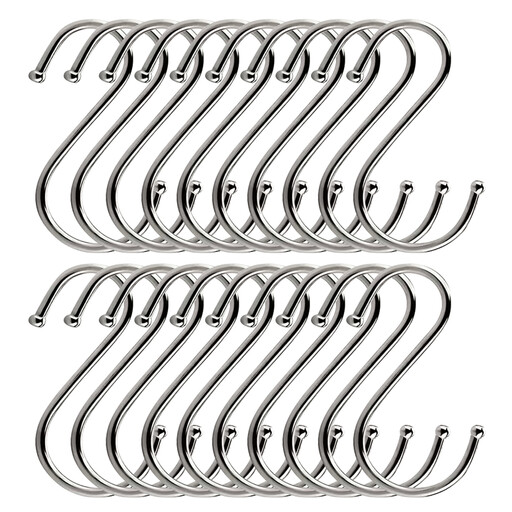
Why this product suits this profile: These S-hooks are designed for rods, rails or edges and can be moved without adhesive or drilling. A set of 20 is suitable for kitchens, bathrooms, wardrobes or gardens.
As no adhesive surface is required, there is no risk of an unsuitable wall surface. The hooks simply hang in place and can be repositioned as needed.
20 metal hooks, 7.5 cm in length and a construction designed for lightweight to medium-weight items, with a rust-resistant surface according to the product information.
We have put together a complete, regularly updated list of products that fully meet these strict selection criteria and the safety regulations applicable in the EU.
When removing hooks designed to come off without leaving residue, the adhesive strip should not be pulled straight outwards. The tab should generally be stretched slowly in the direction in which the strip is designed to be pulled. Keep the hook as still as possible and do not use metal tools. If the tab is damaged, a thin plastic card may help when used carefully. For reusable adhesive hooks, follow the relevant manufacturer’s instructions: some systems require new strips, while others can be used again with suitable replacement strips.
It is not possible to give a fixed lifespan that applies in every case. It depends on the surface, temperature, humidity, load and installation. In bathrooms and kitchens, steam and grease can affect adhesion. Check the hook regularly and remove its load if the adhesive strip starts to come away.
This depends on the type and texture of the wallpaper, as well as the manufacturer’s approval. Smooth, firm surfaces are generally more suitable than delicate or heavily textured wallpaper. With woodchip wallpaper, flaking paint and freshly painted walls, there is an increased risk of reduced adhesion or surface damage.
For smooth, suitable walls, adhesive hooks offer a space-saving solution. Door hooks are more flexible when no adhesive surface is available or when you frequently change your décor. The door thickness must be compatible with the product, and the door must still close easily. For rods and shelving, S-hooks are another drill-free alternative.