
Lieferung heute & morgen

Qualitätsgarantie

Willkommens-Angebote freischalten: KOSTENLOSE Lieferung | Bis zu 80 % RABATT | Kostenlose 30-Tage-JoyPlus-Testphase
App herunterladen
Adhesive hooks without drilling create extra storage space without wall plugs, a drill or visible holes in the wall. This makes them a practical solution for rented homes, small bathrooms, kitchens, hallways and bedrooms. However, self-adhesive hooks can differ considerably in terms of material, installation and load capacity.
Anyone who focuses only on terms such as “strong”, “residue-free” or “for all surfaces” may experience unpleasant surprises later. The actual product specifications and the intended area of use are what really matter.
The description “strong adhesive hooks” alone says very little. A hook for keys or a lightweight towel does not need to support as much as a model intended for bags, kitchen utensils or decorations. A specific maximum load should only be taken into account when it is stated by the supplier. Adhesion also depends on the surface, temperature, humidity and installation.
Self-adhesive hooks generally adhere better to smooth, clean and dry surfaces. Textured plaster, wallpaper, flaking paint, rough walls, grouting or damp surfaces can impair adhesion. “Damage-free hooks” are therefore not automatically suitable for every wall. Before installation, read the manufacturer’s instructions regarding suitable surfaces.
An over-door hook is simply hung over the top edge of a door and does not require an adhesive strip. A self-adhesive wall hook, on the other hand, is stuck directly to the surface. The two options meet different requirements: over-door hooks can usually be repositioned without adhesive, but may affect the door’s movement or rebate. Adhesive hooks require curing time and a suitable surface.
For bathrooms and kitchens, corrosion-resistant materials such as stainless steel are a sensible choice, provided the adhesive strip is suitable for the humidity in those areas. Plastic hooks can be lightweight and versatile, while bamboo elements add a decorative touch. For outdoor use or continuous exposure to moisture, the product specifications should be checked particularly carefully.
One example of a small indoor hook is the 5Five Bamboo Adhesive Hooks Set. The set contains two bamboo and steel hooks, each measuring approximately 4.5 × 4.5 × 3.6 cm. According to the product specifications, it is intended for indoor use and adhesive installation.
With an over-door hook, the door thickness matters. The 5Five HOOK DOOR 5H BLACK NATUREO is designed for standard doors up to 4 cm thick and provides five hooks. Before buying, measure the door leaf, rebate and distance from the wall. If the clearance is too small, the door may be more difficult to close.
With adhesive models, the adhesive area and available space are also important. Hooks should not be installed so close together that bags, towels or cables get in each other’s way.
The maximum load must not be exceeded. The TAILI Adhesive Ceiling Hooks are specified as supporting 2.6 lb per hook, or approximately 1.18 kg. According to the product description, this applies to suitable smooth surfaces and not universally to every wall or ceiling.
For the JORDAN&JUDY No-Drill Strong Adhesive Hooks, 6-Pack, it is recommended that the surface is cleaned and dried beforehand, and that no heavy items are hung for 24 hours after installation. Such installation instructions are relevant to the product’s actual durability.
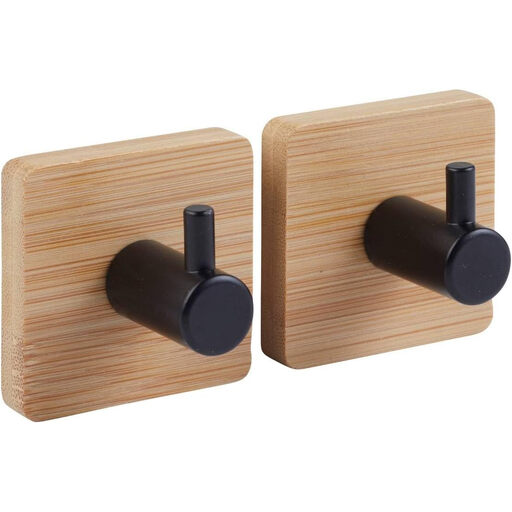
Why this product suits this profile: The compact set is suitable for lightweight everyday items indoors, such as keys, thin cloths or small accessories.
The stated dimensions, quantity and indoor-use specification make it easier to choose than relying on general load-capacity claims.
Two hooks, bamboo and steel construction, plus compact dimensions of approximately 4.5 × 4.5 × 3.6 cm.
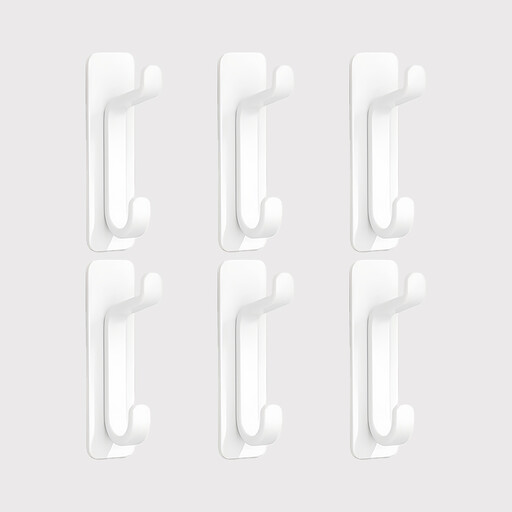
Why this product suits this profile: The six stainless steel hooks with a white finish are suitable for bathrooms, kitchens, bedrooms, hallways and door mounting.
The instructions rule out painted or delicate surfaces and require a dry, clean installation, followed by a 24-hour waiting period.
Stainless steel construction, six hanging points and suitability information for several areas of the home.
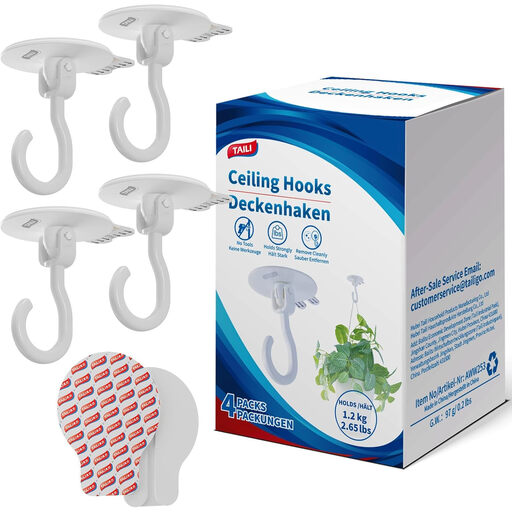
Why this product suits this profile: The swivel ceiling hooks require no drilling and are intended for lightweight plants, fairy lights, towels or decorations on suitable smooth surfaces.
The product specifications identify suitable materials such as glass, tiles and metal, as well as unsuitable rough, cracked or textured surfaces.
Four hooks, a 180-degree swivel function, 360-degree rotation and a stated load capacity of up to 2.6 lb per hook.
For cables, a hook-and-loop cable organiser is often more suitable than a wall hook. The set described contains six rolls, each approximately one metre long, and is intended for bundling and organising cables. For devices that are changed frequently, the reusable hook-and-loop fastening may be more practical.
We have put together a complete, regularly updated list of products that fully meet these strict selection criteria and the safety regulations applicable in the EU.
Their durability depends on the adhesive strip, surface, humidity, temperature and weight. A general time frame is therefore not reliable. Regular visual checks can help you spot loosening adhesive points at an early stage.
This depends on the adhesive strip and the surface. On suitable smooth surfaces, slowly peeling the hook off in accordance with the manufacturer’s instructions can reduce the risk of residue. However, wallpaper, delicate paint or damaged surfaces still carry a higher risk.
Stainless steel or plastic models may be designed for use in bathrooms. However, the information on humidity, surface and load capacity remains crucial. The surface must be dry before installation; wet tile grout or permanently damp areas are generally unsuitable for adhesive fixings.