
Lieferung heute & morgen

Qualitätsgarantie

Willkommens-Angebote freischalten: KOSTENLOSE Lieferung | Bis zu 80 % RABATT | Kostenlose 30-Tage-JoyPlus-Testphase
App herunterladen
Choosing the right adhesive can be a challenge. Whether for a quick household repair, a demanding DIY project, or delicate craftwork, the hardware store shelf is filled with tubes, cartridges, and bottles, all promising different properties. The wrong choice often leads to frustration and unsatisfactory results.
This guide serves as a helpful resource. We introduce various types of adhesives and explain which properties are crucial for which application. Our goal is to provide you with a factual foundation so you can find the most suitable glue for your specific project.
Before you make a decision, three key aspects should be considered. These will help you narrow down the options and identify the right product for your needs.
Not every glue adheres equally well to every material. The most important question is: What exactly needs to be glued? A universal craft glue is well-suited for paper, cardboard, and light fabrics. For more demanding bonds, such as an adhesive for metal and plastic, specialised products are required. Pay close attention to the manufacturer's specifications on material compatibility. Porous surfaces like wood or ceramic often require a different adhesive than smooth, non-porous materials like glass or metal.
Does the bond need to set quickly or be extremely durable? A super glue (cyanoacrylate adhesive), as the name suggests, cures within seconds and is ideal for small, precise repairs. For joints that must withstand high mechanical stress, vibrations, or temperature fluctuations, a heavy-duty adhesive like a 2-part adhesive (epoxy resin) is often the better choice. Although it takes longer to cure, it forms an extremely strong and permanent bond.
The type of application determines the ideal consistency and application method of the adhesive. For large-surface bonding or filling gaps, a hot glue gun is suitable, as the adhesive can be applied quickly and compensates for unevenness. For precise work on small components or on vertical surfaces, a gel-based glue is advantageous because it doesn't drip or run. Such a repair adhesive allows for a clean and controlled application.
Based on different use cases, we have compiled a selection of products that cover a variety of requirements.
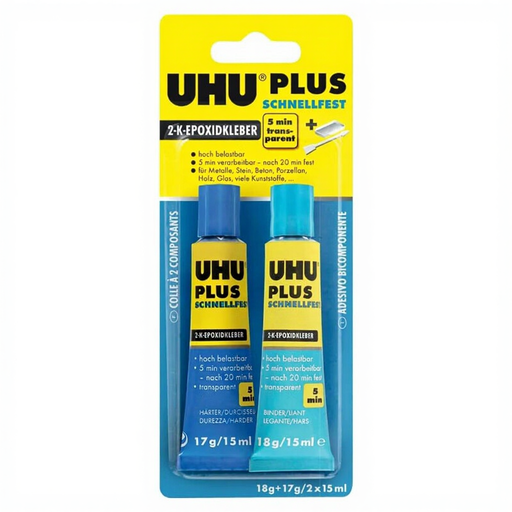
Why it stands out The UHU Plus Schnellfest 2-Component Adhesive is an epoxy resin adhesive designed for fast and resilient repairs. After mixing the two components, it cures into a transparent, extremely strong bond, making it particularly suitable for inconspicuous repairs.
Advantages
Who is it for? This adhesive is an excellent choice for DIY enthusiasts and model builders who need a durable, high-strength solution for repairing metal, ceramic, porcelain, glass, and many plastics. It is a classic repair adhesive for demanding tasks.

Why it stands out The Tilswall Cordless Hot Glue Gun offers maximum flexibility with its cordless operation. With a rapid pre-heat time of just 30 seconds and a well-designed safety concept, it is a practical tool for creative projects and quick repairs around the house.
Advantages
Who is it for? Ideal for crafters, DIY enthusiasts, and anyone who needs a versatile tool for decorations, small assemblies, or repairs on wood, fabric, and plastic. Its independence from the power grid makes it especially convenient.
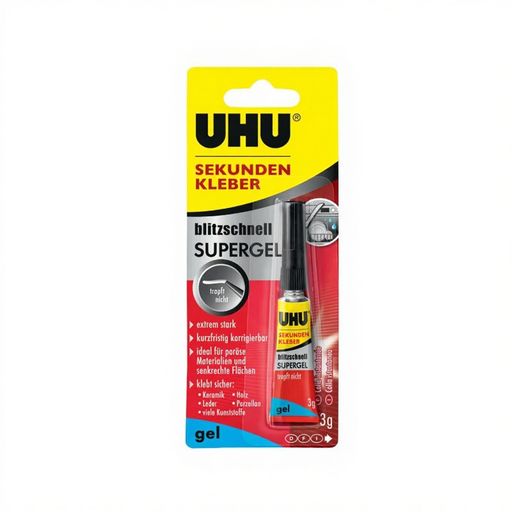
Why it stands out The UHU Super Glue Gel solves a common problem with liquid super glues: dripping. Its gel formula allows for precise application even on vertical surfaces without running. The formula is also shock-resistant, making the bond more resilient.
Advantages
Who is it for? This product is perfect for model making, repairing broken ceramics or jewellery, and all applications where maximum precision is key. It is the ideal super glue for tricky micro-repairs.
The products featured cover a broad spectrum, but there are many other adhesives available for special creative work. Whether for textiles, scrapbooking, or other artistic techniques, the right choice is crucial for success.
Discover our entire range of craft glues and find the perfect solution for your next creative endeavour.
A super glue (cyanoacrylate) cures extremely quickly by reacting with air moisture and is suitable for small, precise bonding points. A 2-part adhesive (usually epoxy resin) consists of a resin and a hardener that must be mixed before application. It cures more slowly but forms a structurally very strong, gap-filling, and often more resilient bond that can withstand greater loads.
The method depends on the type of adhesive and the surface. Water-soluble glues (e.g., wood glue, many craft glues) can often be removed with a damp cloth. For super glue, acetone or a special adhesive remover can help, provided the surface can tolerate it. Cured 2-part adhesive can usually only be removed mechanically (e.g., by sanding). Always test cleaning agents on an inconspicuous area first.
A hot glue gun is very versatile for materials like wood, cardboard, fabrics, ceramics, and some plastics. However, it is unsuitable for heat-sensitive materials such as thin films or styrofoam, as the hot glue can damage them. Likewise, the adhesion on very smooth, non-porous surfaces like glass or metal is often not permanent.