
Lieferung heute & morgen

Qualitätsgarantie

Willkommens-Angebote freischalten: KOSTENLOSE Lieferung | Bis zu 80 % RABATT | Kostenlose 30-Tage-JoyPlus-Testphase
App herunterladen
A height-adjustable basketball hoop in your own garden or driveway is an excellent way for the whole family to get active and have fun. But the sheer number of options can be overwhelming. Many models overpromise and underdeliver. Before you make a decision, it's crucial to understand the common weaknesses that often only become apparent after the purchase, spoiling the fun.
As your Joybuy Product Recommendation Officer, I have analysed the key features that separate a durable basketball stand from a short-lived one. This guide focuses on the facts to help you make an informed choice.
When choosing a basketball hoop for home use, there are three common problems that can lead to disappointment:
outdoor basketball hoop is exposed to the elements. Inadequately coated metal parts quickly begin to rust, and backboards made from low-quality plastic can become brittle and crack due to UV radiation and temperature fluctuations.To avoid these pitfalls, you should carefully examine three core technical parameters. These are the primary determinants of your basketball system's safety, durability, and functionality.
The base is the foundation of any portable basketball system. Its main job is to ensure a secure footing.
kids' basketball hoop, a fill weight of around 66 lbs (approx. 30 kg) is often sufficient. For teens and adults who play more powerfully, models with a capacity of 154 lbs (70 kg) or more are recommended.portable basketball system should be movable despite its heavy weight. Look for integrated wheels. These allow you to easily move the basketball stand to change the playing location in your basketball hoop for the garden or to store it indoors during bad weather.Height adjustability is the key feature that makes the hoop usable for different age groups and heights.
The quality of the materials determines the hoop's lifespan and how it plays.
outdoor basketball hoop. The coating provides effective protection against rust and corrosion.Here are some models that, based on objective features, are well-suited for specific user groups.

Why This Fits Their Persona: This model is specifically tailored to the needs of children aged 4 to 10. The rim height grows with your child, promoting long-lasting fun without them quickly outgrowing the equipment.
The base can be filled with up to 68 lbs (31 kg) of water or sand, providing solid stability for this age group and minimising the risk of tipping. The simple 6-position adjustment mechanism is robust and less prone to defects.
Adjustment Range: approx. 6 ft - 7 ft (182 cm - 213 cm) (6 levels). Material: Powder-coated metal frame and weatherproof PVC backboard. Integrated wheels for easy portability.

Why This Fits Their Persona: For players who take their at-home training seriously. This system allows for play at a height of up to 10.1 ft (3.08 m), which is very close to the official competition height and creates a realistic training experience.
The large base can be filled with up to 198 lbs (90 kg), ensuring high stability even during powerful shots. The powder-coated frame and HDPE backboard are designed for long-term outdoor durability.
Adjustment Range: 7.6 ft – 10.1 ft (233 cm – 308 cm) (6 levels). Backboard: 44-inch (approx. 112 cm) wide HDPE board. Stability: Very high fill weight of up to 198 lbs (90 kg) possible.
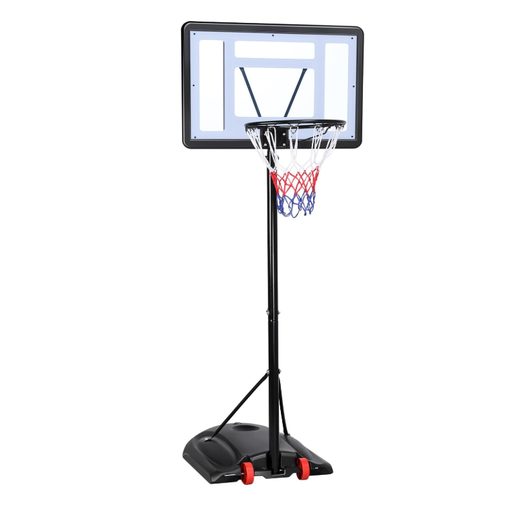
Why This Fits Their Persona: A versatile solution for families or groups with players of different ages and heights. The wide adjustment range covers the needs of both teens and adults for casual games.
This model avoids the trap of having too limited a use case. Instead of being suitable for just one age group, it offers flexible use for many years. The powder-coated metal construction is built to withstand the elements.
Adjustment Range (Rim Height): 5.6 ft - 7.56 ft (170.5 cm - 230.5 cm). Material: PVC and PE backboard for durability. Practical: Includes a ball holder on the base and wheels for transport.
We have compiled a complete, up-to-date list of products that fully meet these strict selection criteria and German safety regulations.
Sand is the better choice for maximum stability, as it has a higher density than water. For the same volume, sand makes the base heavier and more stable. However, water is easier to fill and drain. If you leave the hoop outside in winter, water in the base can freeze, expand, and damage the plastic. In this case, sand is the clear winner, or you would need to add antifreeze to the water.
Weather resistance largely depends on the materials used. Models with a powder-coated steel frame and a backboard made of PE, HDPE, or PVC are designed for year-round outdoor use. Nevertheless, you can extend its lifespan by storing the hoop in a protected area, like a garage, during extreme weather conditions (storms, hail, heavy frost). The net is a wearable part and will need to be replaced occasionally, depending on use and weather exposure.
No, most portable basketball systems for home use are not designed for dunking or hanging on the rim. Their construction is engineered for shooting baskets. The additional weight and sudden force from a dunk can overload the structure, lead to damage to the backboard or frame, and pose a significant tipping hazard. Always follow the specific warnings provided by the manufacturer.