
Lieferung heute & morgen

Qualitätsgarantie

Willkommens-Angebote freischalten: KOSTENLOSE Lieferung | Bis zu 80 % RABATT | Kostenlose 30-Tage-JoyPlus-Testphase
App herunterladen
Adjustable children’s inline skates can be a practical solution when children grow quickly and the skates are intended to cover several shoe sizes. However, the “adjustable size” description alone is not enough when choosing a pair. The actual adjustment range, fit, construction and features such as wheels, bearings and brakes are what really matter.
Parents often come across three typical buying challenges:
On adjustable inline skates, the front section is usually moved using a push button. Depending on the model, several positions may be available. It is important that the smallest setting already provides sufficient support and that the largest setting accommodates the expected growth of the child’s feet.
The models listed here cover different ranges:
The specifications vary between product ranges. That is why you should not search only for “inline skates size 27-43”, but also check the exact model variant. The stated lengths in millimetres, such as 170–194 mm or 252–273 mm, can also help.
When trying on the skates, the foot should sit straight inside the boot with thin to medium-weight sports socks. The toes should not be pressed against the front continuously. At the same time, the heel should move upwards as little as possible when bending the knee. The adjustment mechanism should only be operated after loosening the fastenings, and then securely locked in place.
A stable frame supports power transfer and can give beginners a more controlled skating experience. The selection includes models with a stable plastic frame, high-strength plastic shell or aluminium frame.
A plastic frame can be sufficient for recreational skating and learning the basics. On some models, an aluminium frame is structurally stiffer and designed to provide a robust connection between the boot and wheels. However, this does not automatically mean that one model is more suitable for every child. Body weight, how often the skates will be used and the preferred skating surface also play a role.
The fastenings include a secure buckle and, depending on the model, additional hook-and-loop straps. Several fastening points can make it easier to achieve a good fit. Before every session, check the buckle, hook-and-loop strap and frame fixings.
Several models use eight PU wheels with a hardness rating of 82A. PU wheels are a common feature on children’s inline skates intended for recreational use. The hardness rating describes the hardness of the material, not the overall quality of the skates. Wheel size and the condition of the skating surface also affect how the skates perform.
Some children’s inline skates with ABEC-5 bearings use carbon steel bearings. The ABEC rating refers to the bearing’s manufacturing tolerances and is not a complete measure of speed, noise levels or durability. Other variants are fitted with PVC wheels and 608Z bearings and are intended for straightforward recreational use.
A brake is useful for many beginners. The selected models are supplied with a wear-resistant brake pad. The brake pad must be checked regularly for wear and replaced when necessary. A brake does not replace learning controlled braking movements, nor does it replace a helmet and other protective equipment.
The following recommendations categorise the models according to clear, relevant features. The product details are based on the respective manufacturers’ information.

Why this product suits the profile: The XS variant is designed for a stated range of EU 27–30, making it suitable for younger children taking their first steps with children’s inline skates.
The specific adjustment range of 153–177 mm makes it easier to compare the skates with the measured foot length. The buckle, hook-and-loop straps and brake pad are listed in the product specifications.
Four adjustment positions, PVC wheels, 608Z bearings and a supplied brake for recreational skating.
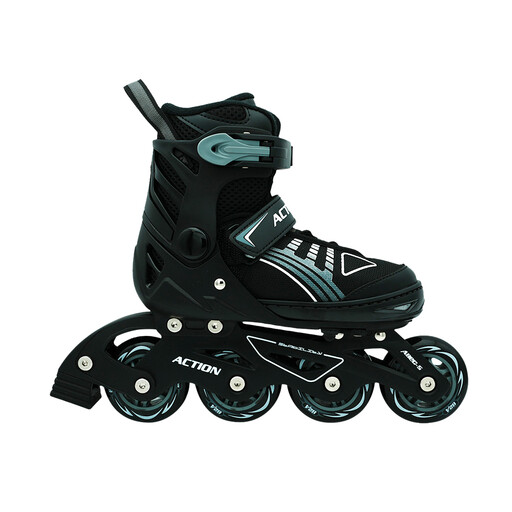
Why this product suits the profile: The aluminium frame is aimed at buyers who value a structurally stable frame solution in children’s inline skates. According to the specifications, size M covers EU 35–38.
The product description clearly specifies the frame, wheels, bearings and fastenings. This makes it easier to compare the features with the intended use before buying.
Aluminium frame, 82A PU wheels, ABEC-5 bearings, buckle, hook-and-loop straps and brake pad.
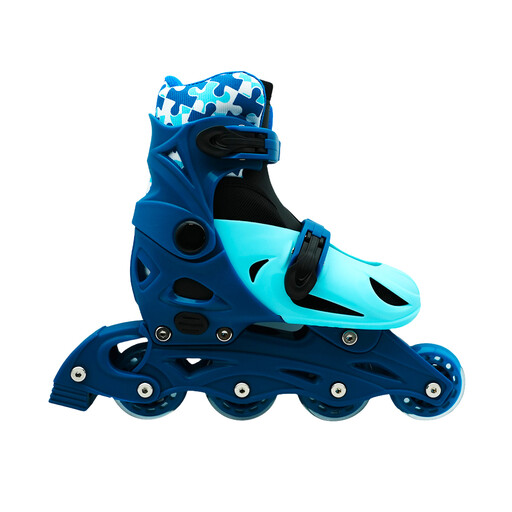
Why this product suits the profile: The M variant is specified for EU 37–40 and combines a high-strength plastic shell with a padded inner boot for regular recreational skating.
The shell and plastic frame are clearly specified. After skating in wet conditions, the wheels and bearings can also be dried, while the fixings should be checked regularly.
Four-way adjustable, eight 82A PU wheels, ABEC-5 carbon steel bearings and a wear-resistant brake pad.
We have put together a complete, regularly updated list of products that fully meet these strict selection criteria and the safety regulations applicable in the EU.
For beginners, a helmet, wrist guards, elbow pads and knee pads should be part of the essential equipment. Skating should take place on smooth, dry surfaces away from traffic. Water, uneven ground and obstacles increase the risk of falling.
After use:
First, undo the buckle and, where applicable, the hook-and-loop strap. Then press the adjustment button and pull the front section out to the correct position. Close all the fastenings and check that the heel and ankle are held securely. The skates should not be adjusted so far that the foot slips inside the boot.
Their service life depends on how often they are used, the skating surface, body weight, care and wear to the wheels and brake pad. The adjustment mechanism can cover several shoe sizes, but it does not replace checking the wheels, bearings, fastenings and frame fixings.
No. They are technical features, but they are not essential requirements for getting started. A good fit, controllable wheel size, working fastenings and a functioning brake are at least as important when choosing a pair.