
Lieferung heute & morgen

Qualitätsgarantie

Willkommens-Angebote freischalten: KOSTENLOSE Lieferung | Bis zu 80 % RABATT | Kostenlose 30-Tage-JoyPlus-Testphase
App herunterladen
An adjustable microwave stand can make use of unused space above the worktop and create room for crockery, spices or other kitchen appliances. For small flats, single-person households and families, however, a microwave stand is only practical if its dimensions, load capacity and stability are suitable for the existing kitchen.
Many disappointing purchases are not caused by the basic concept of the stand, but by unclear product information and unsuitable designs.
The term ‘extendable’ often refers only to a specific adjustment range. Before buying, you should measure the width, depth and height of the microwave, as well as the available space on the worktop. A stand designed for widths of 39 to 62 cm cannot be adjusted to any width smaller or larger than this.
You should also check whether the surface is level and whether doors, cables or ventilation openings on the microwave could be blocked by the kitchen stand.
A multi-tier kitchen stand can create additional space. However, insufficient clearance between the shelves can make it difficult to store tall food containers, rice cookers or toasters. The key considerations are therefore not just the number of tiers, but also the adjustable height and the actual clear height between the shelves.
For a microwave stand with hooks, you should also consider the side clearance. Hooks are useful for cooking utensils or mugs, but must not extend into the microwave’s operating area.
A stated maximum load capacity generally applies under specific conditions. It may assume that the weight is distributed evenly and that the stand is placed on a level surface. Heavy appliances should always be placed on a lower tier.
You should also pay attention to the construction of the joints, the feet and any non-slip pads. A maximum load capacity of up to 36 kg, as stated for one of the models listed below, should not be interpreted as meaning that each individual shelf can bear any load.
First, measure:
A space-saving stand with an extendable width is particularly suitable for small kitchens. According to the product details, the three-tier Maxcook model can be adjusted from 39 to 62 cm wide. It is 33 cm deep and 75.6 cm high. You should compare these measurements with your available space before buying.
A metal microwave stand is often made from steel, iron or stainless steel. Carbon steel can provide a sturdy construction, but if its coating is damaged it needs protection from continuous exposure to moisture. Stainless steel is often used because of its corrosion-resistant surface.
Useful features include:
Abrasive cleaners and wire wool can damage protective coatings. If the stand is made from coated carbon steel, the surface should be dried thoroughly after cleaning.
Check whether assembly tools and instructions are included. An adjustable-height stand must be securely locked in place after adjustment. With an extendable kitchen stand, all connecting elements should be firmly secured before placing appliances on it.
Heavy microwaves, food processors or rice cookers should be placed on a tier with sufficient load capacity. Lightweight items such as spice jars, mugs or kitchen utensils can be stored on higher shelves.
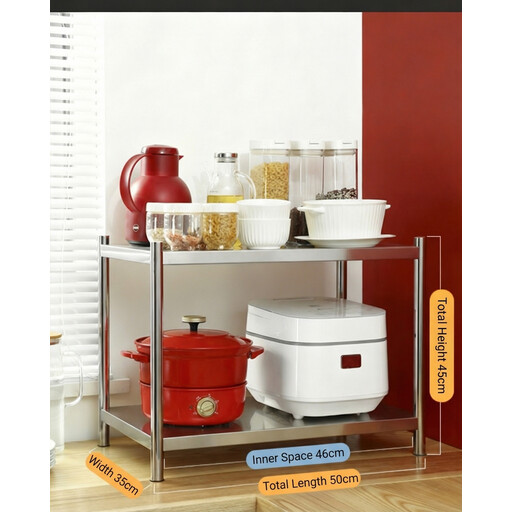
Why this product suits this profile: The two-tier design offers a straightforward solution for households needing extra storage above or beside the microwave.
The more compact design reduces the risk of several low shelves taking up unnecessary space. Dimensions and load capacity should still be checked before buying.
Two tiers and an adjustable-height design for the worktop; suitable for organising kitchen utensils and crockery.
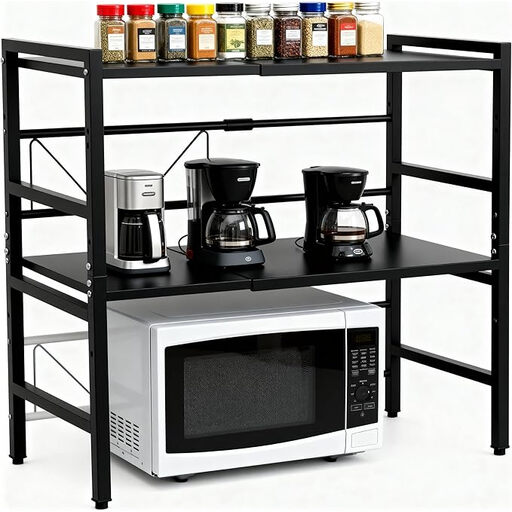
Why this product suits this profile: This three-tier stainless steel model is designed for households wanting to organise their microwave, crockery, spices and kitchen accessories vertically.
The product details specify stainless steel, adjustable shelves and removable hooks. The stated load capacity of up to 36 kg assumes even weight distribution.
Width from 40 to 60 cm, three tiers, hooks and a stated depth of 32.5 cm; according to the description, assembly tools and instructions are included.
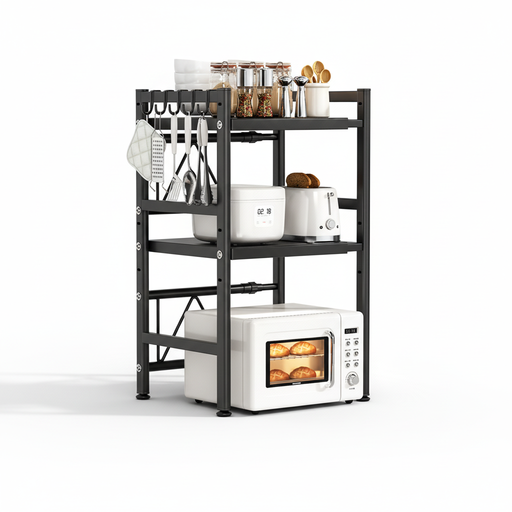
Why this product suits this profile: The three tiers and extendable section are suitable for users with several appliances, such as a microwave, toaster and rice cooker.
The width adjustment from 39 to 62 cm and adjustable shelves allow for a more precise fit. Non-slip feet help keep the stand positioned on a level surface.
Carbon steel with a protective coating, three tiers and five hooks; according to the product description, it is designed for microwaves, toasters, rice cookers and kitchen accessories.

Why this product suits this profile: The two-tier format with adjustable width is suitable for worktops with limited but variable available space.
The adjustment range of 39 to 62 cm makes the fit easier to control than with a fixed frame. The five hooks are removable and can be used on the designated sides.
Two tiers, carbon steel with a grey powder coating, adjustable width from 39 to 62 cm and five hooks; the stated depth is 33 cm.
We have put together a complete, regularly updated list of products that fully meet these strict selection criteria and the safety regulations applicable in the EU.
Place the microwave stand on a level, sturdy worktop. After assembly, check that all screws are tight and that the shelves are level. Appliances must not protrude beyond the shelves.
For everyday use, the following arrangement is recommended:
A stand of this kind does not require its own power connection. Running costs are therefore not limited to operating the stand itself; they arise only from the electrical appliances placed on it.
Stability depends on the material, frame construction, feet, assembly and weight distribution. A wider frame is not automatically more stable. Place the stand on a level surface and distribute heavy items evenly. Do not exceed the maximum load capacity stated in the relevant product description.
No. Width, depth and height vary from one model to another. Measure both the microwave and the available space where it will stand. Take wall-mounted cupboards, sockets, cables and the appliance’s ventilation areas into account.
Cleaning with a soft, damp cloth and a mild cleaning product is generally sufficient. The surface should then be dried. Abrasive cleaners, wire wool and standing water can damage coatings or metal surfaces.