
Lieferung heute & morgen

Qualitätsgarantie

Willkommens-Angebote freischalten: KOSTENLOSE Lieferung | Bis zu 80 % RABATT | Kostenlose 30-Tage-JoyPlus-Testphase
App herunterladen
An adjustable squat rack is often the centerpiece of an effective home gym. It allows you to perform foundational exercises like squats and bench presses safely and with heavy weights. However, the market is flooded with models whose quality differences are not apparent at first glance. Many buyers invest in equipment that quickly proves to be unstable, impractical, or even dangerous. This guide highlights the most common pitfalls and explains which technical features you need to look for to make an informed decision.
Purchasing a squat stand can quickly lead to disappointment if critical details are overlooked. Pay close attention to these three problem areas to avoid a bad investment.
To avoid the problems mentioned above, you should check three core parameters before buying. These define the safety, functionality, and longevity of your equipment.
The specified maximum load capacity, for example up to 250 kg, is an important indicator but must be viewed in context. What's crucial is not just the static load capacity, but also stability under dynamic stress. Pay attention to the material specifications: a frame made of powder-coated steel with a profile thickness of 50 mm x 50 mm or more provides a solid foundation. The powder coating also protects against scratches and corrosion, extending the life of the equipment.
Designing a good adjustable barbell rack requires thoughtful engineering. Check the height adjustment range and the number of levels. A range from approximately 100 cm to 170 cm with 5 cm increments covers most requirements for squats, shoulder presses, and bench presses (in combination with a weight bench). For separate stands, width adjustability is also important to accommodate different barbell lengths.
The safety spotters (spotter arms) are your most important safety net. They should also be multi-adjustable in height to be positioned just below the lowest point of your movement. Additional features like rubberized feet to prevent slipping, locking pins with solid mechanisms, and a stable connection between frame parts are critical for safe training for your home gym.
Based on the criteria above, we have selected products for different user profiles and requirements.

Why This Fits Their Persona: Ideal for users with limited space. The two separate stands can be easily stored away after a workout. The high flexibility in height and width makes them suitable for various exercises and user heights.
The stable H-shaped base of each stand minimizes wobbling. The 6-level adjustable safety spotters provide protection. The 14 height settings in 5 cm increments allow for precise positioning.
High load capacity of up to 250 kg according to the manufacturer. Separate stands for maximum flexibility and space-saving storage.

Why This Fits Their Persona: For users looking for an all-in-one solution. This device combines a pull-up bar and a dip station, making it suitable for a comprehensive bodyweight workout.
Instead of being just a squat stand, this unit provides a wide, stable base for bodyweight exercises, thus avoiding the need to buy multiple separate pieces of equipment that can be unstable and take up space.
Multifunctional design for pull-ups, dips, and other exercises. Height-adjustable to accommodate different users.
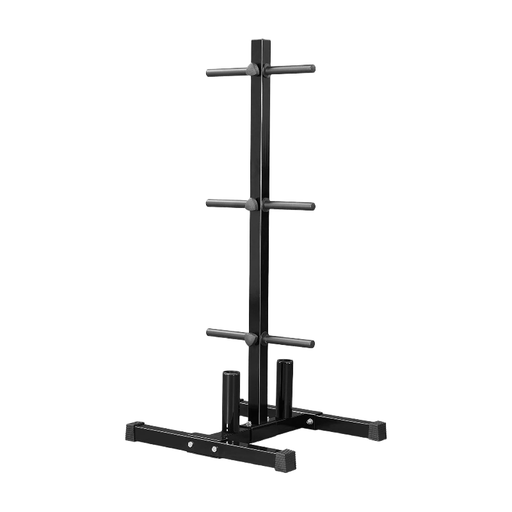
Why This Fits Their Persona: For anyone who has already equipped their home gym with weights and bars and needs a safe, tidy storage solution. Organization is a key part of workout safety.
Prevents the common mistake of a disorganized workout area where loose weight plates become tripping hazards. The vertical storage design maximizes available space.
High load capacity of 400 kg according to the manufacturer. Provides storage for six stacks of weight plates and two barbell bars. Protective caps on the feet prevent floor damage.
We have compiled a complete, up-to-date list of products that fully meet these strict selection criteria and safety standards.
For separate stands, you'll need a clear area of about 1.5 m in width and 2 m in depth to train safely with a standard barbell. Also, consider a ceiling height of at least 2.2 m, especially if you plan to do exercises like standing shoulder presses. Measure your available space accurately before purchasing.
Look for a wide, H-shaped base, a solid steel construction (e.g., 50x50 mm profiles), and a high dead weight of the rack itself—lighter models are often less stable. Check that the locking pins and adjustment knobs secure firmly and that the safety spotters are made from the same robust material as the main frame.
For the vast majority of home users, a maximum load capacity of 250 kg is more than sufficient. Even advanced strength athletes rarely move weights in this range for squats or bench presses. However, a high load capacity rating is also an indicator of a more robust overall construction and provides a reassuring safety margin.