
Lieferung heute & morgen

Qualitätsgarantie

Willkommens-Angebote freischalten: KOSTENLOSE Lieferung | Bis zu 80 % RABATT | Kostenlose 30-Tage-JoyPlus-Testphase
App herunterladen
A physical chessboard, an opponent that executes moves with a real robotic arm, and an artificial intelligence that adapts to your skill level—for many ambitious players, an AI chess robot is the ideal training partner. But the market is filled with devices whose promises often outweigh their actual functionality. Before you make a decision, it's crucial to understand the common pitfalls that can lead to a bad investment.
This guide will help you separate the best from the rest. We focus on the crucial technical features and show you what to look for to find a device that will genuinely improve your game, not just gather dust.
Investing in a high-quality chess computer can be a significant expense. That makes it all the more important to avoid common marketing traps that obscure a device's true value.
electronic chessboard should allow you to seamlessly play chess online, with the robot executing your human opponent's moves on the board.To avoid these mistakes, you should base your choice on objective criteria. The following three parameters are decisive for the performance and long-term value of an AI chess robot.
A chess computer's playing strength is often indicated in ELO points, a rating system also used to classify human players. A wide and finely adjustable ELO range is crucial. Beginners need an AI that makes logical moves at a low level (e.g., ELO 200), while a chess trainer for adults and club players need an opponent that can challenge them up to the grandmaster level (ELO 2500+). Look for a device that offers many different difficulty levels to grow with you as you learn chess with AI.
A high-quality chess computer with piece recognition uses precise sensors to detect the exact position of every piece. This is the foundation for a seamless game. The chessboard with robotic arm should move the pieces quietly, swiftly, and with high accuracy. Technical specifications like a positioning accuracy of under 1 mm and a move speed of just a few seconds are indicators of sophisticated mechanics that deliver an authentic playing experience.
Check the scope of the learning content available at no extra cost. A large, integrated library of exercises, endgame training, and analyses of classic games offers significant added value. Equally important is the ability to connect the device to online platforms. Integration with services like Lichess.org transforms the robot into a physical interface for global online chess, offering unlimited opponent variety.
Based on these criteria, we have identified a few models suited for different needs and playing styles.
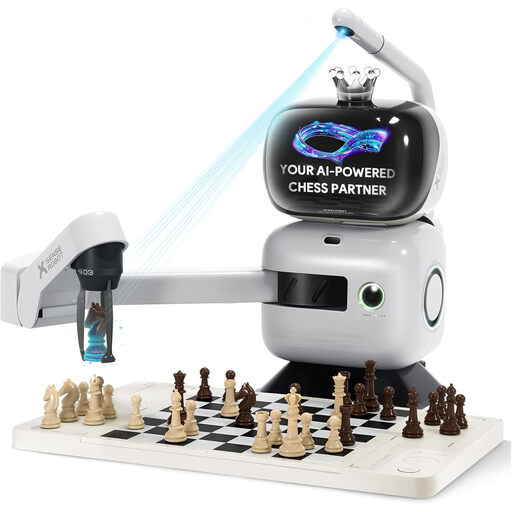
Why This Fits Their Persona: Ideal for players looking for a serious training tool for home use. The wide ELO range and extensive built-in lessons allow for structured, screen-free training.
According to the manufacturer, it offers over 1,200 lessons and training exercises without a subscription. The precise robotic arm and Lichess integration address the pitfalls of inadequate hardware and a lack of online connectivity.
25 AI difficulty levels (ELO 200-3200+). Operates completely screen-free after a one-time setup.
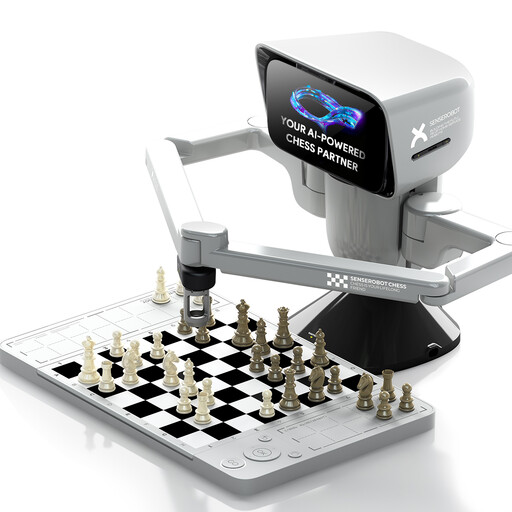
Why This Fits Their Persona: Perfect for players who don't want to give up a physical AI opponent, even on the go. Its compact, all-in-one design with an integrated robotic arm makes it an ideal travel companion.
Functionality is controlled via an accompanying app that offers various AI levels, with no mention of hidden subscriptions. The integrated arm is designed for mobile use.
Compact and portable design. According to the manufacturer, it supports the use of custom 3D-printed pieces.
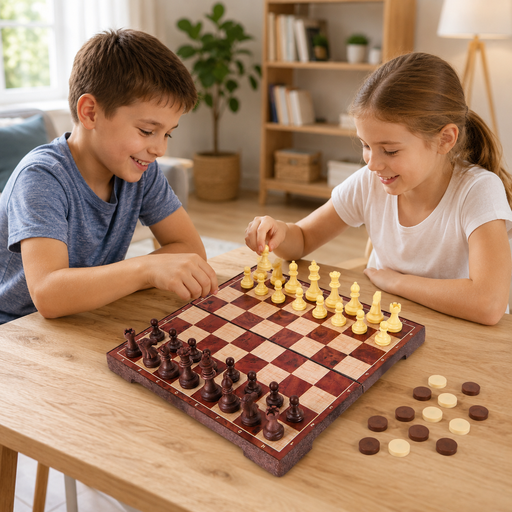
Why This Fits Their Persona: For pure gameplay without any tech components, or for learning the basic rules with a human partner, a classic set is often the most direct and simple path.
It completely avoids technical complexity, potential hardware failures, and recurring costs. What you see is what you get: a board and pieces for playing against a human opponent.
Focus on the essentials. It encourages direct play against friends and family and requires no power source or setup.
If you're interested in board games that promote strategic thinking, we've curated a selection of products that meet strict selection criteria.
Precision varies by model. High-end devices, like the SenseRobot, specify a positioning accuracy of under one millimetre. This ensures that pieces are placed reliably and exactly on their target squares without touching or knocking over adjacent pieces.
Not necessarily. Many modern devices are designed to function completely autonomously after a one-time setup via Wi-Fi or an app. The game itself then takes place entirely screen-free on the physical board, allowing for deeper concentration without digital distractions. Voice prompts can be used to announce moves or provide hints.
The ELO rating is a measure of relative playing strength. A higher ELO value signifies a stronger player. For a chess computer, the ELO range indicates how flexibly the AI can adapt to different skill levels—from a beginner (e.g., ELO 200-800) to a grandmaster (ELO 2500 and up). A wide range is a sign of a versatile and durable training machine.