
Lieferung heute & morgen

Qualitätsgarantie

Willkommens-Angebote freischalten: KOSTENLOSE Lieferung | Bis zu 80 % RABATT | Kostenlose 30-Tage-JoyPlus-Testphase
App herunterladen
An air bed can serve as a space-saving guest bed, a flexible sleeping option at home or a bed for camping. There’s a wide choice, from basic inflatable beds to raised air beds with a built-in pump. But differences in size, weight capacity, pump type and valve can determine whether a model is genuinely right for everyday use.
Before you buy, don’t focus only on claims such as ‘comfortable’ or ‘sturdy’. Specific details are more useful, including dimensions, maximum weight capacity, power supply and construction.
An air bed for two isn’t automatically as wide as a double bed. Models measuring 137 cm wide give two people less room than versions measuring 152 cm. Length matters too: 191 cm may feel a little short for taller people, while 203 cm gives you more room to move.
So always check:
An air bed with a built-in pump is convenient, but it needs a suitable power supply. An electric air bed with a 220–240-volt pump is suitable for use with a household socket, but not necessarily for a campsite without mains electricity.
USB pumps can be powered, for example, by a suitable mains adaptor or power bank. Check the required current and compatibility. A USB port for charging a device doesn’t automatically mean you can use it to power the pump.
A raised air bed measuring 33 to 46 cm high is easier to get in and out of. However, it takes up more storage space and may occupy more room in a tent or small guest room. A lower model, at around 25 cm high, is usually more compact to store and transport.
A soft, flocked surface can make the sleeping area more comfortable, but it’s no substitute for a fitted sheet. It can make the surface feel more pleasant, but it won’t protect the PVC from sharp objects. When using an air bed outdoors, you’ll still need a clean, level surface beneath it.
An air bed for one person is often around 76 to 99 cm wide. Common widths for two people are 137 or 152 cm. The weight capacity should allow for more than just body weight, as there may be additional loads. Some models have a stated capacity of 136 or 272 kg.
Never exceed the manufacturer’s stated maximum weight capacity. Children shouldn’t jump or play on an air bed, as this can put strain on the seams and internal structure.
Many Intex air beds are made with an outer layer of PVC or vinyl. In Dura-Beam and Fiber-Tech air bed models, polyester fibres inside the bed form its supporting structure. This tells you how the bed is made, but doesn’t replace checking its weight capacity, dimensions and care instructions.
Also look for:
A model with a built-in 220–240-volt pump is best suited to indoor use. USB pumps offer more flexibility, but need a suitable power source. An air bed with a hand pump may be a good choice for camping if there’s no mains electricity.
The stated inflation time is a guide. How firm the bed feels depends on the power supply, the ambient temperature and your personal preference. Overinflating it can put unnecessary strain on the seams and material.
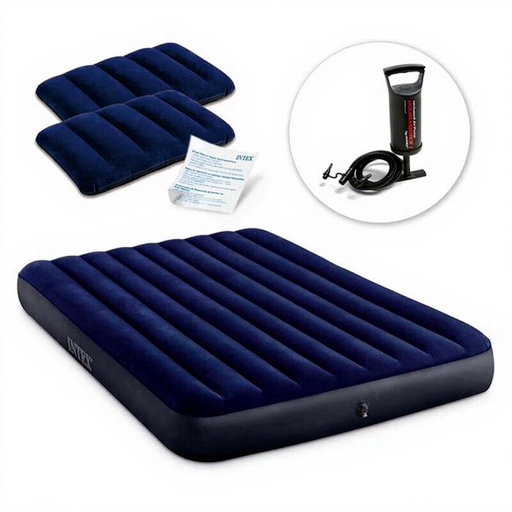
Why it’s a good fit: This two-person model has a 152 × 203 cm sleeping area and comes with a hand pump and two inflatable pillows. It’s suitable for guest rooms, festivals or occasional camping trips.
The dimensions, maximum weight capacity of 272 kg and separate pump type are all clearly stated. This makes it easier to work out how much space you’ll need before buying.
2-in-1 valve, Fiber-Tech construction, flocked top, plus a hand pump and two pillows included.
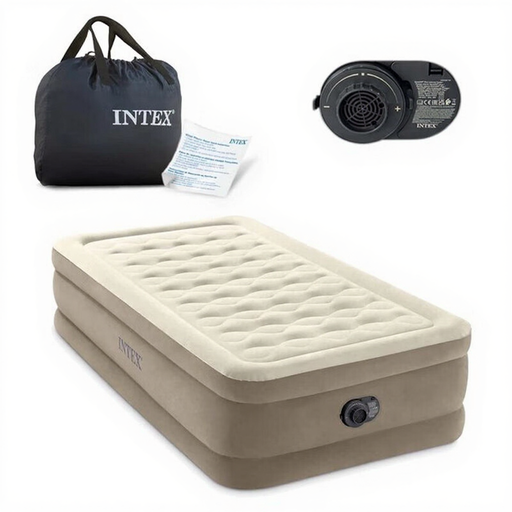
Why it’s a good fit: This raised, single air bed, at 46 cm high, is designed for guest rooms or temporary indoor sleeping arrangements.
Its 46 cm height and built-in 220–240-volt pump are clearly stated, so you can see that it’s better suited to rooms with a mains socket than to camping without electricity.
46 cm high, Fiber-Tech construction, flocked surface, built-in electric pump and carry bag.
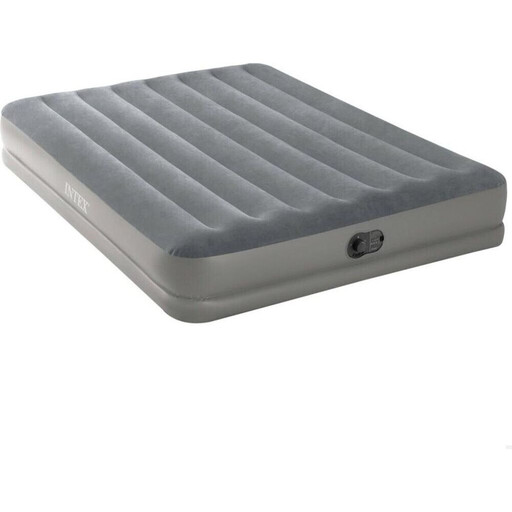
Why it’s a good fit: This two-person air bed with a USB pump is a useful option for households and people on the move who want an electric inflation solution without needing a fixed socket beside the bed.
The USB pump isn’t assumed to work with any power source. You’ll need a compatible USB port or a suitable power bank to operate it.
203 × 152 × 30 cm, built-in USB pump, Fiber-Tech construction and flocked sleeping surface.
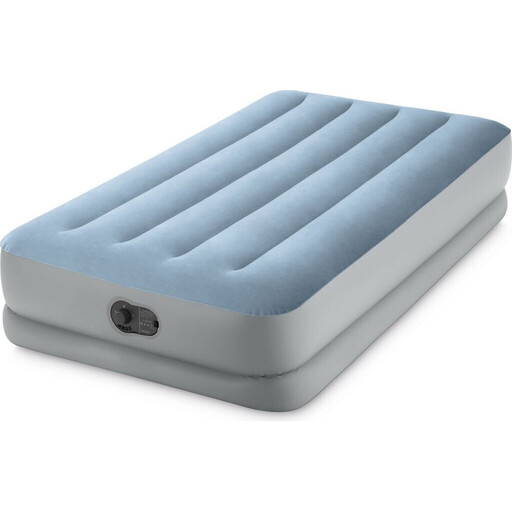
Why it’s a good fit: Its 36 cm height, compact single-bed width and USB pump make it suitable for overnight guests or flexible sleeping arrangements in smaller rooms.
With a maximum weight capacity of 136 kg and a clearly specified USB pump, the key limits for use and power supply are easy to understand.
36 cm high, 191 × 99 cm sleeping area, USB pump, Fiber-Tech construction and carry bag.
Only use an inflatable guest bed on a clean, level surface. In a tent, remove stones, twigs and other sharp objects first. Keep the bed away from naked flames, heaters and intense direct heat. After use, make sure the air bed is completely dry before folding it away.
The material may stretch slightly the first time you use the bed. If the sleeping surface feels softer, you can top it up with air in line with the instructions. Check the air bed for visible damage before each use, and never exceed the stated weight limit.
We’ve put together a complete, regularly updated list of products that meet these strict selection criteria and the safety regulations in force in the EU.
Its lifespan depends on the material, how often you use it, the surface it’s placed on, how it’s stored and the weight it supports. There’s no reliable one-size-fits-all estimate. Storing it somewhere clean and dry, and keeping it away from sharp objects, reduces the risk of damage.
Air beds are generally designed for temporary sleeping arrangements. If you plan to use one as a permanent bed, follow the manufacturer’s guidance and check the valves, seams and surface regularly. For frequent use, an appropriate weight capacity and sturdy internal construction are especially important.
The cost depends on the pump’s power, how long it takes to inflate the bed and your electricity tariff. With a 220–240-volt model, the pump is usually only running for a few minutes each time you set it up. With a USB pump, running costs come from the mains adaptor or power bank you use. So the specific model’s power consumption matters more than simply whether it’s described as ‘electric’.