
Lieferung heute & morgen

Qualitätsgarantie

Willkommens-Angebote freischalten: KOSTENLOSE Lieferung | Bis zu 80 % RABATT | Kostenlose 30-Tage-JoyPlus-Testphase
App herunterladen
By Joybuy Product Recommendation Officer, July 09, 2026
A warm summer day can quickly become uncomfortable when the air in your home is stagnant. Many people reach for a conventional fan, but this often just swirls the warm air around without truly cooling the room. The feeling of stuffiness persists, especially in larger or awkwardly shaped rooms. An air circulator offers a different approach: instead of just creating a direct stream of air, it's designed to set the entire volume of air in a room into motion.
This article serves as an objective guide. We'll explain how air circulators work, highlight the key features to consider before making a purchase, and present a selection of models that meet different needs.
Choosing the right device depends on your individual needs and the specifics of your space. The following points will help you make an informed decision.
A standard fan oscillates, meaning it pivots from side to side, creating a direct breeze. An air circulator, often called a turbo fan, works differently. It produces a focused, vortex-like beam of air that is directed towards a wall or the ceiling. The airflow then bounces off that surface, putting all the air in the room into a gentle, continuous circulation.
The result is a balanced room temperature without unpleasant drafts. This method is particularly effective for using a fan for a whole room and evening out temperature differences, such as between the floor and the ceiling. Some models offer a 360-degree fan function, which enables even more comprehensive air distribution.
No one wants to be disturbed by a loud fan while sleeping or working. A quiet fan for the bedroom should have a noise level below 40 decibels (dB) on its lowest setting. Models that operate at around 30 dB are barely audible and ideal for noise-sensitive environments.
Additional features significantly enhance user convenience. A desk fan with a remote control allows you to adjust settings comfortably from your sofa or bed. An integrated fan with a timer is also practical, as you can program the device to turn on or off automatically after a set period.
A modern room fan is more than just a summer gadget. In winter, it can redistribute the warm air rising from the heating system back down, ensuring more even heat distribution. In summer, it supports your air conditioner by circulating the cooled air more quickly throughout the room. Through this increase in efficiency, an energy-saving fan can help reduce the run times of heating and cooling systems, thereby lowering energy costs.
Based on the criteria above, we have compiled a selection of devices suitable for various applications.
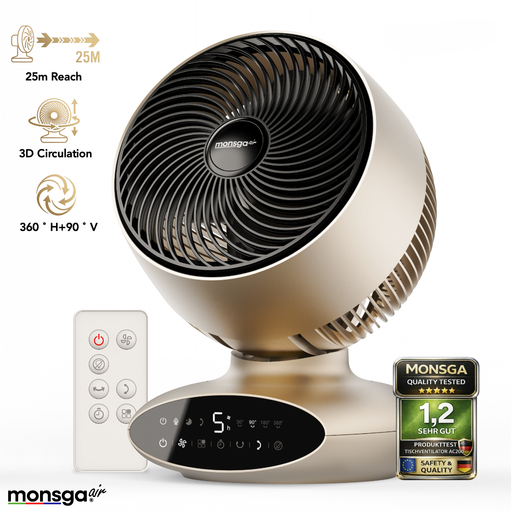
Why it stands out: The monsga AC200 is a prime example of a modern air circulator. It combines high airflow with intelligent oscillation. According to the manufacturer, the Monsga FountainLoop technology generates an airflow that reaches over 25 meters. Its standout feature is the 3D oscillation: the device not only pivots horizontally (up to 360 degrees) but also vertically by 90 degrees. This effectively circulates the air throughout the entire room.
Pros:
Who is it for? This model is aimed at users seeking a powerful and quiet solution for year-round air circulation in medium to large rooms. It is particularly well-suited for tech-savvy users who value convenience features like a remote control and timer.
While an air circulator conditions an entire room, sometimes you just need targeted, mobile cooling. For your desk, workbench, or on the go, compact personal fans are an excellent choice.
Product Spotlight 1: DM-68 CT72 Neck Fan
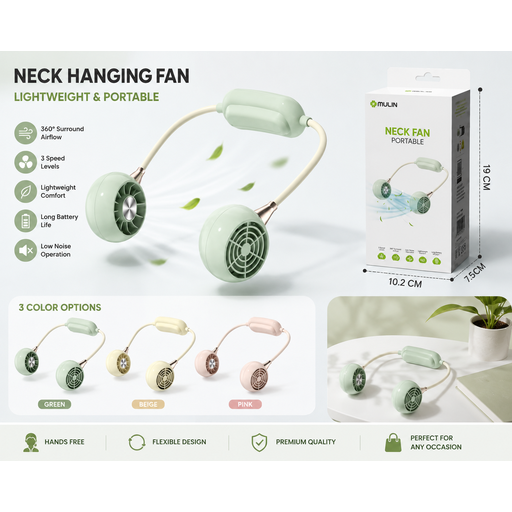
Why it stands out: This neck fan provides hands-free cooling on the go. Its lightweight design and flexible neckband ensure comfort, while the two fan heads direct a targeted stream of air to your face and neck.
Pros:
Who is it for? Ideal for individuals who need a mobile and personal cooling solution for on-the-go use or during activities where they need to keep their hands free.
Product Spotlight 2: Aigostar 6F3B Clip-On Fan
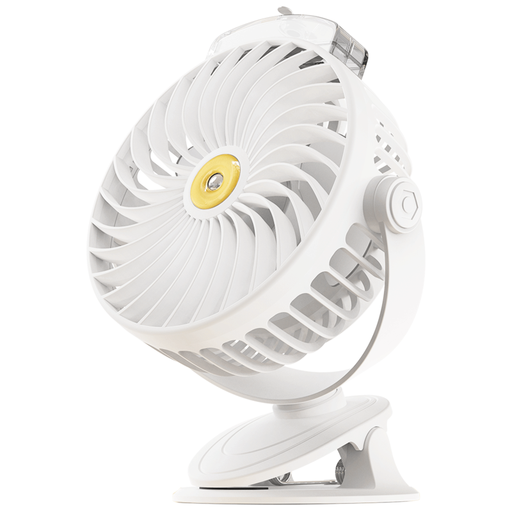
Why it stands out: This model's strength lies in its versatility. It can be placed on a surface using its stable base or attached to desks, shelves, or bed frames with its robust clamp. An additional misting function provides extra refreshment on dry days.
Pros:
Who is it for? A great choice for personal use at a workstation, bedside table, or in a home gym. The misting function is a useful extra for dry indoor air.
The fan market is diverse, offering the right device for every need. The battery-powered category, in particular, features a wide selection of flexible and mobile solutions. If the products presented here don't quite match what you're looking for, or if you'd like to compare more alternatives, it's worth taking a look at our expanded assortment.
Discover our wide selection of rechargeable fans and find the perfect model for your needs.
A conventional fan creates a direct airflow that produces a cooling breeze on the skin but does not change the room's temperature. An air circulator, on the other hand, is designed to set all the air in the room—both the cool air near the floor and the warm air near the ceiling—into motion. This results in a uniform room temperature and a more pleasant climate without drafts.
For an undisturbed night's sleep, a quiet fan for the bedroom should have a noise level below 40 dB on its lowest setting. Models that achieve levels around 30 dB or lower are considered especially quiet and are well-suited for noise-sensitive individuals.
Yes. An energy-saving fan like an air circulator can improve the efficiency of your heating or air conditioning system. In winter, it distributes the warm air that collects near the ceiling evenly throughout the room. In summer, it assists the air conditioner by circulating the cooled air more quickly. As a result, the main units can run for shorter periods, which can lead to a reduction in energy costs.