
Lieferung heute & morgen

Qualitätsgarantie

Willkommens-Angebote freischalten: KOSTENLOSE Lieferung | Bis zu 80 % RABATT | Kostenlose 30-Tage-JoyPlus-Testphase
App herunterladen
Rising summer temperatures often make life in apartments and houses without air conditioning a challenge. Heat tends to build up, especially in attic apartments or poorly ventilated rooms, disrupting sleep and overall well-being. While a conventional fan only provides spot cooling, an air circulator offers a more comprehensive solution. It distributes air throughout the entire room, ensuring a more even and pleasant indoor climate.
This guide will help you understand how air circulators work and identify the key criteria for making an informed purchasing decision. We will present a selection of models with different features to simplify your search for the perfect device to meet your needs.
Before you decide on a model, several technical specifications and convenience features should be considered. These determine how well the device will fit into your daily life and living situation.
No one wants their sleep disturbed by loud noises. The operating noise level, measured in decibels (dB), is therefore a critical criterion, especially if you are looking for a quiet fan for the bedroom. Models with a noise level below 40 dB on the lowest setting are considered very quiet. Some devices also offer special sleep modes that further reduce the fan speed and, consequently, the noise level to ensure an undisturbed night's rest.
Modern air circulators offer a range of features that significantly enhance comfort. A fan with a remote control and timer allows you to adjust settings conveniently from your sofa or bed and program the device to turn off automatically after a preset time.
Another important feature is oscillation, the swivelling motion of the device. While basic models only oscillate horizontally, advanced units enable 360-degree oscillation as well as a vertical tilt. This 3D oscillation distributes the airflow throughout the entire room—from ceiling to floor—ensuring effective and even air circulation.
Given rising electricity prices, energy consumption is a relevant factor. An energy-saving fan not only helps your wallet but also the environment. Models with brushless direct current (DC) motors are often the better choice. Compared to conventional alternating current (AC) motors, they consume significantly less power for the same output and are also often more durable and quieter in operation.
Based on the criteria mentioned, we have compiled a selection of devices that cover different requirements—from compact table fans to powerful room circulators.
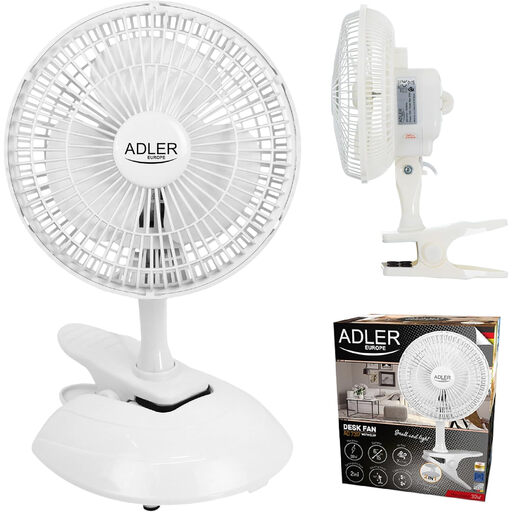
Why it stands out: The ADLER AD 7317 is a classic and functional small table fan that is compact. Its special feature is its versatile design: it can either be placed on its sturdy base or attached to a tabletop, shelf, or bed frame with the integrated clip.
Advantages:
Who is it for? This model is ideal for users looking for a straightforward and affordable solution for direct use at a workstation, on a nightstand, or in small rooms.
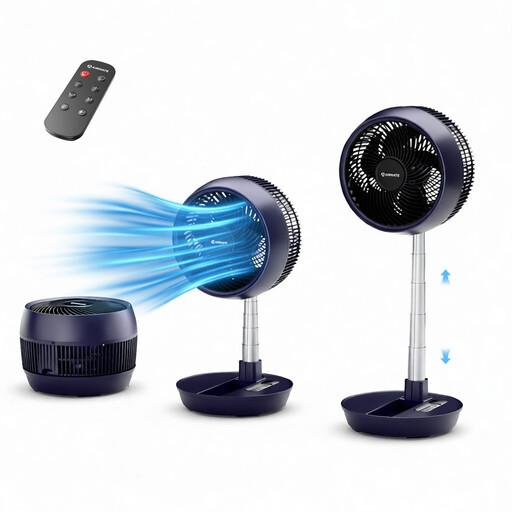
Why it stands out: The AIRMATE Air Circulator combines functionality with a thoughtful design. It is foldable and height-adjustable, making it especially space-saving for storage. Its brushless DC motor ensures energy-efficient and quiet operation.
Advantages:
Who is it for? This model is aimed at users who value energy efficiency, quiet operation, and smart features. Its foldable design also makes it an excellent choice for apartments with limited storage space.
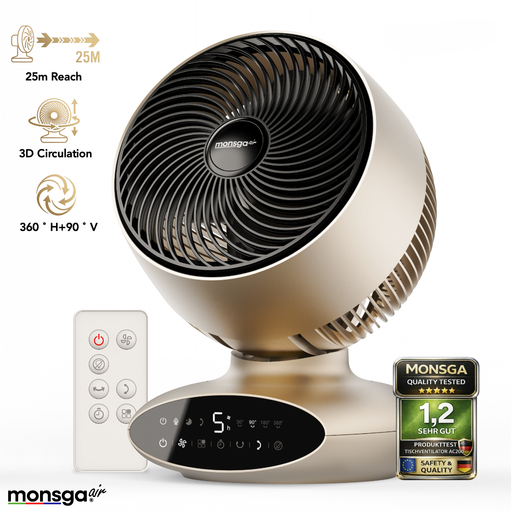
Why it stands out: The monsga AC200 is a powerful air circulator designed for maximum room coverage. Its standout feature is its dual oscillation, which combines a horizontal swivel of up to 360° with a vertical tilt of 90°.
Advantages:
Who is it for? The monsga AC200 is the right choice for tech-savvy users and individuals with larger living spaces who want effective and even air circulation throughout the entire room.
If the models presented don't exactly meet your requirements, or if you'd like to compare other variants like a pedestal fan or different designs, you can find a wider selection in our category. Discover more models and find the right portable cooling fan for your home.
A conventional fan creates a directional airflow that you feel directly on your skin, providing a cooling effect through evaporation. An air circulator, on the other hand, is designed to set the entire air mass in a room into motion. It creates a concentrated, vortex-like air stream that uses walls and ceilings to circulate the air. This leads to a more even temperature distribution and prevents stagnant pockets of warm or cold air.
Power consumption depends heavily on the model and its motor technology. An energy-saving fan with a modern DC motor often consumes only between 2 and 10 watts on its lowest setting and about 24 to 30 watts on its highest. Older models with AC motors can consume significantly more.
An air circulator does not actively lower the room temperature like an air conditioner. However, it significantly improves the perceived cooling effect by keeping the air in motion, which enhances the body's natural cooling process through sweat evaporation. By circulating the air, it also helps to break up pockets of hot air trapped near the ceiling and distribute cooler air from the floor, leading to a noticeably more comfortable indoor climate. Models with wide 360-degree oscillation are particularly effective for this purpose.