Desk users who are sensitive to sleep disruption and noise
You use the same room for work and sleep, and want to consider air movement, noise and controls at night.


If you want to direct air beyond your desk and into other parts of the bedroom, a compact air circulator with horizontal and vertical adjustment could be a good option. For a focused breeze at your desk, a conventional desk fan may be enough. Compare the space it takes up, how it works and the noise figures for the speed you’ll actually use. A fan moves air, but it won’t lower the room temperature.
You use the same room for work and sleep, and want to consider air movement, noise and controls at night.
You want to feel the airflow not just at your desk, but in other parts of the bedroom too.
You need to make sure the space it takes up and its sweep fit around your screen, papers and the position of your bed.
A good fit if: You want to direct air from your desk to other parts of the bedroom too.
Bear in mind: Size and features vary by model. Before buying the Rowenta QV2540F1, check the model documentation to confirm the timer details.
A good fit if: A focused breeze at your desk is all you need and you don’t require multidirectional airflow.
Bear in mind: The body of the fan and its sweep need to fit on your desk. A noise figure for the lowest setting doesn’t necessarily tell you how loud other settings will be by your bed.
The ZVEI lists noise levels and power consumption among the key considerations when choosing a fan. Also think about whether you want it to move air around your immediate workspace or further afield.
| What matters to you | What to check before buying | Who is this important to? |
|---|---|---|
| Minimal disturbance | Check the noise figure and the setting it applies to, the adjustable speeds and whether you can operate the fan without unwanted lights. | If I also use the room at night, I want the airflow to disturb me as little as possible while I work and sleep. Around 29% of consumers prioritise minimal disturbance when using a room for both purposes. |
| Air circulation around the room | Check the horizontal and vertical adjustment, whether it’s manual or automatic, and the usable settings on the specific model. | If I want to direct air to another part of the bedroom too, airflow aimed only at my seat may not be enough. Around 29% of consumers prioritise airflow beyond the desk. |
| Desk space | Check the overall dimensions, whether there’s a stable surface to place it on, the cable route and the clearance needed for its sweep. | When there’s little free desk space, the fan and its sweep need to fit alongside my screen and papers. Around 24% of consumers prioritise its footprint and positioning on the desk. |
| Energy use | Consider the power consumption of the specific model alongside how many hours you plan to use it each day. | If I run the fan regularly, I want to keep its power consumption and running time in mind. Around 18% of consumers prioritise energy use when they plan to use a fan for longer periods. |
A fan can make your skin feel cooler, but it doesn’t remove heat from the bedroom.
In hot weather, combine air movement with shading and ventilation when the air outside is cooler. The Verbraucherzentrale recommends, among other things, opening windows between the evening and early morning, provided it’s cooler outdoors.
A noise figure for the quietest setting won’t tell you how loud the stronger setting you need will be by your bed.
Check which operating setting each noise figure applies to, and whether the airflow at that setting is right for your space.
The Rowenta model pages give conflicting information about the timer on the QV2540F1 and the automatic oscillation on the VU2740F0.
If either feature is important to your choice, check the exact model number and the documentation supplied with the product.
The MeacoFan 1056 is described as a desk or floor fan that circulates air horizontally and vertically.
The Turbo Swift Compact QV2540F1 is a compact desk fan with multidirectional oscillation, while the VU2740F0 is a larger desk fan alternative.
The Philips CX1030/01 desk fan is an option if a desk fan with rotation and tilt is all you need.
These product options range from a focused airflow at your desk to circulating air beyond your immediate seating area.
 No image available
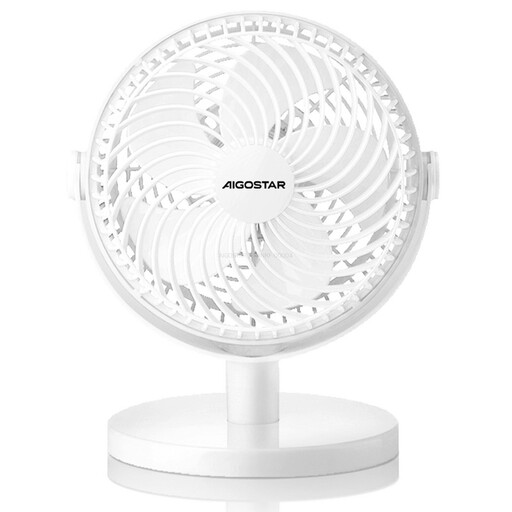
For a focused breeze at your desk. The product details describe it as suitable for personal use in rooms up to around 1 m².
Two speeds and a head that adjusts through 360°; dimensions: 200 × 170 × 225 mm.
There’s no claim that it circulates air across a larger area.
 No image available
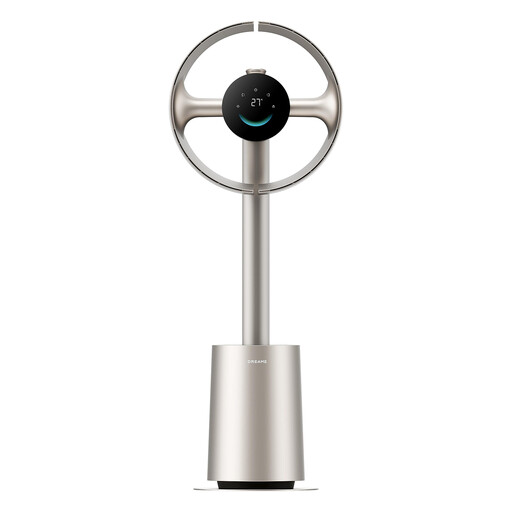
For circulating air beyond your immediate seating area. The product description lists 180° horizontal oscillation and 90° vertical oscillation.
It also lists ten speed settings, a night mode and power consumption of 55 W.
The stated coverage of up to 40 m² is a product specification. Check that the fan suits your preferred positioning and the space available.
 No image available
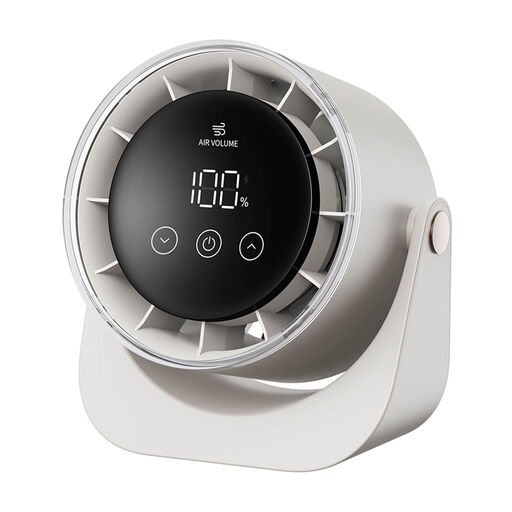
For directing airflow at your desk. The product description says the head tilts through 90°.
The product details list a built-in battery and 100 speed settings.
 No image available
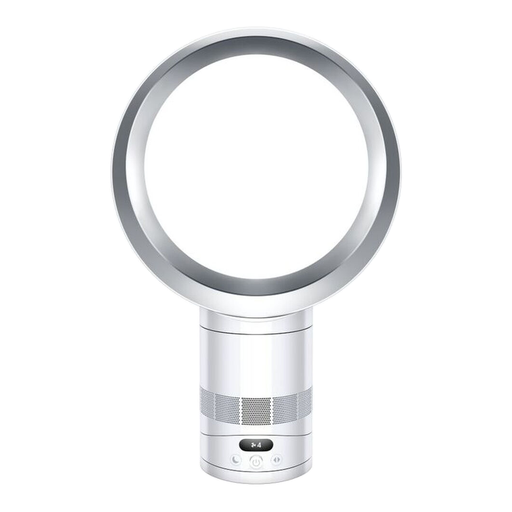
For airflow you can direct from your desk. The product description lists manual tilt and 70° oscillation.
It has a sleep mode with a dimmed display. Noise levels are listed as 29 dB in sleep mode and a maximum of 42 dBA. These figures apply to different operating conditions.
 No image available
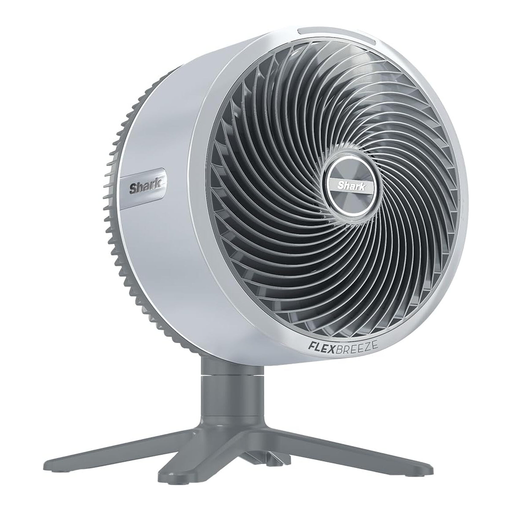
For airflow you can direct at your desk and beyond your immediate seating area.
The product description lists battery or mains operation, five speeds, 180° side-to-side oscillation and 55° tilt.
No. The Umweltbundesamt distinguishes between the cooling effect you feel when air moves and a reduction in room temperature. To lower the room temperature, use suitable shading and ventilate when the air outside is cooler.
Check which operating setting the dB(A) figure applies to. A figure for the lowest setting doesn’t automatically tell you how loud a higher setting might be if you need it at your desk.
Multiply the power consumption in watts divided by 1,000 by the number of hours the fan is running. This gives you the energy used in kWh. If available, use the power consumption figure for the setting you actually plan to use.
Place it on a stable, level surface and keep the air inlets clear. The MeacoFan 1056 instructions highlight these points; for other models, follow the instructions supplied with the product.
According to Your Europe, CE marking is required only for products covered by relevant harmonised EU rules that require it. The Bundesnetzagentur lists labelling, manufacturer details, and German-language instructions and warnings among the points to check.