
Lieferung heute & morgen

Qualitätsgarantie

Willkommens-Angebote freischalten: KOSTENLOSE Lieferung | Bis zu 80 % RABATT | Kostenlose 30-Tage-JoyPlus-Testphase
App herunterladen
Reliable on-the-go cooling isn't a luxury—it's a necessity, whether you're camping, on a long-haul truck journey, or on a family outing. A compressor cooler promises consistent temperatures, even down to freezing, regardless of the ambient temperature. But the market is flooded with models making grandiose promises. Before you make a decision, it's crucial to understand the common pitfalls that can lead to a purchase you'll regret.
As your Joybuy Product Recommendation Officer, I'll help you correctly interpret technical specs and make an informed choice. We'll focus on the facts that truly matter.
Many buyers are swayed by marketing buzzwords, only to find later that their device fails to meet expectations. Pay close attention to these three points:
To avoid a bad investment, you should focus on the technical fundamentals. These three criteria determine the real-world usability and durability of your cooler.
A modern 12V/230V electric cooler offers maximum flexibility. You can power the unit via the cigarette lighter socket in a car (12V), a truck (24V), or a standard wall outlet (100-240V). However, for mobile use, power consumption is key. Look for these features:
The volume of a cooler should match your use case. For a day trip, 15-25 litres is sufficient, while for a family vacation in a campervan or for professional drivers, 40 litres or more makes sense. More important than the litre count is the layout:
A portable cooler must withstand the rigours of the road.
Based on the objective criteria above, we have identified several models that represent a smart choice for specific user groups.
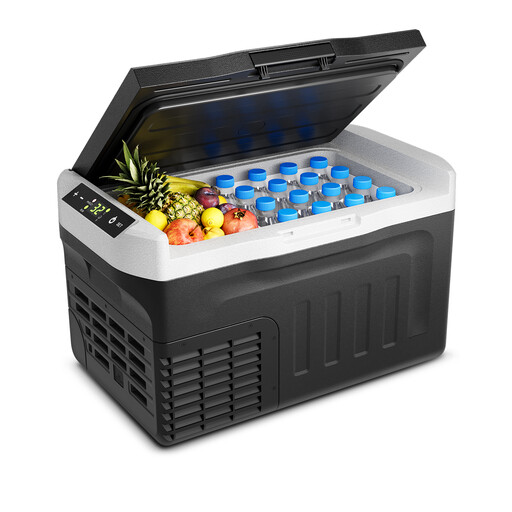
Why This Fits Their Persona: Ideal for users seeking a compact yet powerful solution for their car or for short camping trips. Its light weight and app control offer modern convenience without excess bulk.
Features a three-stage battery protection system (L/M/H) that reliably prevents deep discharge of the vehicle battery. The thick insulation layer ensures stable cooling performance that isn't just on paper.
Bluetooth app control for remote monitoring and adjustment. Low operating noise of just 42 dB according to the manufacturer, and an efficient ECO mode.
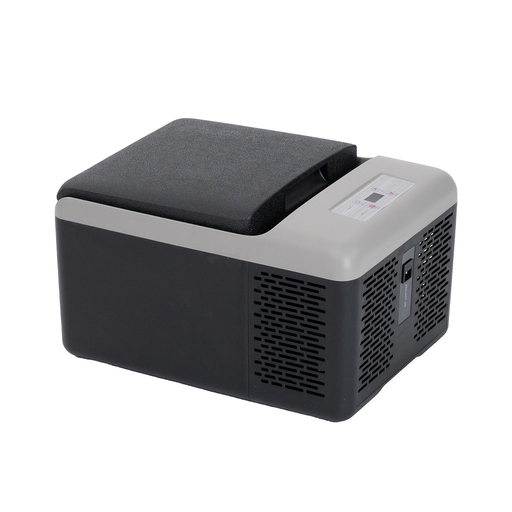
Why This Fits Their Persona: Perfect for longer tours, serving as a proper camping fridge. The dual-zone function provides the flexibility needed for self-sufficiently storing both fresh and frozen foods.
Addresses the impractical volume issue with two independently controlled compartments. This maximises the utility of the 36-litre space by enabling true simultaneous cooling and freezing.
True dual-zone control (-20°C to 20°C in both compartments). Three-stage battery protection and a USB port for charging devices.
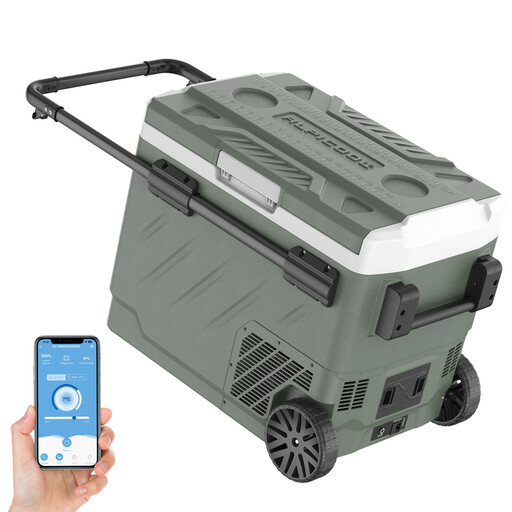
Why This Fits Their Persona: With 49 litres, it offers a large storage capacity for week-long supplies on the road. The sturdy wheels and retractable handle make this large car freezer box manageable even outside the vehicle.
Combines a large, highly usable volume with thoughtful details like a reversible door and an integrated cutting board. This goes beyond mere litre specifications and focuses on real-world practicality.
Large 49-litre capacity with dual-zone technology. Heavy-duty wheels and a retractable handle for high mobility. App control and interior LED lighting.
We have compiled a complete, up-to-date list of products that fully meet these strict selection criteria and safety regulations.
Yes, this is highly recommended. Similar to a household refrigerator, a compressor cooler should stand upright for at least 6 to 12 hours after transport before being switched on. This allows the oil that may have circulated in the cooling system during transit to settle back into the compressor. Ignoring this step can lead to inadequate cooling performance or even damage to the compressor.
The runtime depends on several factors: the car battery's capacity (in Ah), the set temperature, the ambient temperature, the quality of the insulation, and how often the cooler is opened. A typical 40-litre cooler in ECO mode at an internal temperature of 5°C consumes an average of 1-2 Ah per hour. On a healthy 60 Ah car battery, it could theoretically run for 20-30 hours before the battery protection (set to a medium level) shuts it off to preserve enough power to start the engine.
The main difference lies in the cooling technology. Thermoelectric coolers (using Peltier elements) can only lower the internal temperature by a certain amount below the ambient temperature (e.g., 15-20°C below). On a hot day with 35°C inside the car, they will only reach about 15°C. A compressor cooler works like a real refrigerator. It can reach and maintain its target temperature (e.g., 4°C or -18°C) regardless of the outside temperature. This makes it significantly more powerful and energy-efficient, establishing it as the right choice for anyone needing reliable cooling and freezing performance.