
Lieferung heute & morgen

Qualitätsgarantie

Willkommens-Angebote freischalten: KOSTENLOSE Lieferung | Bis zu 80 % RABATT | Kostenlose 30-Tage-JoyPlus-Testphase
App herunterladen
An air fryer can prepare chips, vegetables, poultry, baked goods and reheated food with little or no additional oil. However, to ensure the appliance remains genuinely practical in a British household, you should consider more than just wattage and the number of programmes. Capacity, footprint, cleaning and straightforward operation are all key factors.
The manufacturer's capacity usually describes the volume of the basket. However, the basket should not be filled completely if the hot air is to circulate evenly. A 7-litre model may therefore take up more space, while the usable area is limited by the shape of the basket. Families should also consider whether one large basket or two separate cooking chambers would better suit their daily routine.
An air fryer with automatic programmes makes it easier to get started. However, the preset values are only guidelines. The quantity, thickness, starting temperature and desired level of browning all affect the cooking time. Appliances with manual temperature and time settings offer greater control, while simple rotary controls may appeal to users who prefer uncomplicated operation.
An air fryer with a viewing window lets you check your food without opening the drawer. However, this does not automatically eliminate the need to shake or turn the food. When it comes to the coating, buyers should follow the care instructions: metal utensils, harsh cleaners and abrasive sponges can damage the surface. A dishwasher-safe frying basket reduces cleaning effort, but the manufacturer's specifications for the maximum temperature and the basket's position in the dishwasher remain decisive.
As a general guide:
When choosing an air fryer for families, you should also consider the basket shape. A tall, narrow basket may save worktop space, while a wide basket can be advantageous for flat foods such as potato wedges.
Measure the width, depth and height before buying. The appliance needs sufficient clearance all around for air intake and exhaust air. It should not be positioned directly beneath a wall cupboard or next to easily flammable materials. In the UK, connection to a suitable, earthed socket with 220 to 240 volts is standard. Multi-socket extensions and unsuitable extension leads can be problematic with high-powered appliances.
Depending on the model, a useful temperature range may be, for example, between 60 and 200 °C or 40 and 230 °C. A timer with automatic shut-off makes the appliance more convenient to use. For low-fat frying, only a small amount of oil is usually needed on the food; “oil-free cooking” should therefore not be assumed to produce identical results to a traditional deep fryer.
You should also check:
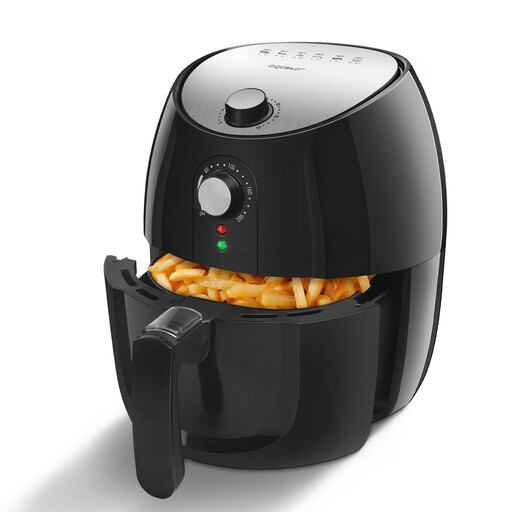
Why this product suits this profile: This model combines a 3.5-litre capacity with mechanical temperature and time controls. It is straightforward to use and suits anyone who would rather do without touchscreen extras.
The straightforward feature set avoids unnecessary programme selection. The removable basket and non-stick coating make cleaning easier.
1500 watts, 80–200 °C and a timer of up to 30 minutes; the appliance is designed for simple individual dishes.
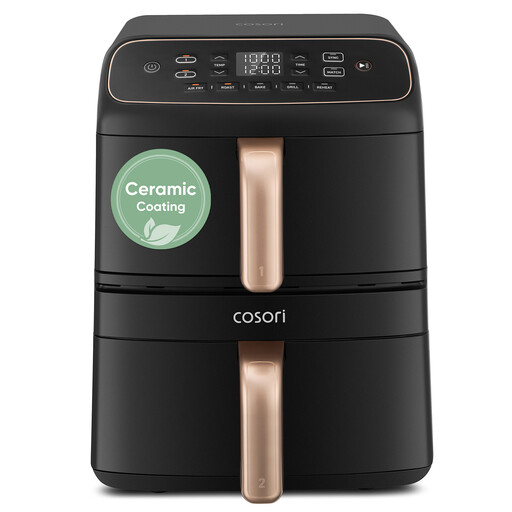
Why this product suits this profile: Two baskets arranged one above the other provide a total capacity of 8.6 litres, while the vertical design takes up less worktop space than double-basket appliances positioned side by side.
The separate baskets mean that different ingredients do not have to be cooked together in one chamber. According to the product specifications, both baskets are dishwasher-safe.
PFAS-free ceramic coating, two DC motors and five functions: Air Fry, Roast, Grill, Bake and Reheat.
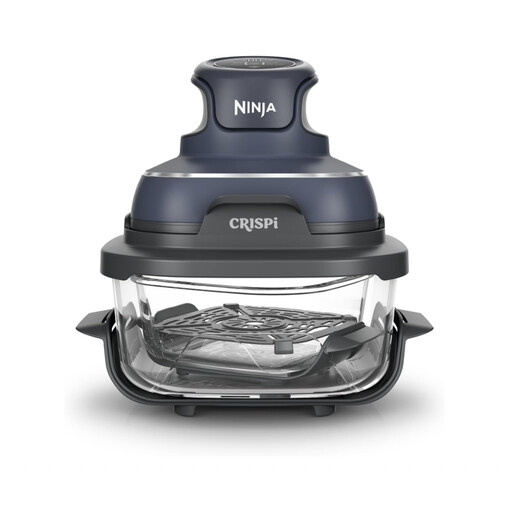
Why this product suits this profile: Two borosilicate glass containers with capacities of 1.4 and 3.8 litres accommodate both small and larger quantities. The glass containers are transparent and, according to the product specifications, dishwasher-safe.
The different containers prevent unnecessarily large cooking volumes when preparing small portions. The transparent material makes it easier to monitor the food.
Four functions: Air Fry, Roast, Keep Warm and Re-crisp; 1700 watts and two containers for flexible quantities.
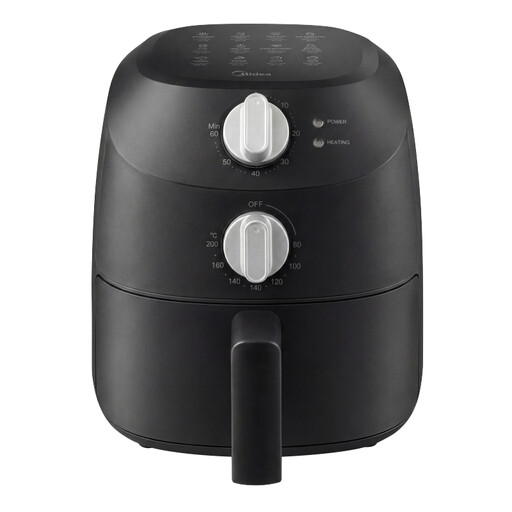
Why this product suits this profile: The 2-litre format is designed for individual portions and small kitchens. At 1150 watts, this appliance remains compact and easy to accommodate in everyday use.
The small chamber prevents you from using unnecessary energy and worktop space for a single portion. Removable parts make cleaning easier.
2-litre capacity, 60-minute timer and dishwasher-safe parts according to the product specifications.
We have put together a complete, regularly updated list of products that fully meet these strict selection criteria and the safety regulations applicable in the EU.
Before using the appliance for the first time, clean the removable parts according to the instructions. The housing must not be immersed in water. After use, allow the appliance to cool down completely before cleaning the basket or rack. Hot air and steam may escape when the drawer is opened, so use the handle and keep a safe distance.
Energy consumption depends on the power rating, operating time, preheating and how fully the appliance is loaded. A small air fryer is not automatically cheaper if several batches are needed. For a fair comparison, compare the total time required with cooking in the oven. Manufacturer claims about energy or time savings should be treated as product-specific information rather than a general guarantee.
As well as the appliance dimensions, you should allow additional clearance for air intake and exhaust air. The exact distances are given in the instruction manual. A vertical double-basket model may be more practical than two baskets positioned side by side when worktop space is limited, but it will require more height.
Its lifespan depends on how often it is used, cleaning, the coating and the availability of replacement parts. Overfilling, scratches caused by metal utensils and blocked ventilation openings can affect its usability. A two-year warranty is listed for several of the models mentioned; the relevant sales and warranty terms and conditions apply.
There is no universal answer. For small portions, the shorter preheating and cooking time can be beneficial. For larger quantities, an oven may be used more efficiently. To calculate your own costs, multiply the power rating in kilowatts by the operating time in hours and your electricity price.