
Lieferung heute & morgen

Qualitätsgarantie

Willkommens-Angebote freischalten: KOSTENLOSE Lieferung | Bis zu 80 % RABATT | Kostenlose 30-Tage-JoyPlus-Testphase
App herunterladen
An air fryer can prepare fries, vegetables, fish, meat and baked goods with little oil. However, not every appliance suits every household. A small basket can quickly become a bottleneck for families, while a large model may take up unnecessary space in a single-person kitchen.
As a Joybuy Product Recommendation Officer, I filter the most important product specifications and explain what buyers in Germany should consider before ordering. The focus is not on blanket promises, but on transparent criteria such as capacity, power, controls and cleaning.
A specification such as “5 litres” does not automatically indicate how much food can be prepared in practice. Food should not be packed too tightly, so that hot air can circulate properly. An overfilled basket can result in unevenly cooked dishes.
As a general guide:
An XXL air fryer, however, requires more counter space and may be harder to store, depending on its design.
An air fryer with multiple programmes may appear versatile at first glance. What matters, however, is whether the temperature and cooking time can be adjusted manually. Preset menus are only guidelines, as the quantity, size and starting temperature of the food can vary.
Appliances with a temperature range of around 80 to 200°C and a timer of up to 60 minutes are practical. A lower temperature range can be useful for delicate foods or keeping dishes warm. The number of programmes should therefore not be the sole selection criterion.
With a dishwasher-safe air fryer, the term generally refers to the basket, rack or drawer—not the appliance as a whole. The housing, heating element and electronics must not be immersed in water.
Before buying, it is worth checking:
Coated baskets should not be cleaned with metal utensils or abrasive sponges.
A 5-litre air fryer may be sufficient for two to three people. Families should check whether the basket can actually accommodate an appropriate quantity or whether several batches will be necessary. A 6.5-litre air fryer offers more room, although its footprint should also be compatible with the available counter space.
With dual-chamber models, the total capacity is divided between two baskets. This makes it easier to prepare different dishes simultaneously, but it does not necessarily mean that one large dish will fit inside.
The wattage affects, among other things, how quickly the appliance heats up and how consistently it maintains its temperature during operation. The range includes models rated at 1,250 to 2,800 watts, for example. Higher power consumption can be useful with large cooking chambers, but it may also increase electricity usage per hour of operation.
More important than wattage alone are:
An air fryer with a touch display generally provides digital time and temperature controls. Rotary dials, on the other hand, can offer pleasantly straightforward operation. A viewing window with interior lighting allows you to monitor the food without removing the basket. This can be particularly useful for delicate baked goods or short cooking times.
The term “low-fat air fryer” describes a cooking method that often uses little or no additional oil. It is not a general claim about nutrition or the effects of any particular dish.
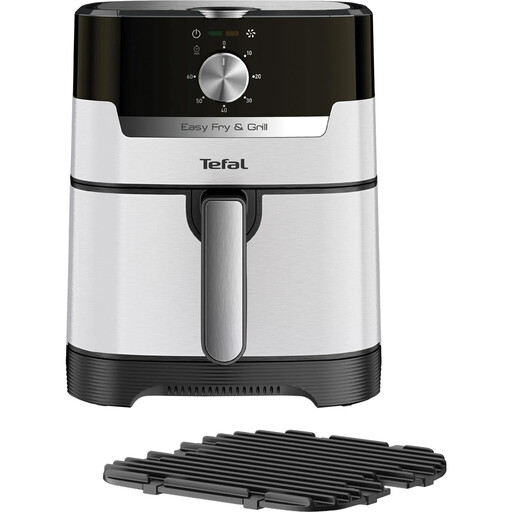
Why it is a good fit: This 4.2-litre model combines air frying and grilling, making it suitable for couples or smaller families.
The medium capacity is clearly specified, while temperature and time can be adjusted using rotary dials.
4.2 litres, 1,550 watts, 80–200°C, 60-minute timer and removable dishwasher-safe parts according to the product specifications.
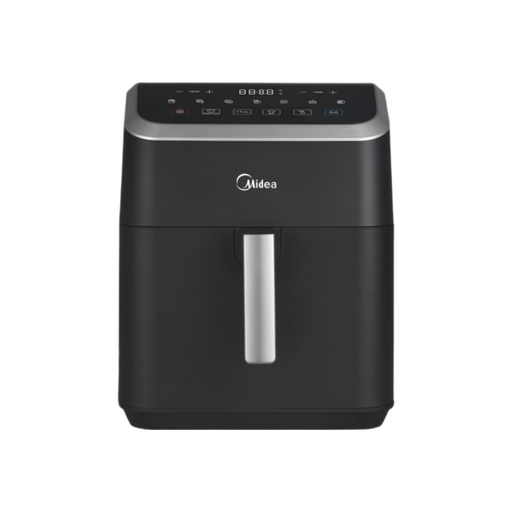
Why it is a good fit: Designed for professionals and families who appreciate digital controls and preset programmes.
Alongside seven programmes, it offers manual settings from 40–200°C and cooking times of up to 60 minutes.
5.5 litres, 1,600 watts, touch control panel, overheat protection and dishwasher-safe basket according to the product description.
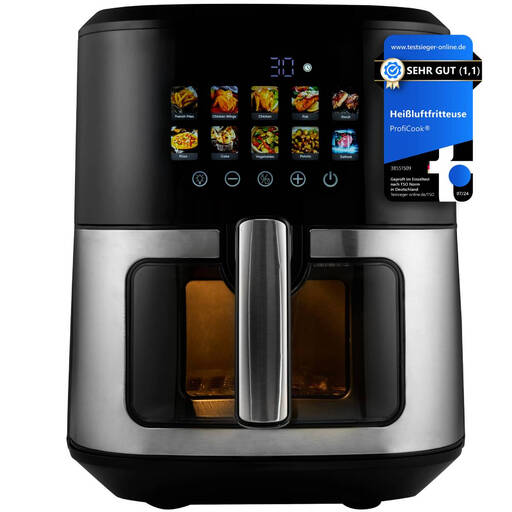
Why it is a good fit: The spacious cooking chamber is well suited to family meals and users who prefer a viewing window.
The viewing window and interior lighting make it easier to monitor food without repeatedly removing the basket.
6.5 litres, 1,700 watts, nine automatic programmes, sensor touch display and temperature selection from 50–200°C.

Why it is a good fit: Two separate 4.5-litre chambers allow different ingredients to be cooked simultaneously.
The total capacity is clearly presented as two separate baskets, making it easier to plan how the appliance will be used.
9-litre total capacity, ten programmes, two digital touch control panels and a specified power rating of 2,400–2,800 watts.
Our selection of flame-free cooking appliances includes further models for different household sizes and cooking preferences.
Place the appliance on a level, heat-resistant surface and leave sufficient clearance around the air outlet. The manufacturer’s specific recommendations should always take priority. Do not overfill the basket, so that air can circulate properly.
For running costs, wattage is not the only factor that matters. Power, operating time and frequency of use are also decisive. A 1,600-watt air fryer running for 30 minutes theoretically consumes around 0.8 kWh. Actual consumption depends on the heating cycle and electricity tariff. Claims such as “up to 70% more energy-efficient” are manufacturer specifications and should not be interpreted as a universal comparison for every household.
For four people, appliances with a capacity of around 5 to 6.5 litres are generally worth considering. The right size depends on whether side dishes and the main course are prepared together or in separate batches. If you want to cook two different dishes at the same time, a dual-chamber model with separate baskets may be a sensible choice.
Its service life depends on usage, cleaning, the coating, care and the availability of replacement parts. Allow the appliance to cool after every use, then clean it and store it in a dry place. Metal utensils, overfilling and blocked ventilation openings can accelerate wear.
You can calculate the cost using this formula: Power in kW × operating time in hours × electricity price per kWh. With a power rating of 1,500 watts and an operating time of 30 minutes, the theoretical consumption is 0.75 kWh. The actual cost depends on your electricity tariff.