
Lieferung heute & morgen

Qualitätsgarantie

Willkommens-Angebote freischalten: KOSTENLOSE Lieferung | Bis zu 80 % RABATT | Kostenlose 30-Tage-JoyPlus-Testphase
App herunterladen
An air fryer can prepare chips, vegetables, chicken, pastries and reheated meals. Compared with traditional deep-frying, little or no additional oil is usually needed. However, not every appliance is right for every household. In everyday use, the interior, controls, cleaning and space required often matter more than the number of automatic programmes.
A large capacity does not automatically mean that a large portion will become evenly crisp. With basket-style appliances, the usable surface area is crucial: an overfilled drawer restricts air circulation. For chips or vegetables, a shallow, evenly distributed layer may be more effective than a fully loaded basket.
An air fryer oven with multiple levels allows you to prepare more food at once. However, cooking times and rack positions may need to be adjusted. Buyers should therefore distinguish between basket capacity, usable cooking surface and number of levels.
An oil-free fryer can be used without adding oil. However, with potatoes, breaded products or marinated vegetables, the result still depends on the recipe, moisture, quantity and cooking time. The term ‘healthy fryer’ is therefore no substitute for specific information about temperature, portion size and preparation method.
A display with numerous programmes may appear versatile. However, if you regularly want to grill, bake or prepare several components at the same time, you should check the appliance design first. An air fryer with grill requires a suitable grill plate, for example. For preparing two different dishes at the same time, an air fryer with two chambers is more practical than a single large basket.
A useful temperature range for everyday applications is approximately 80 to 200 °C, depending on the model. Some air fryer ovens offer higher settings. This can be relevant for certain grilling or pizza functions, but should be checked against the instruction manual and the relevant accessories.
Wattage alone is not an indication of quality. It describes electrical power consumption, not necessarily the speed or evenness of cooking. Information about airflow, heating technology and maximum cooking time is more useful. A 60-minute timer is sufficient for many standard dishes; for longer applications, an air fryer oven with an extended time range may be the better choice.
Mechanical dials are straightforward and easy to read. Touch controls often offer more programmes and more precise settings. An air fryer with viewing window lets you monitor the food without opening the basket and allowing heat to escape.
Removable baskets, grill plates and trays should be easy to access once the appliance has cooled down. A dishwasher-safe air fryer can reduce the cleaning required. Before buying, check which parts are actually approved for use in the dishwasher. The main appliance must not be immersed in water.
For coated baskets, soft sponges and suitable kitchen utensils are recommended. Models with stainless-steel baskets may partly avoid a conventional non-stick coating. This can appeal to buyers looking for a robust, coating-free contact surface. Regardless of the material, grease and food residue should be removed regularly.
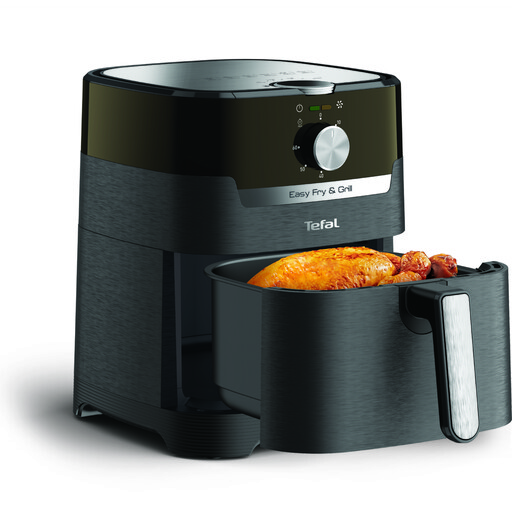
Why this product suits this profile: This 4.6-litre model combines air frying and grilling in one appliance. The temperature can be set between 80 and 200 °C, while the timer runs for up to 60 minutes.
The integrated cast-iron grill plate offers more than a vague programme promise. The stated capacity also helps you plan portions realistically.
2-in-1 design, 1,550 watts, 4.6-litre capacity and, according to the product details, dishwasher-safe removable parts.

Why this product suits this profile: According to the product specifications, the interior and basket are made from metal and 304 stainless steel respectively. The viewing window, interior light and dials support direct monitoring.
The viewing window reduces unnecessary opening. Details about the stainless steel and BPA-free cooking area make the material choice more transparent than broad health claims.
6.5 litres, 1,700 watts, temperature range from 80 to 200 °C and mechanical controls without preset menus.
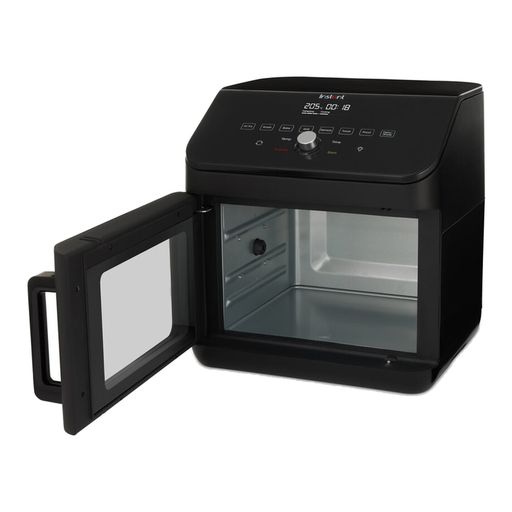
Why this product suits this profile: Two levels, a rotisserie spit and several functions make this appliance suitable for family meals, baking, grilling, reheating and dehydrating.
This design offers more than just a large basket capacity: the accessories and levels are intended for different preparation methods. This makes it easier to assess how suitable the appliance is before buying.
13-litre capacity, two rack levels, rotisserie spit and nine specified cooking programmes.
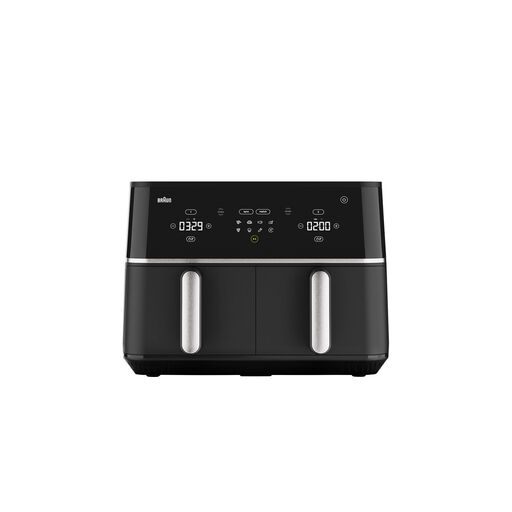
Why this product suits this profile: The two separate 5-litre baskets let you cook different dishes at the same time. A synchronisation function can align their finishing times.
Separate chambers prevent the side dish and main course from competing for the same cooking space. The individual capacities make the loading limits clear.
10-litre total capacity, two 5-litre baskets, 80 to 220 °C, eight programmes and, according to the product details, dishwasher-safe baskets.
We have put together a complete, regularly updated list of products that fully meet these strict selection criteria and the safety regulations applicable in the EU.
In addition to the appliance’s dimensions, you need to allow sufficient clearance from walls and wall units. The ventilation openings must not be blocked. The safety instructions provided by the relevant manufacturer are the key reference. A large XXL appliance or air fryer oven also needs room for opening the door or pulling out the baskets.
Its lifespan depends on how often it is used, cleaning, the coating, seals and proper handling. A general figure in years is not reliable. Regularly removing grease and food residue, avoiding overfilling and using suitable utensils can reduce wear. If the cable, housing or heating element is damaged, the appliance should not be used again.
Running costs depend on power consumption, cooking time and the electricity price. The simple calculation is: power in kilowatts multiplied by the operating time in hours and your tariff per kilowatt-hour. A 1,800-watt appliance running for 20 minutes theoretically uses around 0.6 kilowatt-hours. Preheating, multiple batches and long cooking times increase consumption. The wattage is therefore not the only factor that matters; it is also important that the appliance size is well matched to the portion being prepared.