
Lieferung heute & morgen

Qualitätsgarantie

Willkommens-Angebote freischalten: KOSTENLOSE Lieferung | Bis zu 80 % RABATT | Kostenlose 30-Tage-JoyPlus-Testphase
App herunterladen
An air fryer is a kitchen appliance that cooks food using a stream of circulating hot air. This method achieves a crispy texture similar to traditional deep-frying, but with significantly less—or even no—oil. It operates on the principle of convection: a heating element warms the air inside the cooking chamber, and a fan circulates it rapidly and evenly around the food. This results in shorter cooking times and more efficient energy use compared to a conventional oven.
Choosing the right model depends on objective parameters that should be tailored to your household's specific needs. Instead of searching for general terms like "best air fryer," a more effective approach is to analyse the following technical specifications.
Capacity is a crucial criterion and is measured in litres (L).
The material of the basket or container affects handling, cleaning, and durability.
The power, measured in watts (W), affects preheating and cooking times. Models with higher wattage (e.g., 1500 W to 2000 W) typically reach the target temperature faster. Additional features expand the range of applications:
Based on an analysis of technical specifications and practical use cases, we present three distinct models.
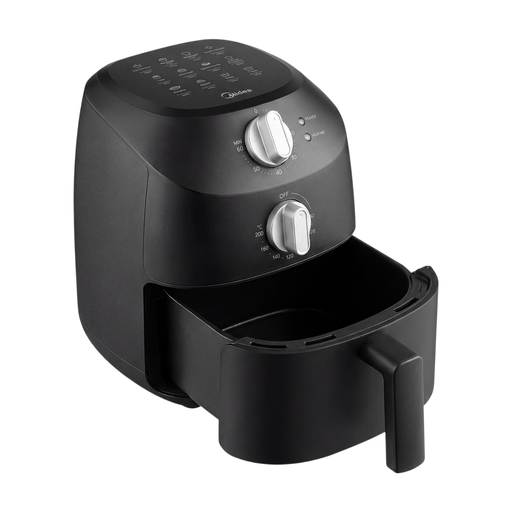
Why we recommend this product: The Midea MAF20P0BPK addresses the need for a space-saving appliance for small kitchens. With its compact dimensions (218 × 218 × 232 mm) and a low weight of 2.28 kg, it is easy to position on a worktop or store away. The 1150 W power output is well-suited for its 2-litre capacity, enabling quick preparation.
Pros:
Who it's for: This model is an ideal choice for single-person households and couples looking for a quick and straightforward solution for preparing small meals and snacks.
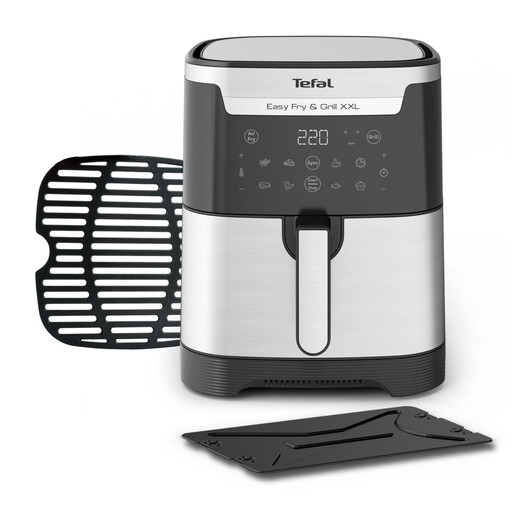
Why we recommend this product: The Tefal EY801D15 combines a large capacity with high functionality. Its standout feature is the "Flexcook" divider, which splits the 6.4-litre cooking chamber into two separate zones, allowing it to be used as a Dual Zone Air Fryer. The additional grill function significantly expands its range of applications. With 1800 W of power, the appliance is designed for rapid preheating and cooking.
Pros:
Who it's for: This appliance is aimed at families and users who value versatility and a large capacity to efficiently prepare complete meals in one go.
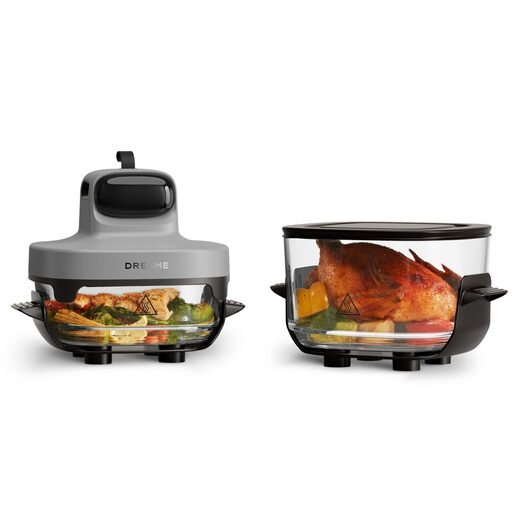
Why we recommend this product: The Dreame Tasti PT60 stands out for its material choice and technology. It uses two borosilicate glass cooking containers (2.5 L and 4.5 L), making it PFAS-free and coating-free. The 360° visibility through the glass allows for constant monitoring of the cooking progress. The combination of 3D hot air and steam technology aims to keep food crispy on the outside and juicy on the inside.
Pros:
Who it's for: This model appeals to health-conscious users who prioritise coating-free materials and desire precise control over the cooking process. The two container sizes offer flexibility for different quantities.
The market offers a wide variety of other appliances with different specifications. You can find an overview of additional options and models in our air fryer category.
1. How does an air fryer work without oil? An air fryer cooks food using rapidly circulating hot air. This process, known as convection, creates a dry heat that quickly seals the food's surface, resulting in a crispy texture. The fat naturally present in the food is often sufficient to achieve a result similar to deep-frying. This is the core technology for low-fat frying.
2. What is the difference between an air fryer and a convection oven? Both appliances use convection. However, an air fryer has a smaller cooking chamber and a more powerful fan. This allows the air to circulate faster and in a more concentrated manner, leading to shorter cooking times and often a crispier finish. Additionally, an air fryer's preheat time is typically much shorter.
3. How do you clean an air fryer? Most models feature removable baskets and drawers that are often dishwasher-safe. For non-stick parts, care should be taken to use soft sponges to avoid damaging the coating. Glass or stainless steel containers are more robust and can also be cleaned in the dishwasher or by hand. The appliance's housing can be wiped down with a damp cloth.