
Lieferung heute & morgen

Qualitätsgarantie

Willkommens-Angebote freischalten: KOSTENLOSE Lieferung | Bis zu 80 % RABATT | Kostenlose 30-Tage-JoyPlus-Testphase
App herunterladen
An air fryer can be a handy appliance for cooking chips, vegetables, poultry or reheating leftovers. However, not every model delivers the right results in everyday use. Buyers often choose based on capacity alone or eye-catching marketing claims. What really matters is the design, controls, cleaning and how you'll actually use it in your home.
A claim like 9-litre air fryer or 10-litre air fryer refers to the volume of the cooking chamber, not necessarily the usable food capacity. If you overload the baskets, the hot air can't circulate properly. This can lead to unevenly cooked food.
For one person or a couple, a compact 2-litre air fryer is often sufficient. Families and meal-prep users will benefit more from 5 to 10 litres. With a dual-basket air fryer, the total volume is split between two separate baskets.
Automatic programmes, a touchscreen and a viewing window may seem practical at first glance. What really counts is whether you can also adjust the temperature and time manually. A timer and temperature control let you adapt settings to different foods and quantities.
Even an air fryer with a viewing window shouldn't be chosen solely for visual checking. The window can make it easier to monitor progress, but it doesn't replace the need to shake or turn the food occasionally, if the instruction manual recommends it.
A non-stick frying basket makes cleaning easier. Even more convenient are removable parts that the manufacturer says are dishwasher-safe. However, a dishwasher-safe frying basket doesn't mean the whole appliance can go in water or the dishwasher. The housing with the heating element and electronics should only be cleaned with a suitable cloth.
Before you buy, also check that there's enough space for air intake and exhaust. The appliance needs to sit on a flat, heat-resistant surface and not directly under a wall cupboard.
With a dual-basket air fryer, features like 'Sync Finish' or linked settings are useful. These allow you to coordinate different cooking times so that both components are ready to serve at roughly the same time.
The wattage describes the electrical power consumption, but it isn't the only measure of cooking performance. Basket size, air circulation and temperature range are also important. Depending on the model, available temperatures typically range from 80 to 200 °C.
Higher power can be helpful with large cooking chambers, but it also increases the potential load on your electrical circuit. Appliances around 2,400 to 3,100 W should be plugged directly into a suitable, earthed wall socket. Only use multi-socket adaptors or extension leads if the instruction manual explicitly allows it.
Automatic programmes simplify frequently used cooking methods like chips, chicken, vegetables or baked goods. They provide starting values and should be adjusted according to quantity, thickness and desired browning. That's why manual temperature and time settings remain important.
With low-fat frying, food is mostly cooked by circulating hot air. Depending on the food, you can use a little oil for flavour or browning. An oil-free air fryer isn't the same as a traditional deep-fat fryer: oil isn't poured into the basket. Always follow the manufacturer's safety instructions.
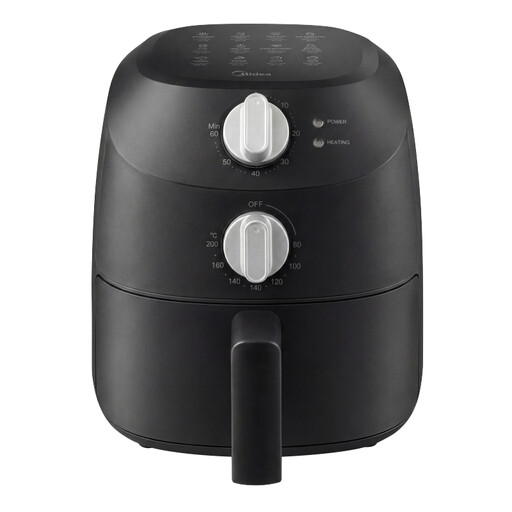
Why this product fits the profile: The 2-litre capacity takes up relatively little counter space and is designed for smaller portions for one or two people.
The compact size reduces the risk of buying a large appliance for small everyday portions. The basket is dishwasher-safe according to the product specifications.
1150 W power, 60-minute timer, non-stick basket and removable parts for cleaning.
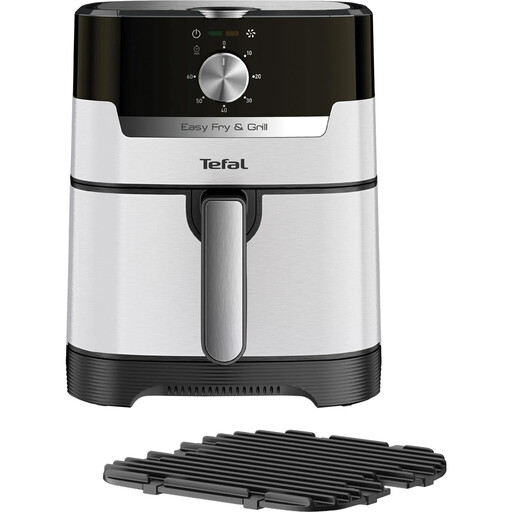
Why this product fits the profile: This appliance combines air frying and a grill function in one model, with a temperature range of 80 to 200 °C.
Manual temperature and time settings complement the pre-set functions. The removable parts are dishwasher-safe according to the product specifications.
4.2-litre capacity, 1500 W power, 60-minute timer and integrated grill function.
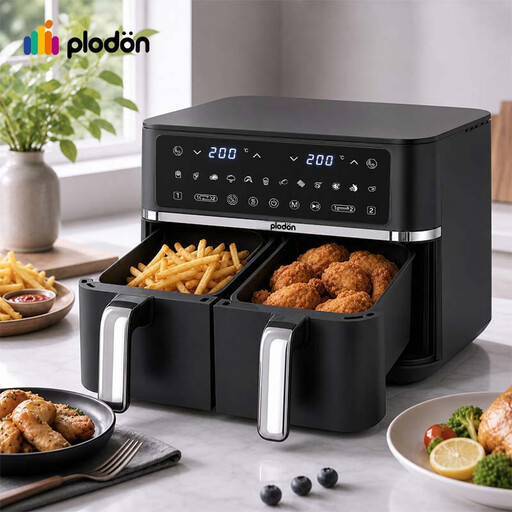
Why this product fits the profile: Two separate 4.5-litre baskets support family meals, different foods and meal prep in one go.
The separate zones prevent differently seasoned foods from touching. Sync Finish and independent temperature control address different cooking times.
9-litre total capacity, 12 automatic programmes, touchscreen, preheat, keep warm and dishwasher-safe parts.
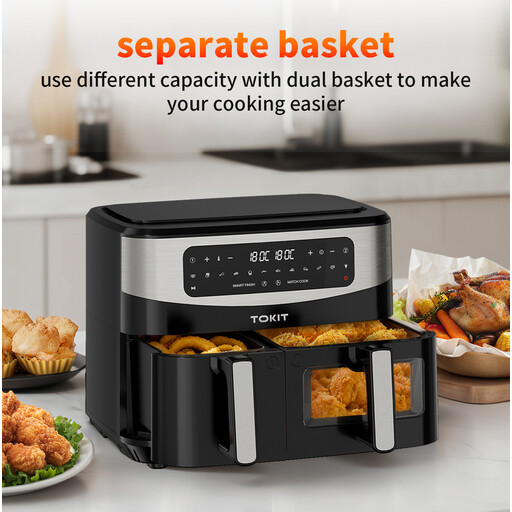
Why this product fits the profile: This model offers two compartments and a total capacity of 10 litres for larger households or multiple components of a meal.
The dual-compartment layout makes separate cooking easier. Before buying, consider the counter space, power consumption of 2850 W and the available socket.
10-litre capacity, two separate compartments and a power rating of 2850 W at 220 to 240 V.
We've put together a full, regularly updated list of products that meet these strict selection criteria and comply with EU safety regulations.
An air fryer should sit on a stable, heat-resistant surface while in use. The air intake and exhaust must not be covered. Only touch hot baskets, steam and exterior surfaces by the designated handle. The housing must not be immersed in water.
Electricity costs depend on power, running time and your energy tariff. A simple guide is:
Power in kW × operating time in hours × electricity price per kWh = electricity cost
An appliance with 1,500 W running for 30 minutes uses 0.75 kWh in theory. Actual costs may vary due to heating phases, pauses and different programmes. When comparing with an oven, also consider the temperature needed, preheat time and food quantity.
For one person or a couple, a compact air fryer of around 2 to 3.2 litres can be enough. If you regularly cook several components at once or batch cook, allow for more capacity.
The lifespan depends on how often you use it, how you clean it, the coating and proper handling. Baskets and racks are wear parts that may need replacing sooner. Before buying, it's worth checking the availability of spare parts, warranty terms and the manufacturer's care instructions.
Many foods can be prepared with little or no added oil. The result depends on water content, surface area, quantity and temperature. Do not pour oil into the container unless the appliance is specifically designed for it; an air fryer is not a traditional deep-fat fryer.