
Lieferung heute & morgen

Qualitätsgarantie

Willkommens-Angebote freischalten: KOSTENLOSE Lieferung | Bis zu 80 % RABATT | Kostenlose 30-Tage-JoyPlus-Testphase
App herunterladen
An air fryer promises crispy results with minimal fat, and has become a staple in many kitchens. But the market is overwhelming and full of marketing promises. Anyone looking to buy an air fryer often faces a flood of models whose advertised features prove impractical in practice.
Before you make a decision, it's important to know the typical pitfalls that can lead to a bad purchase. We'll show you what to look for to find a device that truly fits your needs.
Many devices look convincing at first glance, but turn out to be inadequate in daily use. Pay special attention to these three points to avoid disappointment:
To make the right choice, you should focus on objective and measurable parameters. These three factors are crucial for long-term satisfaction with your appliance.
Ignore the litre specification on the packaging and check the actual dimensions of the cooking basket. Consider how many people you regularly cook for.
For healthy cooking, it's not just about reducing fat, but also about the material your food comes into contact with. Specifically look for the PFAS-free label. Models with a ceramic coating or stainless steel cooking baskets are a good alternative here. These materials are not only safe but often more durable and scratch-resistant.
A practical appliance must be easy to clean. Check if the cooking basket and the crisper plate are fully removable and explicitly marked as dishwasher-safe. A smooth design without hard-to-reach corners makes manual cleaning much easier. Practical air fryer accessories like custom-fit parchment paper liners can further minimise cleaning effort by catching grease and food residue.
Instead of presenting a confusing list, we have selected models that meet specific requirements and purposefully avoid the pitfalls mentioned.
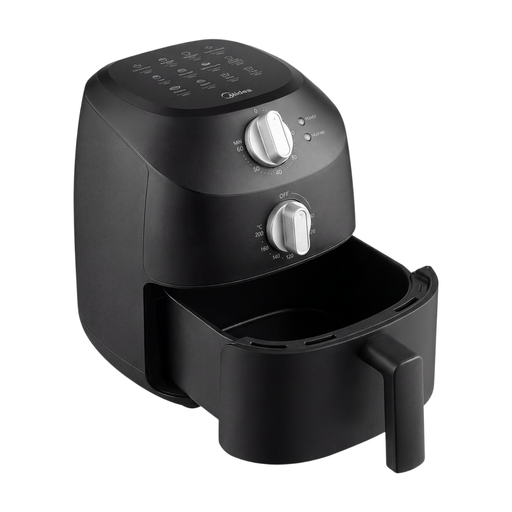
Why it's a good fit: With a 2-litre capacity, this appliance is ideal for preparing single portions. Its extremely compact, space-saving design fits even in the smallest kitchen or dorm room without blocking valuable counter space.
The capacity is honestly designed for small portions and doesn't create false expectations. According to the manufacturer, the non-stick basket is dishwasher-safe and easy to handle, which minimises cleaning effort.
Extremely small footprint (21.8 x 21.8 cm). Fast preheating with 1150 watts of power for quick meals.
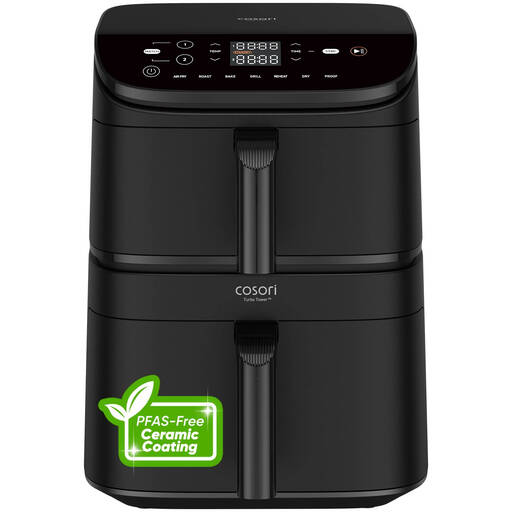
Why it's a good fit: This appliance combines a large volume with a smart, vertical design. The two stacked baskets (6.5 L & 4.3 L) allow you to cook a complete family meal without taking up much counter space.
According to the manufacturer, the baskets and crisper plates feature a PFAS-free ceramic coating, directly addressing health concerns. The tower design is an honest solution to the capacity problem in standard kitchens.
PFAS-free ceramic coating. Vertical, space-saving design with 3 cooking levels. Quiet operation due to DC motor.
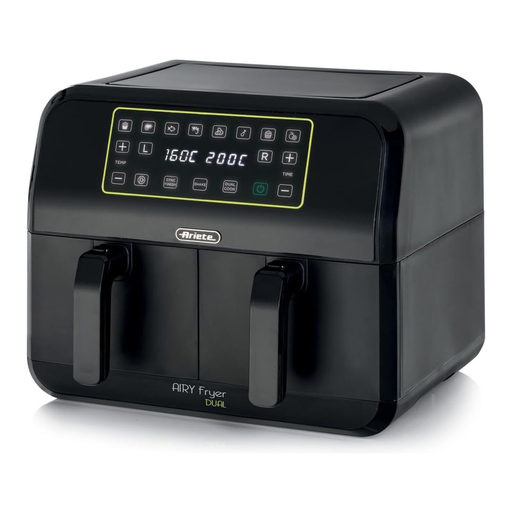
Why it's a good fit: As a classic dual-basket air fryer, this model offers maximum flexibility. With two separate 4-litre baskets, you can cook two different dishes at different temperatures and times simultaneously – ideal for families with different tastes.
The clear separation into two zones avoids misunderstandings about capacity. The sync feature ensures that both dishes are ready at the exact same time, solving a common problem when coordinating meals.
Dual-zone function for cooking two different foods. Sync finish feature for serving at the same time. Large total capacity of 8 litres.
We have compiled a complete, up-to-date list of products that meet these strict selection criteria and safety regulations.
Power consumption depends on the wattage and duration of use. An air fryer with 1500 watts (1.5 kW) running for 30 minutes consumes 0.75 kWh of electricity. Compared to a conventional oven, which needs to preheat longer and heats a larger volume, an air fryer is generally more energy-efficient for small to medium portions.
Yes, for many foods like pre-fried frozen products (e.g., fries) or chicken pieces, no additional oil is needed to achieve a crispy result. For fresh, homemade fries or vegetables, adding a teaspoon of oil is often recommended to improve browning and flavour. The principle of low-fat frying is still maintained.
PFAS (per- and polyfluoroalkyl substances) are a group of chemicals used in many conventional non-stick coatings (like PTFE). They are very durable and can accumulate in the environment and the body. A PFAS-free coating, for example one based on ceramic, avoids these substances. For users who value healthy cooking and a non-toxic kitchen environment, this is an important quality feature.