Vegetable crisp experimenters
You want to make thin batches of vegetables crisp with precise control, and care more about temperature settings and cooking progress than a large stated capacity.


For small batches of vegetable crisps in a shared kitchen, an easy-to-clean single basket is a sensible starting point. What matters is the usable surface area: the stated capacity doesn’t tell you how many slices will fit side by side. If you’re cooking for several people or preparing different vegetables at the same time, a dual-basket model can make things easier, but it takes up more space and requires more cleaning. A dehydrating function is particularly useful if you also want to dry vegetables for longer at a low temperature. Whatever type of appliance you choose, thin slices, thorough drying and keeping an eye on browning are still important.
You want to make thin batches of vegetables crisp with precise control, and care more about temperature settings and cooking progress than a large stated capacity.
You share worktop and storage space, and want removable parts that are easy to clean after use.
You want to prepare several portions or different ingredients, and need to decide whether extra batches or a larger appliance will work better in your kitchen.
| Buying priority | What to check | Who is it important to? |
|---|---|---|
| Cooking and browning | Check whether you can adjust the temperature and cooking time, and keep an eye on how the food is cooking. Slice the vegetables thinly, dry them thoroughly and watch how they brown; the German Federal Institute for Risk Assessment advises aiming for ‘golden rather than burnt’ vegetable crisps. | If I want to cook vegetable crisps evenly, adjustable temperature and time matter more than a large capacity. Around 28% of consumers put control over the cooking result first. |
| Cleaning | Check whether the basket and inserts for the specific model are dishwasher-safe. More than one basket also means more parts to clean after cooking. | Anyone who wants to keep shared baskets and contact surfaces clean with minimal fuss will pay particular attention to cleaning. Around 22% of consumers prioritise this. |
| Worktop and storage space | Compare the appliance’s width and height with the space you actually have, and allow for the clearance it needs. A compact-sounding name doesn’t tell you how big the appliance or its interior is. | If I have to share worktop and storage space, I prioritise available room over capacity and extra features. Around 22% of consumers prioritise the space an appliance takes up. |
| Portions for several people | Consider whether you often really do prepare different portions at the same time. Two independently controlled baskets can make this possible, but they take up more space and mean more cleaning. | For consumers who want to prepare several portions or ingredients at once, being able to use the baskets separately is particularly important. Around 17% put cooking multiple portions at the same time first. |
| Running costs and repairs | Compare actual power consumption and cooking time for the same portion; the stated wattage alone won’t tell you how much electricity it will use. The Verbraucherzentrale distinguishes between your statutory rights and a voluntary guarantee with its own terms and conditions. | If I’m weighing up ongoing costs and what happens if something goes wrong, I check the consumption and terms of the specific offer. Around 11% of consumers prioritise running and maintenance costs. |
Cosori lists the Turbo Tower Compact with two baskets holding a total of 8.6 litres and an appliance height of 365 mm. So a narrower casing doesn’t necessarily mean a small appliance.
Measure the width and depth, as well as the clearance above where you plan to put it. Choose based on your portions and available space, not just the product name.
Cosori describes the Turbo Tower Compact as a 6-in-1 version with ‘Dry’ and a 5-in-1 version without this function. So whether you get the feature depends on the specific version.
Check the full list of features and the model version in the specific offer.
The German Federal Institute for Risk Assessment found high levels of acrylamide in the vegetable crisps it tested. This doesn’t tell you the level in crisps made at home using a particular appliance.
Avoid heavy browning, and don’t assume that using less oil means there are no other health risks.
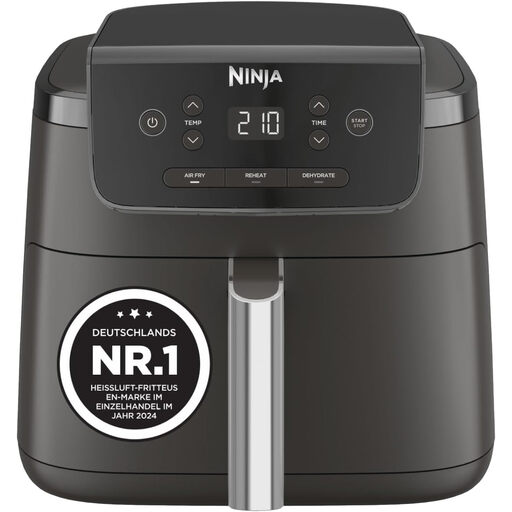
The NA322/00 combines a single basket with a viewing window and a listed dehydrating function.
The TurboBlaze and Turbo Tower Compact offer different approaches to temperature control and cooking multiple portions at once.
The Easy Fry Essential EY1308 is a single-basket model for smaller portions, with a straightforward design.
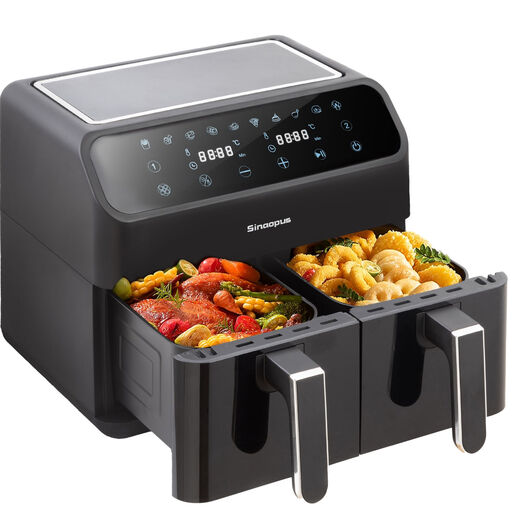
The Satisfry Dual Basket 9L is a dual-basket option for cooking portions separately or at the same time.
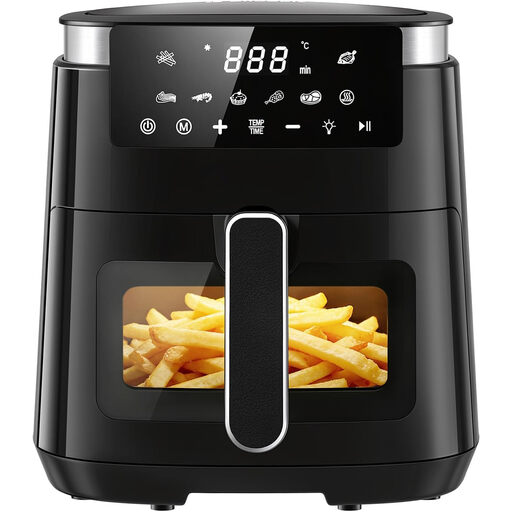
The Life X10 XL MD 11780 is a single-basket option with a viewing window.
This selection includes appliances for small portions, manual temperature and time settings, cooking multiple batches at once or drying food for longer.
 No image available
Could suit you if you want to make smaller snack portions and dry vegetables for longer at a lower temperature.
4.7-litre basket; temperature settings from 30–210 °C; dehydrating function; described as suitable for 1–2 people.
 No image available
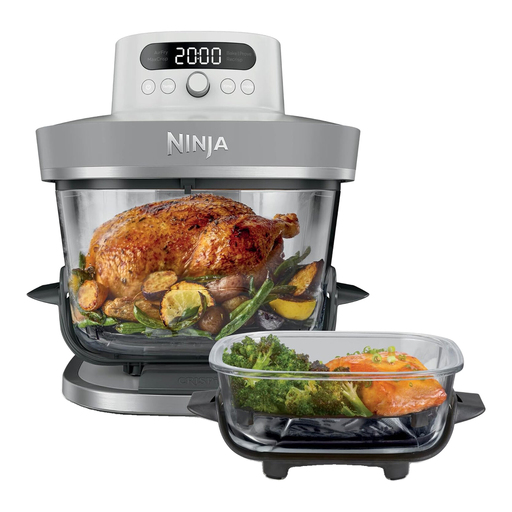
An option if you want manual temperature and time settings, plus containers in two sizes for different amounts of snacks.
Glass containers with capacities of 5.7 and 2.3 litres; manual temperature and time settings; containers described as dishwasher-safe.
 No image available
Could work for cooking several portions at once if you’ve allowed for the extra space and cleaning it requires.
Two independently controlled 4.5-litre baskets; temperature and time controls for each zone; viewing windows.
 No image available
An option if you want to set the temperature and time yourself, and watch the cooking through a viewing window.
5.5 litres; described as suitable for 2–4 people; dehydrating function; viewing window with interior light; basket described as dishwasher-safe.
 No image available
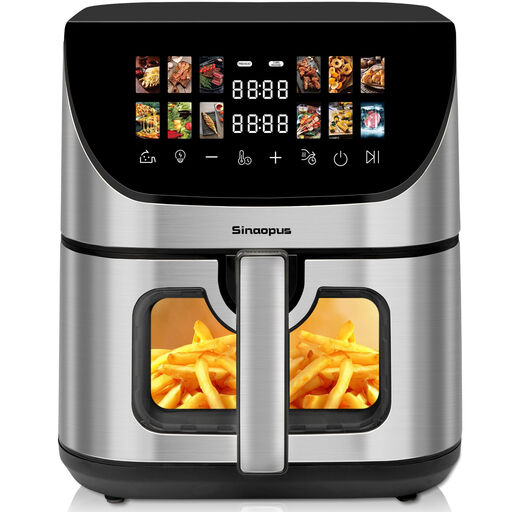
Could be worth considering if you want a viewing window and a larger stated capacity; 9 litres doesn’t tell you how many slices will fit in a single layer.
9 litres; 1,800 W; 12 programmes; temperature range of 80–200 °C.
Slice the vegetables thinly and dry them thoroughly. Tefal’s root vegetable recipe recommends this preparation, but its cooking time is for an ActiFry appliance and can’t automatically be applied to other air fryers. Keep an eye on the browning; the German Federal Institute for Risk Assessment recommends aiming for ‘golden rather than burnt’.
Not necessarily. Philips advises against covering the base of the basket in its air fryers, as this can restrict airflow. Philips also says loose baking paper without food on top could reach the heating element and catch fire. Check the instructions for your specific model, and clean any used parts and contact surfaces.
You can only compare the electricity cost of a portion by considering actual power consumption, how long you use the appliance and your electricity tariff; the stated wattage alone won’t tell you the cost. The Verbraucherzentrale explains that statutory rights and a voluntary guarantee have different legal bases and terms.
Electrical appliances covered by the Low Voltage Directive must carry the CE marking. The directive applies to appliances with a rated voltage of 50–1,000 V AC or 75–1,500 V DC. Check the marking and accompanying documents for the specific appliance; the CE mark alone doesn’t prove that it has been independently tested.
Yes. According to the German Federal Office of Consumer Protection and Food Safety, the manufacturer or importer based in the EU is responsible for ensuring that materials that come into contact with food are safe. A marketing claim about the coating isn’t a substitute for checking the specific product.