People dealing with pollen in a student room
You’re mainly looking for particle filtration suited to your room, and want to avoid mistaking product specifications for a guarantee that your symptoms will disappear.


For a student room used for both studying and sleeping, the air purifier should be suited to the size of the room above all: compare the room volume with the stated particle CADR and check which fan speed the noise rating applies to. A quiet night mode may not deliver the same airflow as the highest setting. An air purifier complements ventilation; it does not remove pollen that has already settled on surfaces.
You’re mainly looking for particle filtration suited to your room, and want to avoid mistaking product specifications for a guarantee that your symptoms will disappear.
You use the same room for work and sleep, so need to weigh up noise, lighting and airflow at the setting you’ll actually use.
You need a unit that’s easy to position, and want to know which replacement filter fits the exact model before you buy.
Start with the room size and the airflow you expect to use day to day. Then weigh up night-time operation, replacement filters and the space available.
| Consideration | What to look for when buying | Who is it important to? |
|---|---|---|
| Pollen filtration performance | Compare the room volume with the particle CADR in m³/h. Xiaomi Germany lists 16 to 27 m² in the technical specifications for the Smart Air Purifier 4 Compact; according to Xiaomi, the 48 m² figure is based on two air changes per hour. | If I want to filter pollen from the room air, it matters whether the airflow matches the room size. Around 33% of consumers put pollen filtration performance first. |
| A good night’s sleep | Check the noise rating and the fan speed it applies to. Bosch lists 25 dB(A) for the Air 2000 in sleep mode, but does not provide a CADR for this setting. | If you sleep and study in the same room, you’ll want to be able to run the filter at a tolerable setting. Around 27% of consumers put a good night’s sleep first. |
| Replacement filters and ongoing costs | Check the full model and filter names match. Xiaomi recommends replacing the Smart Air Purifier 4 Compact filter every 6 to 12 months; this does not apply to all models. | If I need to keep an eye on ongoing costs, I want to know which filter fits and when it should be replaced before I buy. Around 20% of consumers make ongoing costs their main consideration. |
| Space and ease of use | Compare the dimensions and tabletop or floor placement with the space available; also consider whether you’ll operate it on the unit or through an app. | In a small, multi-purpose room, the unit shouldn’t take over your workspace and should be straightforward to use. Around 20% of consumers put space and ease of use first. |
Room coverage figures may be based on a particular air-change rate. Xiaomi lists both 48 m² based on two air changes per hour and an effective coverage area of 16 to 27 m² in the technical specifications for the Smart Air Purifier 4 Compact.
Compare your room dimensions, the basis used for the room coverage figure and the particle CADR. Then consider which fan speed you’d be comfortable using day to day.
Noise ratings for sleep mode and maximum CADR figures describe different operating conditions; they don’t mean that both are achieved at the same time.
Check which fan speed the noise rating applies to, then weigh up a good night’s sleep and airflow at the setting you’ll actually use.
Filters are model-specific consumable parts. Xiaomi says the Smart Air Purifier 4 Compact filter is compatible with this model and recommends replacing it every 6 to 12 months.
Before buying, check the full model number against the filter name and the manufacturer’s guidance.
A filter specification doesn’t account for every condition in your room. The US Environmental Protection Agency also warns that ozone irritates the airways.
For pollen filtration, look for particle filtration and suitable airflow. Think of the unit as a complement to limiting pollen coming indoors and ventilating your room, not as a promise of a cure.
The Air 2000 is a compact comparison option with a stated CADR and sleep mode.
The Core 300S and the separate Core 300S Pro are worth considering if you’re comparing app and automatic features.
The Smart Air Purifier 4 Compact is described as a tabletop or freestanding unit with sensor and automatic features.
This selection includes air purifiers whose product information mentions pollen filtration or use in a room shared for studying and sleeping.
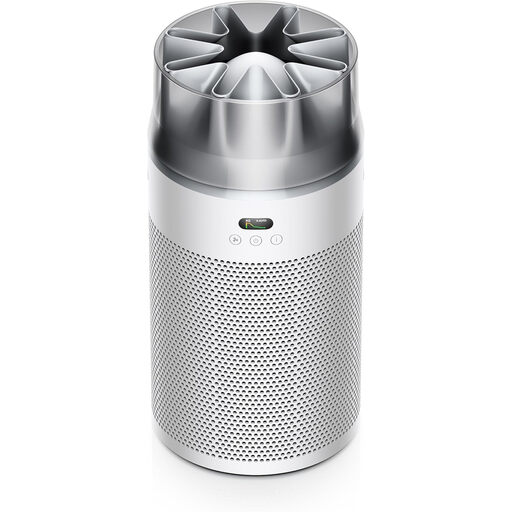 No image available
A good fit if you’re looking for app and automatic features, as well as a sleep mode, in a compact air purifier.
The product information lists an electrostatic filter, an activated carbon filter, app control, automatic mode and sleep mode.
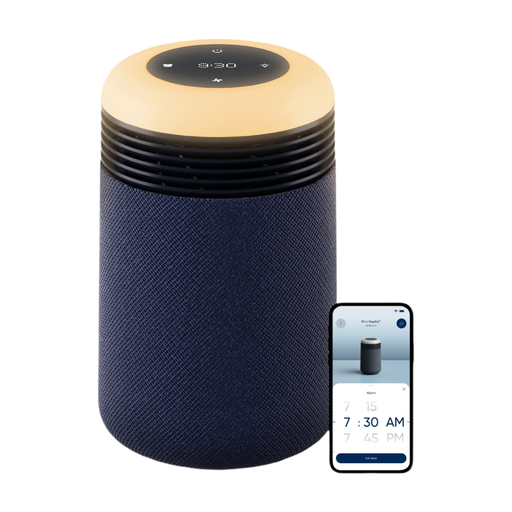 No image available
Worth considering for a small room if you’re looking for a compact model with a night mode and wake-up light.
Blueair product information gives a room coverage figure of up to 13 m² and operation from 21 dB. It states that the filter should be replaced after nine months.
It is described as featuring HEPASilent filtration, app control and an integrated wake-up light.
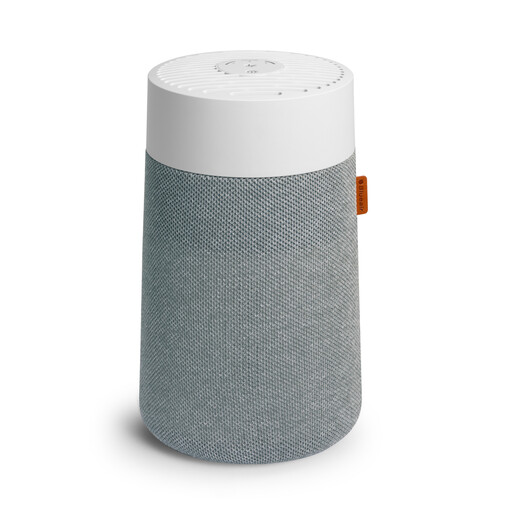 No image available
A good fit if you want a portable unit and a stated CADR to compare with your room size.
The product information lists a CADR of 117 m³/h and a room coverage figure of up to 20 m². Filter replacement is recommended every 6 to 9 months.
It is described as featuring HEPA filtration and two-button controls.
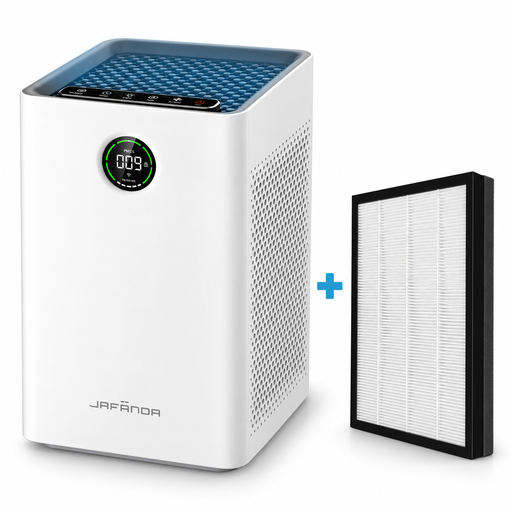 No image available
Worth considering if you want to use app or voice control and a sleep mode in a room shared for studying and sleeping.
The product information lists a CADR of 260 m³/h, five fan speeds, a PM2.5 sensor and a sleep mode at 23 dB.
The filter replacement guidance is 3,000 operating hours.
 No image available
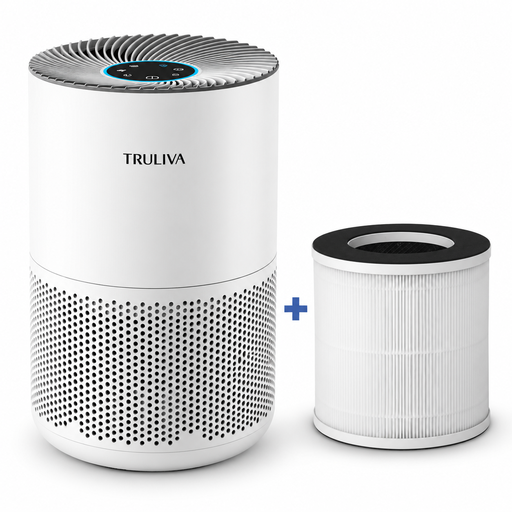
A good fit if you’re looking for a sleep mode and an extra replacement filter in the box for a room used for studying and sleeping.
The product title lists a CADR of 260 m³/h, a sleep mode at 24 dB, a timer and an additional H13 True HEPA replacement filter.
It is also described as having three filter stages and being suitable for tabletop or floor placement.
No. An air purifier filters recirculated air, but it doesn’t bring in fresh air or remove CO₂ or water vapour. The German Environment Agency therefore recommends using portable air purifiers only as a supplement to ventilation.
Not directly. An air purifier captures airborne particles that are drawn into it; particles that have already settled need to be removed from surfaces separately.
First, check which replacement filter fits the full model number and what replacement guidance the manufacturer provides. You can calculate electricity costs using power consumption in kW × operating hours × your electricity rate per kWh.
No. The US Environmental Protection Agency warns against using air purifiers that deliberately generate ozone in occupied rooms, because ozone irritates the airways. This does not mean that all ionisation functions are banned in Germany.
When you buy from a trader in the EU, you are generally entitled to a legal guarantee of at least two years from the date you receive the goods. According to Your Europe, this claim is against the seller and is separate from a voluntary manufacturer’s guarantee; the EU rules cited do not apply to purchases from private individuals.