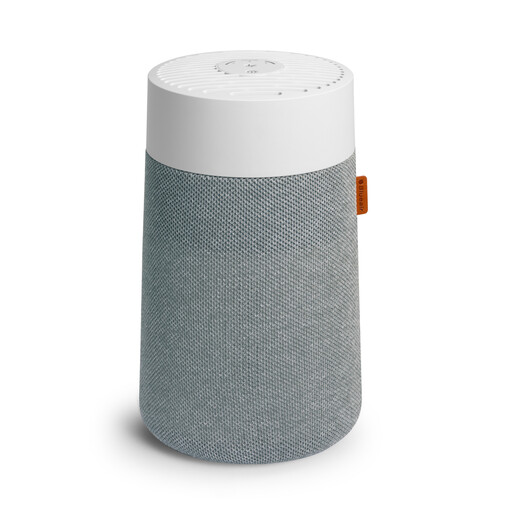
Who might benefit from an air purifier for fluff?

Homes with airborne fabric fluff

If fluff is stirred up when you handle clothes or household textiles in the room you use most, a particle filter may complement efforts to tackle its sources. Xiaomi specifically lists fluff among the particles captured by the primary filter in the Smart Air Purifier 4 Compact. This isn’t a measurement of fluff reduction throughout the room.

People living in small, multi-purpose rooms

If a room is used for living, working or sleeping, it’s important to choose an air output suited to that particular space. The US Environmental Protection Agency (EPA) recommends matching CADR to room size; read manufacturers’ room-size claims alongside the assumptions they’re based on about air changes per hour.

Noise-sensitive users who run their purifier for long periods

If you want to run the purifier near your desk or bed, check the noise rating and operating mode alongside the required air output. Bosch lists a sleep mode and a sound power level of 49 dB(A) for the Air 2000. This doesn’t directly tell you how loud it will be beside your bed or what its CADR is in sleep mode.

What should you look for when buying?

If fluff is mainly on floors, furniture or textiles, start by tackling its source and cleaning surfaces. For fluff still floating in the air, focus next on performance in the room you use, a suitable operating mode and the care required for the specific filter.

What matters What to check before buying Who is this important to?
Capturing airborne fluff Check the pre-filter and how easy it is to access for maintenance; don’t confuse the filter material’s capture rate with fluff reduction throughout the room. If I want to capture fluff that’s still floating in the air, I look at the filter design and whether particles can reach the air inlet. Around 36% of consumers prioritise capturing airborne fluff.
Suitable performance for the room Compare the room size, particle CADR in m³/h and the assumptions behind the manufacturer’s room-size claim. In a small, multi-purpose room, I need an air output suited to the space I actually use, rather than relying on the advertised room size alone. Around 29% of consumers focus primarily on suitable room performance.
Comfortable operation Check the noise rating and what it measures, the available operating modes and the purifier’s dimensions. Don’t compare sound power and sound pressure directly. If the purifier is running near me while I work or sleep, I need to be comfortable with the mode I choose. Around 21% of consumers prioritise quiet operation.
Filter care and ongoing costs Check the exact filter compatibility and the manufacturer’s replacement guidance; take the current price of the correct replacement filter into account before buying. I want to know in advance which filter the purifier uses and what day-to-day care involves. Around 14% of consumers pay particular attention to filter care and ongoing maintenance.

Manufacturer specifications show why the figures need to suit the room in question. Xiaomi lists a particle CADR of 230 m³/h for the Smart Air Purifier 4 Compact. Its advertised 48 m² is based on two air changes per hour, while the separate specifications page gives an effective coverage range of 16 to 27 m². These figures don’t prove how well it will reduce fluff in your home.

Avoid common misconceptions

  • Assuming a large advertised room size means it can cover your whole home

    Portable air purifiers are designed for individual rooms or areas. The Xiaomi Smart Air Purifier 4 Compact’s advertised 48 m² is based on two air changes per hour; its specifications page also lists an effective coverage range of 16 to 27 m².

    Choose based on the room where you’ll actually use the purifier, and compare its particle CADR with the assumptions behind the room-size claim.

  • Assuming a filter’s capture rate means your room will be fluff-free

    A purifier can only filter air that reaches its inlet. It won’t remove fluff that has already settled on textiles, furniture or the floor. Germany’s Federal Environment Agency describes air purification as a complement, not a replacement for tackling the sources.

    Continue to reduce sources of fluff and clean surfaces; consider filter claims alongside air output and placement.

  • Checking whether the right replacement filter is available only after you buy

    Filters need to be maintained or replaced, and they aren’t necessarily interchangeable between models. Xiaomi states that the filter for the Smart Air Purifier 4 Compact is only compatible with this model and recommends replacing it every 6 to 12 months.

    Before buying, check the exact filter name, the replacement guidance and the availability of the correct replacement filter.

    Filter care and electricity consumption are ongoing considerations to bear in mind when using your purifier.

Key brands to consider

Xiaomi

The Smart Air Purifier 4 Compact combines a compact design with a stated particle CADR and a separate, model-specific filter.

  • Xiaomi lists a particle CADR of 230 m³/h for this model and says the compatible filter’s primary filter captures particles including fluff.
  • The advertised 48 m² applies at two air changes per hour; the specifications page lists an effective coverage range of 16 to 27 m². Neither figure is based on an independent fluff test.

Bosch

The Air 1000 and Air 2000 have different particle CADR ratings, as stated by the manufacturer. This may help you choose a model to suit your room and where you plan to put it.

  • Bosch lists a CADR of 100 m³/h and a pre-filter for the Air 1000. The Air 2000 is listed at 180 m³/h, and Bosch also offers a compatible replacement filter.
  • These specifications relate to different models and don’t provide an independent comparison of how well they capture fluff.

Philips

According to Philips, the 600 Series AC0651/10 can be controlled remotely using the Air+ app.

  • App control may be useful if you want to operate the purifier from a distance.
  • App features don’t tell you whether the air output and filter are suited to your needs. Check these specifications separately for the specific model.

Air purifiers for individual rooms

These Joybuy products are designed for use in individual rooms. Their product descriptions mention particle filtration, but the filter design, air output and room-size claims vary.
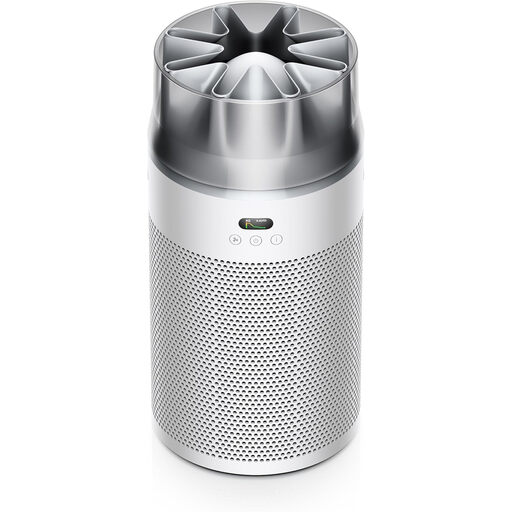
Dyson Hushjet Compact air purifier

Dyson Hushjet Compact Air Purifier

A possible choice if you’re considering an electrostatic particle filter and a sleep mode.

  • The product description lists an electrostatic particle filter and an activated carbon filter.
  • The electrostatic filter is stated to last for five years.
  • Sleep mode is rated at 24 dB; according to the product description, the coverage claim of up to 100 m² applies at 1 ACH.
Joybuy
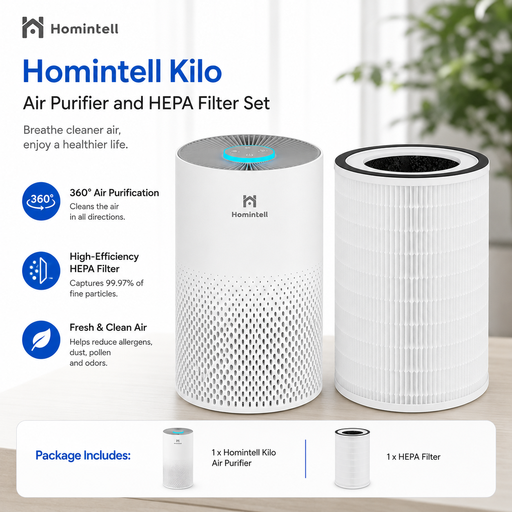
Homintell Kilo air purifier with an additional replacement filter

Homintell Kilo Air Purifier with additional HEPA and activated carbon replacement filter

For a smaller room, if the stated 18 m² suits your space and you’d like to consider a pre-filter.

  • The product description lists a 3-in-1 filter with a pre-filter, HEPA filter and activated carbon filter; the pre-filter is designed for hair and dust.
  • It is listed at 150 m³/h CADR and for rooms up to 18 m².
  • The description specifies that original filters must be used; the product title includes an additional replacement filter.
Joybuy
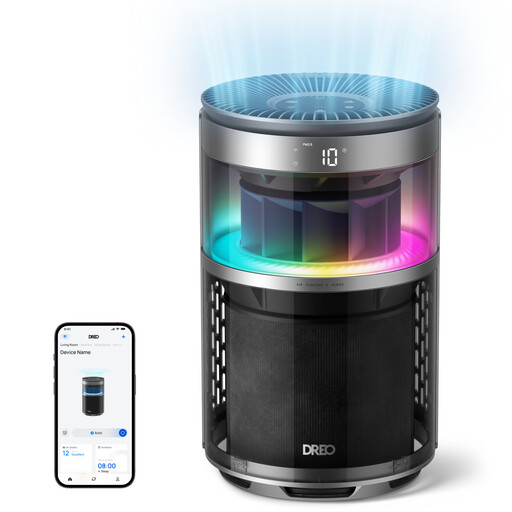
DREO Smart Air Purifier with three-stage HEPA filtration

DREO Smart Air Purifier with 3-stage HEPA filtration

An option if you want to compare the pre-filter, stated air output and different room-size claims.

  • The description lists a removable FiberCatch pre-filter, as well as HEPA and activated carbon filters.
  • It is listed at 221 m³/h CADR and for 19 m² at 4.8 air changes per hour, or 90 m² at 1 air change per hour.
  • Sleep mode is rated at 18 dB.
Joybuy
Blueair Blue Pure Mini Max air purifier

Blueair Blue Pure Mini Max Air Purifier

For a single smaller room, if the stated room size and air output suit your needs.

  • The description lists HEPA filtration, a CADR of 117 m³/h and coverage for rooms up to 20 m².
  • The noise level is listed as 44 dB.
  • According to the description, the filter should be replaced every six to nine months. You’ll need to use the replacement filter specified for this model.
Joybuy
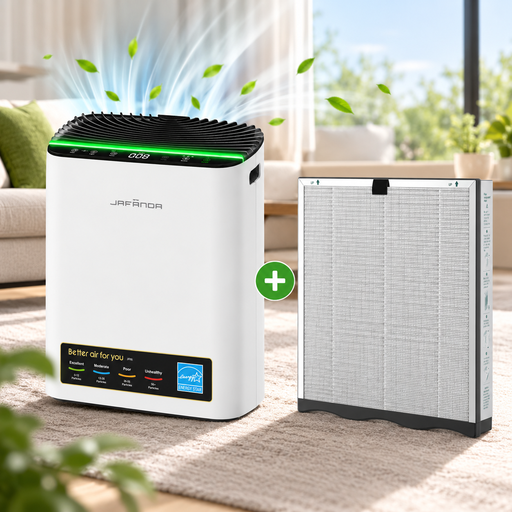
JAFANDA air purifier with an additional True HEPA 13 replacement filter

JAFANDA Air Purifier with additional True HEPA 13 replacement filter

A possible choice if you want to compare the stated air output and room-size claim at the specified air-change rate.

  • The product description lists a pre-filter, HEPA filtration and activated carbon filtration.
  • It is listed at 268 m³/h CADR and 245 ft² at five air changes per hour.
  • Low mode is rated at 20 dB and the high setting at 53 dB; the product title includes an additional replacement filter.
Joybuy

Frequently asked questions

Can an air purifier replace vacuuming and airing out a room?

No. A portable purifier filters air in a room or area, but it won’t remove fluff that has already settled. Tackling sources and cleaning surfaces are still important. Filtration also doesn’t replace airing out a room, which helps remove moisture and CO₂.

How should I use and maintain the filter?

Place the purifier in the room in question with a clear path for airflow, and follow the instructions for your specific model when replacing the filter. Xiaomi recommends replacing the Smart Air Purifier 4 Compact filter every 6 to 12 months; switch off and unplug the purifier before changing it. This is the recommendation for this particular filter, not a general replacement schedule.

What ongoing costs should I consider?

Factor in electricity consumption and the correct replacement filter. Bosch and Xiaomi list filters for specific models; Xiaomi recommends replacing the Smart Air Purifier 4 Compact filter every 6 to 12 months. Check the price and availability of the filter that fits your exact model.

What legal requirements should I be aware of when buying an electric air purifier in Germany?

CE marking is required for products covered by harmonised EU rules that explicitly require it. It is the manufacturer’s declaration of conformity, not an independent quality mark. For relevant devices, Germany’s Federal Network Agency checks matters including labelling, product identification, manufacturer details, and German-language instructions and warnings. These general criteria don’t prove that a specific product listing is compliant.