Homes with a large living room
What matters here is particle performance suited to the room, not just the maximum floor area figure. AHAM Verifide bases its room size recommendations on a specific air change rate.


For a large living room, the particle CADR should match the actual room volume and the air changes per hour you want. Maximum floor area figures are only meaningful when they use the same calculation basis. Then check the filter, noise levels at the fan speed you plan to use and the availability of suitable replacement filters. An air purifier filters the air that passes through it, but does not remove allergens from upholstery or replace cleaning or ventilation.
What matters here is particle performance suited to the room, not just the maximum floor area figure. AHAM Verifide bases its room size recommendations on a specific air change rate.
An air purifier can filter airborne particles from the air that passes through it. ECARF notes that cat allergens can also be found on furniture and textiles, so cleaning these remains a separate task.
If you plan to run the appliance frequently in an occupied room, consider noise levels, suitable replacement filters and, if needed, additional odour filtration when choosing a model.
First, check the purifier’s performance for your room, then look at its filter, noise levels during your planned use and maintenance requirements. AHAM Verifide bases its room size recommendations on 4.8 air changes per hour, so floor area figures based on different air change assumptions are not directly comparable.
| Buying criterion | What to look for | Who it matters to |
|---|---|---|
| Room coverage | Measure the floor area and ceiling height; compare the particle CADR and the air change assumption behind the stated floor area. | If my living room is large, I want to be sure the purifier’s performance matches the room volume. Around 29 % of consumers prioritise suitable room coverage. |
| Airborne pet allergens | Check the particle filter and pre-filter for the specific model; continue to clean upholstery and textiles separately. | If my main aim is to reduce airborne pet allergens, particle filtration matters more to me than visible pet hair. Around 23 % of consumers put allergen filtration first. |
| Noise during everyday use | Compare noise and performance figures for the same fan speed; don’t assume the quietest mode offers full cleaning performance. | If I want to run the purifier while using the living room, it needs to operate without becoming a nuisance in everyday life. Around 18 % of consumers prioritise a mode suitable for use in the living room. |
| Replacement filters | Check the exact filter name, compatibility, replacement guidance and current price before buying. | I want to know which compatible filter I’ll need to buy later, so I can plan for maintenance. Around 18 % of consumers prioritise replacement filters and ongoing costs. |
| Pet odours | Consider activated carbon if you also need to tackle odours, and plan ahead for suitable replacement filters. | If pet odours bother me as well as particles, I’ll look specifically for additional odour filtration. Around 12 % of consumers put odour reduction first. |
A large floor area figure may be based on fewer air changes per hour than another figure.
Compare the room volume and particle CADR, as well as the air change rate used for each figure.
An air purifier filters the air that passes through it. Allergens on furniture and textiles still need to be cleaned separately, and particle filtration and odour reduction are two different things.
Continue to clean upholstery and textiles separately. If odours are also a concern, consider activated carbon as an additional feature.
The stated maximum performance does not necessarily tell you how well the appliance performs at a quieter setting. Filters also have a limited lifespan, which depends on usage and indoor air quality.
Check noise levels and particle performance at the setting you intend to use, as well as the replacement guidance for the exact compatible filter.
Bosch lists a particle CADR of 600 m³/h and coverage of up to 125 m² for the Air 6000. The model combines a pre-filter, HEPA H13 and activated carbon.
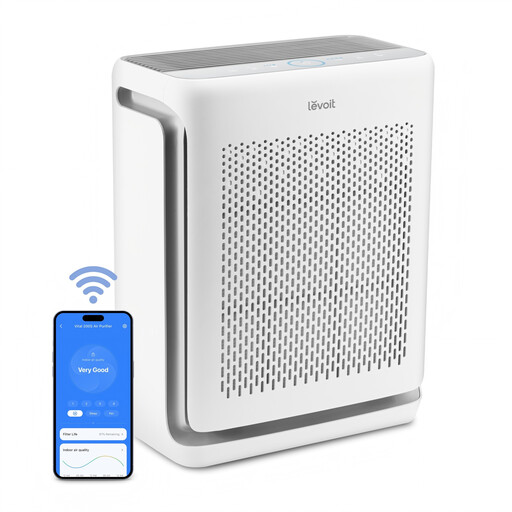
Levoit lists coverage of up to 147 m² for the Core 600S, based on cleaning the air twice an hour. According to the manufacturer, the model includes an app display showing filter life.
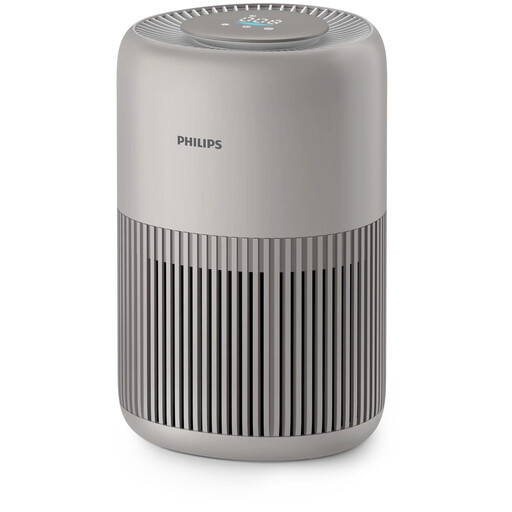
For the AC3033/10 in the 3000i Series, Philips lists a particle CADR of 520 m³/h and coverage of up to 135 m².
For the Smart Air Purifier 4 Pro, model AC-M15-SC, Xiaomi lists a particle CADR of 500 m³/h and coverage of 35–60 m².
The air purifiers below may suit homes with pet allergens and larger rooms. Compare each model’s performance figures with your room size and desired air change rate.
 No image available
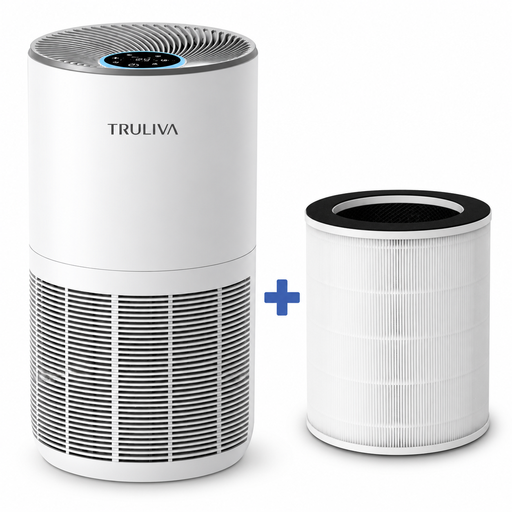
For large rooms where airborne pet allergens are a key concern. The product name lists a CADR of 450 m³/h, which you should compare with your room volume and desired air change rate.
Features listed include an H13 True HEPA filter, three-stage filtration and an extra replacement filter.
 No image available
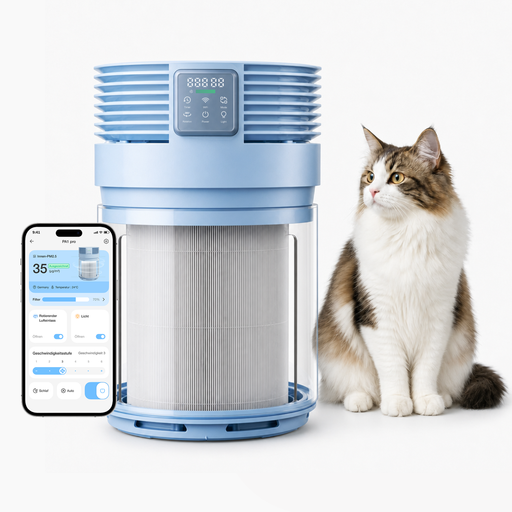
If pet odours matter as well as airborne particles, the product name lists an activated carbon filter. Check whether the purifier is suitable for the size of your living room using an appropriate performance figure.
Features listed include an H13 HEPA filter, activated carbon filter, automatic mode and digital display.
 No image available
This model may suit a living room if its stated coverage of 65 m² matches your actual room size. Check the performance figure for the setting you intend to use.
The product name lists 65 m², 49 dB and 21 W. Check the conditions under which the coverage and noise figures were measured.
 No image available
For pet owners looking for a Pet Mode and washable pre-filter. The stated coverage of 88 m² is based on two air changes per hour.
The product name lists a washable pre-filter. Check whether the air change assumption suits the size of your living room.
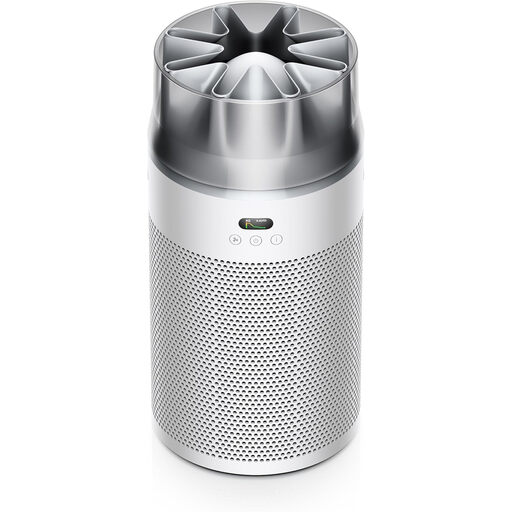 No image available
If odours are a concern as well as pet allergens, the product name lists electrostatic filtration and a 360° activated carbon filter.
The stated coverage of up to 100 m² is based on one air change per hour. The one-year figure applies to the activated carbon filter; the five-year figure applies to the electrostatic filter.
No. Consider the room’s floor area, ceiling height and particle CADR, as well as the air change assumption behind the manufacturer’s figure. AHAM Verifide uses 4.8 air changes per hour for its verified room sizes; this basis does not automatically apply to every manufacturer’s figure.
No. An air purifier filters the air that passes through it. ECARF notes that cat allergens can also be found on furniture and textiles, so these need to be cleaned separately.
Before buying, check the exact name of the replacement filter and follow the instructions for your specific model. Philips notes that filter life depends on usage and air quality; Xiaomi recommends replacing the Smart Air Purifier 4 Pro filter every six to twelve months.
No. The German Environment Agency notes that portable air purifiers do not remove CO₂ or water vapour from indoor air. Its statement relates mainly to classrooms, rather than a performance test specific to living rooms.
No. Simply listing an ionisation function does not tell you whether a specific model emits ozone. If you want to avoid this feature, check the operating options on the appliance.