
Lieferung heute & morgen

Qualitätsgarantie

Willkommens-Angebote freischalten: KOSTENLOSE Lieferung | Bis zu 80 % RABATT | Kostenlose 30-Tage-JoyPlus-Testphase
App herunterladen
An airbed can be a practical spare bed when guests stay over, you’re sleeping in a tent, or you only occasionally need an extra sleeping surface at home. However, poor purchases often happen not because of the price, but because of unclear information about size, pump, weight capacity and intended use.
Before you buy, you should keep three typical pitfalls in mind:
First, check the actual external dimensions and the available space in the room, tent or vehicle. An inflatable guest bed for one person is typically around 76 to 99 cm wide. Models that are 137 to 152 cm wide may be intended for two people, but they need more floor space.
The height affects getting in and out. An airbed that is 22 to 25 cm high is usually easier to transport and fits well in many tents. An airbed that is 33 to 42 cm high can be more comfortable to get out of at home, but it is often larger and heavier when folded.
Also pay attention to the maximum weight capacity stated by the seller. For the models listed here, the figures range from 136 kg for single models up to 272 kg for certain full and queen models. These values should not be taken as a general comfort guarantee, but rather as a weight limit to be observed.
With an Intex airbed featuring Fiber-Tech construction, many polyester fibres form the internal structure. With a Bestway airbed, on the other hand, Tritech material and coil-beam constructions may be used. Such details describe the build, but they don’t replace checking the dimensions and weight capacity.
A flocked top feels less smooth and can help stop your fitted sheet from slipping. The sides and bottom of many models are made from PVC or vinyl. This material should be protected from sharp objects, pointed stones, animal claws and excessive heat.
An airbed with a pump can be set up more quickly than a model without one. However, the power source is the key factor when choosing:
A self-inflating mattress is not automatically the same as an airbed with a built-in pump. Read the product description carefully so you don’t have to buy a separate pump or a compatible mains adapter afterwards.
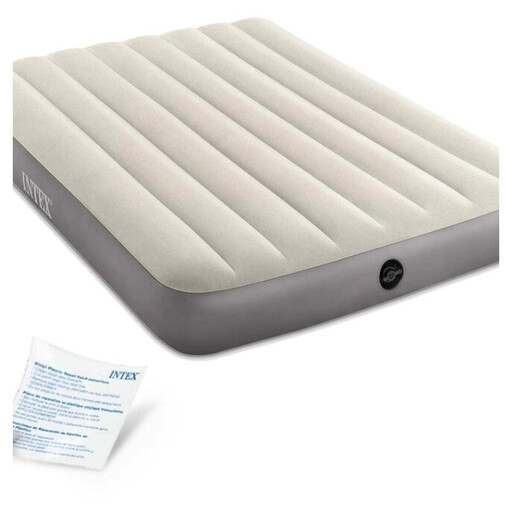
Why this product suits the profile: The full size offers a wide sleeping surface for one or two people, while the model without a built-in electric pump can be used flexibly with an existing hand, foot or electric pump.
The 2-in-1 valve design makes inflation and deflation easier. However, you will need to have a separate pump or budget for one.
137 x 191 x 25 cm, Fiber-Tech construction, flocked top and stated weight capacity up to 272 kg.
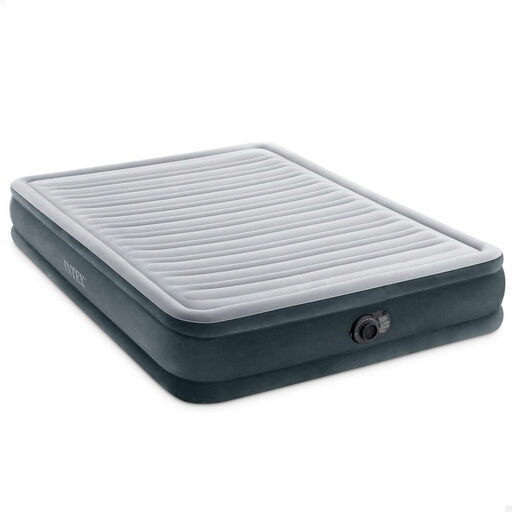
Why this product suits the profile: This raised two-person airbed is designed for regular use as a guest bed or temporary sleeping solution at home.
The product details clearly state the dimensions, pump type, number of people and weight limit. This makes it easier to check the space requirements before you buy.
152 x 203 x 33 cm, built-in 220–240 V pump, Fiber-Tech construction and stated weight capacity up to 272 kg.
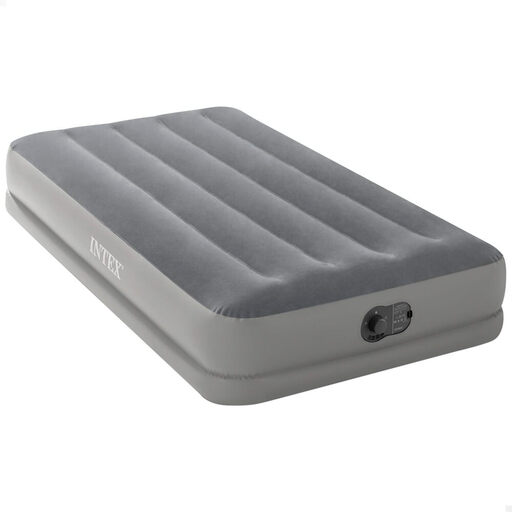
Why this product suits the profile: At 99 x 191 x 30 cm, this single bed is ideal for camping, festivals and guests. The built-in USB pump can be powered by a compatible 5-volt USB source.
The USB power supply reduces reliance on a 220–240 V mains socket. However, you must check the compatibility of the power source before use.
99 x 191 x 30 cm, built-in USB pump, stated weight of 3.22 kg and maximum weight capacity of 136 kg.
We’ve put together a full, regularly updated list of products that fully meet these strict selection criteria and the safety regulations in force in the EU.
Always place your airbed on a clean, level surface. When camping, remove stones, twigs and other sharp objects. A groundsheet can provide extra protection against abrasion. Do not inflate the mattress beyond the recommended comfort firmness.
After use, let the airbed dry completely before folding it away. Store it in a cool, dry place away from direct sunlight. PVC can be damaged by heat, UV radiation and incorrect storage. The actual lifespan depends on how often you use it, the surface, the weight load and how well you look after it.
Depending on the model and pump, the product details usually state around two to six minutes. A built-in electric pump is generally faster than a hand or foot pump. The first time you use it, you may occasionally need to top it up, as the material can stretch slightly at first.
For camping and festivals, a small pack size, low weight and a pump that doesn’t rely on the mains are important. A USB pump with a power bank or a manually operated pump may be more suitable than a 220–240 V model. Also check that the dimensions fit inside your tent and that the ground is adequately protected.
The exact consumption depends on the power and inflation time of the built-in pump. When making your buying decision, the stated voltage, running time and power source are more important than general consumption claims. For occasional use, compatibility with your existing mains socket or USB power source is usually the key factor.