
Lieferung heute & morgen

Qualitätsgarantie

Willkommens-Angebote freischalten: KOSTENLOSE Lieferung | Bis zu 80 % RABATT | Kostenlose 30-Tage-JoyPlus-Testphase
App herunterladen
An air fryer with dehydrator function combines several kitchen appliances in one unit. Depending on its design, it can fry, bake, grill, roast and dry food. That sounds practical for families, meal-prep enthusiasts and keen home cooks. However, appliances vary considerably in terms of temperature range, interior space, cleaning and their actual suitability for dehydrating.
If you focus only on large litre capacities or a wide range of automatic programmes, you could end up buying an appliance that is too small for everyday use, difficult to clean or unsuitable for the type of dehydrating you have in mind. The following criteria will help you assess marketing claims objectively.
A specification such as 9-litre air fryer or 30-litre air fryer initially describes the volume. However, what really matters is how that volume is divided between baskets, shelves or dehydrator trays.
A tall cooking chamber may be suitable for a pizza or a whole chicken, while a single basket may be less practical for several portions of chips. Conversely, dual-zone appliances offer two separate areas, but require more worktop space and may have chambers of different sizes.
An air fryer with a dehydrator programme is versatile, but not every model operates within the temperature range suitable for delicate foods. Low temperatures and even air circulation are important for fruit, vegetables and herbs. Meat also involves additional legal and hygiene requirements relating to preparation, temperature control and storage.
A food dehydrator with temperature control is often designed specifically for long drying cycles. Before buying, you should therefore check:
A multifunction air fryer with 20 or more programmes may appear highly flexible. In practice, what matters is whether you can adjust the temperature and time manually, and whether the programmes are clearly named. A touchscreen can be convenient, while dial controls may be more practical with dirty or wet hands.
Cleaning is also often underestimated. Non-stick coatings, removable racks and dishwasher-safe parts can reduce the effort involved. Nevertheless, you should check the manufacturer’s specifications carefully, as not every component will be suitable for the dishwasher.
For a food dehydrator for fruit and vegetables, a low, adjustable temperature range is important. According to the product specifications, the WOOX appliance operates from 35 to 75 °C and has a timer of up to 72 hours. This is a different design focus from many air fryers, whose temperature range starts at around 80 °C.
According to the product data, the aeco DUO Dual Chamber Air Fryer offers a range of 80 to 200 °C. Although it has a dehydration programme, this temperature range makes it more of a combination appliance for hot food preparation than a traditional dehydrator for especially low temperatures.
Even air circulation affects whether food dries evenly across several levels or whether certain areas dry out more quickly. With an air fryer with dehydrator, you should therefore pay attention to the position of the fan, the number of racks and the permitted load.
An appliance with four dehydrator trays can hold more thinly sliced fruit than a single frying basket. For crispy foods, however, unrestricted air circulation in the basket is often more important than the maximum number of levels.
The wattage indicates the maximum electrical power, not automatically the speed or the result. The aeco DUO is rated at 2,850 watts and has two chambers of 3 and 6 litres. According to the product description, the OIMIS models have 1,800 watts and a capacity of 30 litres.
For ongoing use, the following applies: the longer a dehydrating programme runs, the more strongly the duration and power consumption affect your electricity costs. A simple guide is:
Cost = power in kilowatts × operating time in hours × individual electricity price.
With two appliances using different amounts of power, a longer period of low-level heating can therefore work out differently from a short cooking process. Actual consumption depends on the programme, ambient temperature and how fully the appliance is loaded.
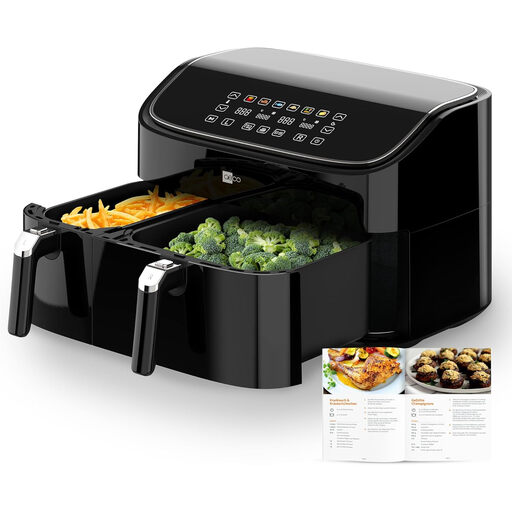
Why this product suits this profile: Two separately controlled chambers of 3 and 6 litres allow you to prepare different foods at the same time. The SYNC function can align the finishing times.
The usable chamber sizes are clearly stated. Buyers can match the layout more accurately to their portion sizes instead of focusing solely on the total volume.
9-litre total capacity, six programmes, digital touchscreen and dishwasher-safe grill racks according to the product specifications.
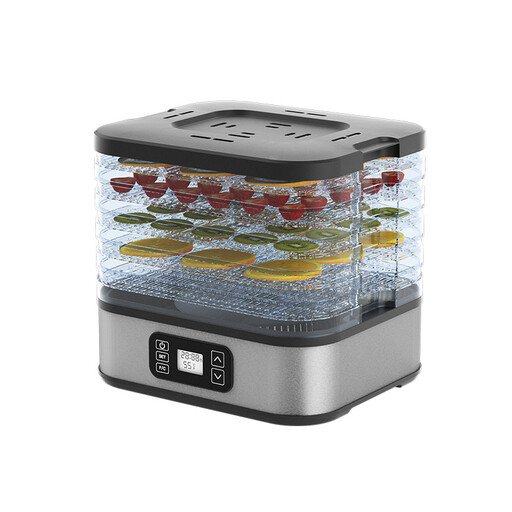
Why this product suits this profile: Its design is focused on drying, making it suitable for users who regularly want to prepare fruit, vegetables, herbs, meat or pet treats.
The temperature range from 35 to 75 °C and the timer of up to 72 hours are clearly specified. This makes it easier to assess whether the appliance is suitable for long dehydrating processes.
Five removable dehydrator trays, 360-degree air circulation, a transparent design and an operating noise level of up to 45 dB according to the product specifications.

Why this product suits this profile: The large cooking chamber is designed for families and users who want to prepare pizza, toast, roasts or grilled dishes as well as dehydrated food.
The product data lists 30 litres, four fruit trays and 21 programmes. This makes it clear before buying whether the appliance is geared more towards versatility than small dehydrating batches.
30-litre cooking chamber, 1,800 watts, rotisserie function and a temperature range from 30 to 230 °C according to the description.
We have put together a complete, regularly updated list of products that fully meet these strict selection criteria and the safety regulations applicable in the EU.
Yes, provided the appliance has a suitable dehydration programme and an appropriate temperature range. Fruit and vegetables should be cut into evenly thin slices and placed with enough space between them. With a single frying basket, the quantity may be limited. For regular, larger batches, a food dehydrator with several levels is usually more practical.
The lifespan depends on factors including how often it is used, cleaning, the coating, the fan and the heating system. It is not possible to give a reliable general lifespan based solely on the wattage or litre capacity. Avoid overfilling the appliance, clean it according to the manufacturer’s instructions and allow it to cool down completely after use.
That depends on how you plan to use it. A combination appliance saves worktop space and can handle several cooking tasks. A separate food dehydrator, on the other hand, is designed for low temperatures and long running times. Compare the purchase price, electricity consumption, usable dehydrating area and the functions you will actually use regularly.