
Lieferung heute & morgen

Qualitätsgarantie

Willkommens-Angebote freischalten: KOSTENLOSE Lieferung | Bis zu 80 % RABATT | Kostenlose 30-Tage-JoyPlus-Testphase
App herunterladen
An airplane toy for children can encourage role-play, building or first flying experiences. The range extends from simple toy airplanes and airport playsets to remote-controlled aircraft for children. However, differences in recommended age, dimensions, power supply and small parts can be substantial.
Anyone who buys based solely on lights, sounds or eye-catching packaging can quickly overlook important details. Three common purchasing mistakes occur particularly often:
The manufacturer’s age recommendation is an important starting point. For an airplane toy for children aged 3 and over, parents should pay particular attention to detachable accessories, figures, battery compartments and small wheels. Products containing small parts must not be given to children under three, as they may pose a choking hazard.
LEGO models are often recommended for ages 6, 7 or 8 and up, depending on their complexity. A LEGO airplane with 333 building blocks presents different requirements than a large toy airplane that requires only a few simple steps. For younger children, clearly structured functions, sturdy connections and easily accessible controls are generally more practical.
Before buying, it should be clear how the child wants to play:
A product with numerous functions is not automatically the right choice. What matters is whether the assembly, operation and storage requirements suit the child’s age and the available play area.
For plastic models, the product description should explicitly specify a material such as ABS plastic. For construction and playsets, the number of parts, model dimensions and the stability of the connections are also relevant.
For electronic models, it is worth checking:
Children should not operate remote-controlled models near faces, hair or loose clothing. In Germany, the instructions for use and the product labelling must also be followed. Depending on their weight, location of use and features, drones may be subject to additional legal requirements. Before operating one outdoors, parents should check the current regulations.
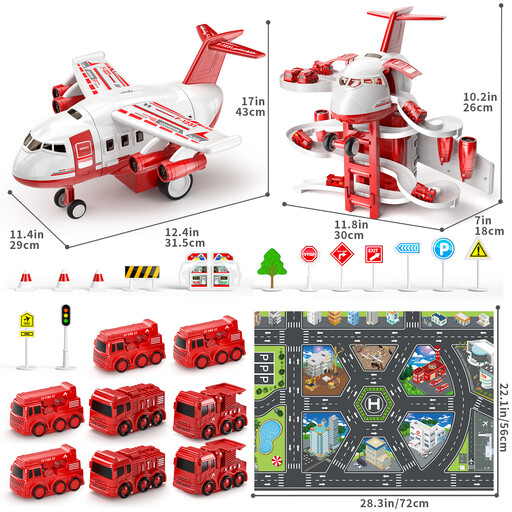
Why it suits this profile: The set is described as suitable for children aged approximately 3 to 8 and combines airport role-play with a racetrack. It can be used indoors or outdoors.
The play experience is not limited to sound effects: the set includes a play mat, eight vehicles and a convertible racetrack.
The vehicles move by pushing, while the wings can be removed. Light and sound functions are activated with a button.
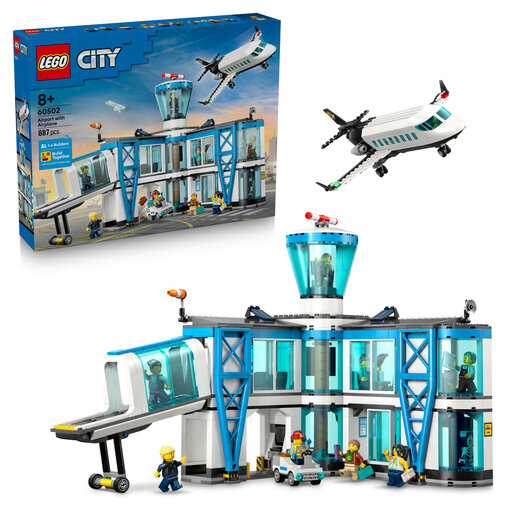
Why it suits this profile: For children aged 8 and over, the set offers an airport, a passenger airplane, nine minifigures and 887 building blocks for both construction and role-play.
The number of parts, dimensions and recommended age are clearly specified. This makes it easier to assess the space required before buying.
An airport terminal, jet bridge, luggage scanner, display board and several vehicles enable a wide range of scenarios.
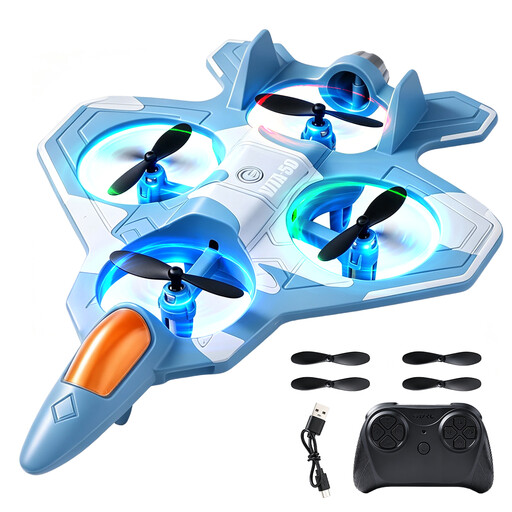
Why it suits this profile: According to the product information, the model is intended for children aged 8 and over and is designed for supervised flights indoors and outdoors.
The description specifies one-button take-off and landing, altitude hold and propeller protection. An open area and adult supervision are still required.
The specifications include a 2.4 GHz remote control, a rechargeable 3.7 V battery, LED lighting and additional spare propellers.
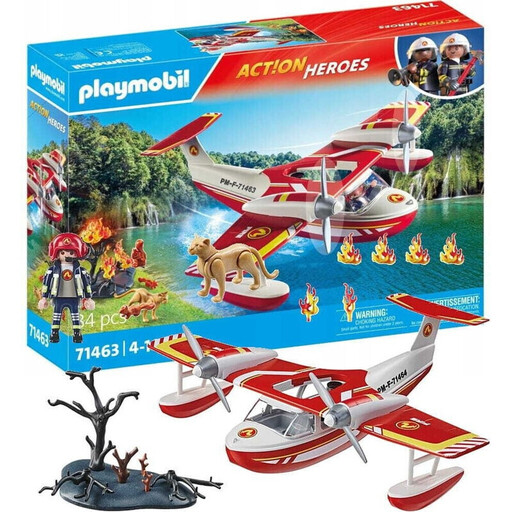
Why it suits this profile: Children aged 4 and over can create their own rescue scenarios with a figure, animals, flames and a manual water function.
The central play feature works without batteries, making it independent of charge levels and battery availability.
The product specifications list rotating propellers, water intake and release, as well as a wingspan of approximately 40 cm.
The complete selection includes airplane toys organised by play style, age and features, including construction, role-play and RC models.
For children aged 3 and over, large, easy-to-use models without loose small parts are suitable options. A toy airplane with a play mat, vehicles or a manual play function may require less effort to operate than a construction kit. The manufacturer’s specific age recommendation and safety warnings must be checked before buying.
This depends on the model’s size, propeller protection and the manufacturer’s specifications. Compact indoor models are designed for indoor use but still require sufficient distance from furniture, people and fragile objects. Larger RC models are better suited to an open environment. Adults should supervise children during their first flying attempts.
Mechanical models generally incur no ongoing energy costs. An airplane with lights and sound requires batteries. RC models require electricity to charge the battery and often additional AAA or AA batteries for the remote control. Before buying, check whether the charging cable, battery and batteries are included.