
Lieferung heute & morgen

Qualitätsgarantie

Willkommens-Angebote freischalten: KOSTENLOSE Lieferung | Bis zu 80 % RABATT | Kostenlose 30-Tage-JoyPlus-Testphase
App herunterladen
Coffee beans, ground coffee and tea are sensitive to moisture, oxygen, heat and light. Sealing a coffee canister airtight can make everyday storage easier – provided that its design, material and capacity match your actual consumption.
However, many households buy based on colour or advertising claims. This can lead to common mis-buying mistakes: the canister is too large, the lid does not stay sealed or cleaning is more complicated than expected. The following buying guide explains what coffee lovers, owners of bean-to-cup and espresso machines, offices and cafés should look out for.
A lid that sits firmly in place is not automatically hermetically sealed. The key factors are a properly fitting seal, a secure closure and a clean canister rim. A vacuum coffee canister also has a mechanism that removes air from the container. However, the vacuum function must be used correctly and does not replace proper storage.
A large coffee storage canister may seem practical if it can hold several packs. However, if a lot of empty space remains after some coffee has been removed, there will correspondingly be more air inside the container. For households with low consumption, a smaller airtight coffee container is often easier to manage day to day. For 500 g of coffee beans, always check the usable internal capacity against the manufacturer’s specifications.
A stainless-steel coffee canister typically protects its contents from light and is resistant to knocks. A glass coffee canister makes the fill level visible, but may be heavier and more prone to breakage. Wooden lids, enamel surfaces and sealing rings also require the specific cleaning method recommended for them. Do not assume that a product is dishwasher-safe unless the manufacturer states this.
For coffee beans, tea and dry foods, the product should be explicitly intended for food contact. Borosilicate glass is more resistant to temperature changes than ordinary glass, but sudden changes in temperature should still be avoided. For plastic containers, pay attention to the food-safe materials specified by the manufacturer.
Stainless steel is opaque and suitable for storage on the worktop. An enamel coating can provide additional colour options, but should not be cleaned with abrasive products if the manufacturer advises against them.
Look for:
With a manual vacuum canister, the vacuum indicator or operating button should be easy to reach. The vacuum must be recreated after each opening. A moisture indicator, on the other hand, only provides a guide value. For the MHW-3BOMBER model, the manufacturer explicitly points out that the integrated hygrometer is not intended to be a highly precise measuring instrument.
The right size depends on your consumption and the type of coffee:
Before buying, also measure the space next to your bean-to-cup or espresso machine. A canister with sufficient capacity can still be impractical if its diameter is too large.
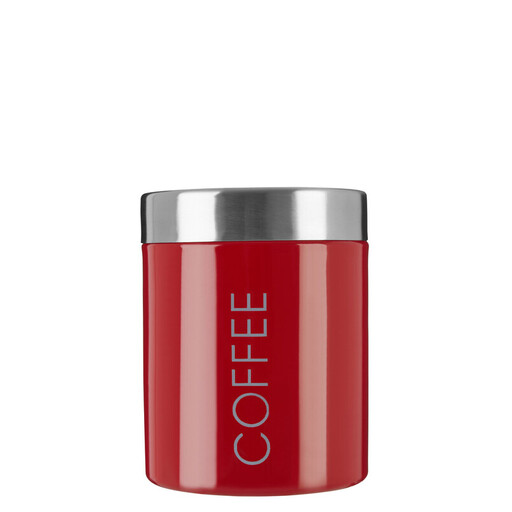
Why this product suits this profile: Measuring H13 x D10 x W10 cm, this compact canister is suitable for anyone looking for a clearly labelled coffee storage canister with manageable dimensions.
The manufacturer’s specifications mention a tightly closing lid and an all-stainless-steel construction. The canister is not described as dishwasher-safe, so it should be washed by hand.
Stainless-steel body, clear vertical “coffee” lettering and a satin-finish stainless-steel lid.
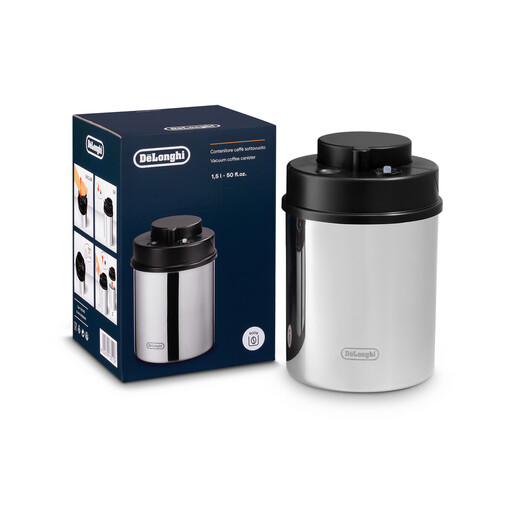
Why this product suits this profile: Suitable for bean-to-cup and espresso machines, this canister features a manual vacuum system, a date indicator and a capacity of 1,300 ml or up to 500 g of coffee beans, according to the product specifications.
The vacuum function is operated using large and small buttons. After opening, the vacuum can be deliberately released and then recreated.
Polished stainless-steel body, manual vacuum sealing and integrated date indicator.
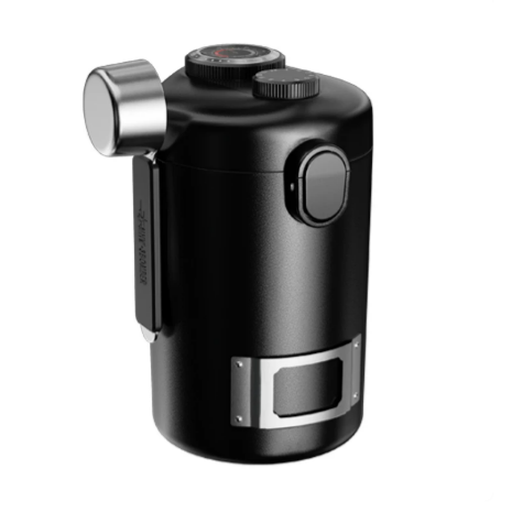
Why this product suits this profile: This canister is aimed at home baristas, offices and cafés that want to keep coffee, tea, dry foods or accessories neatly organised.
The manufacturer specifies a silicone sealing ring, a double storage structure and a moisture indicator. According to the product information, the indicator is intended only as a guide.
Food-safe contact materials according to the product description, moisture monitor and two-layer internal construction.
If you want to organise coffee, tea and sugar together, you can use a tea, coffee and sugar canister set. The Premier Housewares sets with three containers are each labelled according to their contents. Please note that they are designed to be cleaned with warm soapy water or a damp cloth and are not described as dishwasher-safe.
For individual ingredients, the Hermet glass containers with acacia wood lids are a suitable choice. Depending on your needs, the versions with 0.4 litres, 0.6 litres and 1.6 litres of usable capacity can be used for coffee, tea, nuts or other dry foods. The glass and lids should be washed by hand; the 0.4-litre container is explicitly not suitable for use in a microwave, oven or dishwasher.
A coffee canister is not the right solution for capsules. A capsule holder for 32 capsules, such as the 5Five model, measures 29 x 10 x 10 cm and is made from powder-coated alloy steel. It keeps capsules neatly arranged and is designed for use on a flat, stable surface.
We have put together a complete, regularly updated list of products that fully meet these strict selection criteria and the safety regulations applicable in the EU.
Place the container somewhere dry, cool and protected from light wherever possible. Keeping it near the hob, oven, dishwasher or in direct sunlight is not recommended. Only fill it with dry beans or dry ground coffee, and close the lid immediately after removing coffee.
Its service life depends on the material, seal and care. Stainless-steel and glass containers can be used for a long time if handled carefully. Check regularly whether the sealing ring has become brittle, deformed or loose. If the glass is cracked, the lid is damaged or the closure no longer seals properly, the container should no longer be used for food.
That depends on your consumption and how often the container is opened. A manual vacuum coffee canister can be useful if you store larger quantities of coffee and do not open the container constantly. For daily use and quick consumption, a suitable airtight coffee container with a reliable seal is often sufficient. Ease of use, size and regular cleaning are what matter – not simply the word “vacuum” on the packaging.