
Lieferung heute & morgen

Qualitätsgarantie

Willkommens-Angebote freischalten: KOSTENLOSE Lieferung | Bis zu 80 % RABATT | Kostenlose 30-Tage-JoyPlus-Testphase
App herunterladen
If you’re looking for the Faber-Castell Albrecht Dürer Watercolour Pencils, Set of 30, you’ll want a versatile tool for drawing, illustration and watercolour techniques. Combining dry coloured-pencil drawing with layers of colour that can be blended with water is practical, but there are a few common pitfalls to watch out for. Products described as ‘watercolour pencils’ don’t all offer the same contents, lead thickness or storage options.
This buying guide from the Joybuy Product Recommendation Officer will help you assess product details objectively and choose a watercolour pencil set to suit your drawing style.
Water-soluble coloured pencils are designed to let you blend the colour you’ve applied with water. That’s useful for watercolour techniques. However, it also means the colour layer doesn’t automatically become waterproof once it has dried. The Faber-Castell Albrecht Dürer Set of 30 is explicitly described as not water-resistant.
For finished work, it’s best to use a protected workspace and, depending on the paper and how you plan to use the artwork, apply a suitable fixative or frame it. Protect fabrics, furniture and other delicate surfaces from colour pigments and water.
A set with 30 colours offers more choice than a 12-piece watercolour pencil set, but it won’t necessarily include every individual colour you need. The key is to choose a palette that suits your subject. Landscape artists often need several greens, blues and earth tones, while illustrators may also want skin tones, greys or pastels.
It’s also worth checking whether you can buy the pencils individually. This matters if you use certain shades particularly often.
A loose box can be impractical in a rucksack and may leave pencil points more vulnerable to damage. The selected Faber-Castell set comes with a roll-up pencil case and a water brush. This makes it easier to carry and lets you blend colours on the go. However, you should empty the water brush completely before storing it and keep the pencils dry.
According to the product details, the 30-piece set has 3.8 mm leads. A thicker lead can be useful for covering larger areas and offers several usable edges for hatching. The hexagonal wooden barrel provides a firm grip and helps stop the pencil rolling off the table.
The stated line width is approximately 2 mm or more. For very fine details, you’ll need a well-sharpened point. A quality sharpener for artists’ coloured pencils can help reduce the risk of unnecessarily damaging the wooden barrel or lead while sharpening.
The Set of 30 is listed as grade B. Compared with harder leads, a B-grade pencil can give a softer application of colour. This works well for shading, layering and smooth transitions. For precise outlines, sharpen the point regularly.
The details for the 12-piece Albrecht Dürer set, by contrast, state grade F. This difference shows why it’s important to check the product specifications directly rather than comparing products by brand name alone.
Water-soluble coloured pencils can be used in two ways:
Watercolour paper or another suitably sturdy paper is best for wet techniques. Thin, standard paper may buckle or roughen when wet. A water brush is handy when you’re out and about, while a traditional watercolour brush often gives you more control over the amount of water for larger areas.
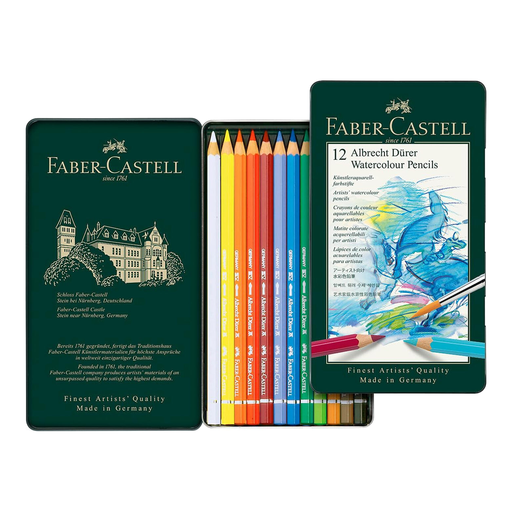
Why this product suits this profile: The 12-piece set is a compact way to try water-soluble coloured pencils and work out how many colours you need.
The product details explicitly mention water-soluble pigments and storage in a metal tin. This makes it easier to understand the colouring technique and what’s included.
12 coloured pencils, 3.8 mm leads and a metal tin; according to the product details, suitable for dry and wet techniques.
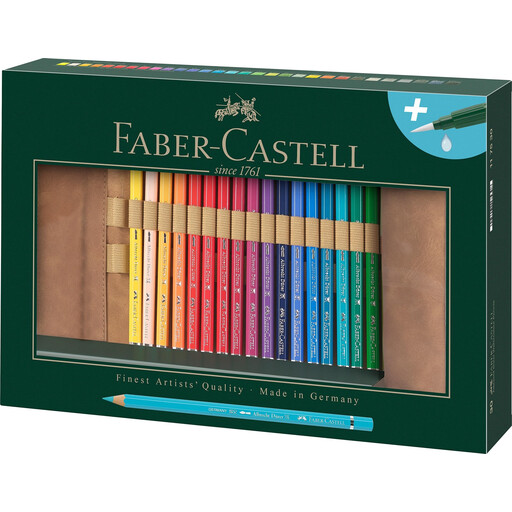
Why this product suits this profile: For illustrators and artists who regularly work with a range of colours, this set combines 30 shades with dry and watercolour techniques.
The details specify the 30 pencils included, their 3.8 mm leads, the roll-up pencil case and the water brush. The fact that they are not water-resistant is also made clear.
30 colours, grade B, hexagonal wooden pencils, a roll-up pencil case and a water brush.
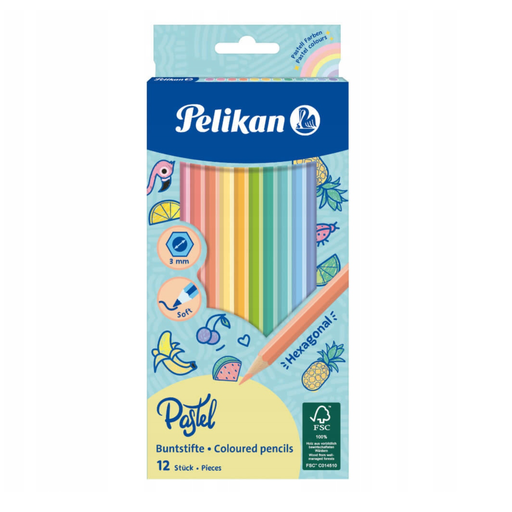
Why this product suits this profile: If you mainly make dry sketches, colourful notes or creative DIY projects, a non-water-soluble coloured pencil set may be a better fit.
The product description identifies these as coloured pencils for drawing and writing. If you don’t need wet techniques, you won’t be paying for a feature you won’t use.
12 coloured wooden pencils for drawing and writing; according to the product details, they can also be used with other art materials.
We’ve put together a complete, regularly updated list of products that meet these strict selection criteria and fully comply with the safety regulations in force in the EU.
For consistent results, store the pencils somewhere dry and away from high humidity. The roll-up pencil case keeps them organised, provided you empty the water brush separately. Use a clean, suitable sharpener, as a damaged lead can produce uneven lines.
When choosing paper, heavier drawing paper may be enough for a few light touches of water. For larger washes, watercolour paper with a suitable weight is a better choice. Before starting a larger piece, try a small colour sample: the dry colour may look different once it has been blended with water.
Yes. According to the product details, the 30-piece set is recommended for adult artists, illustrators and hobby painters. You can use it dry, like a traditional artists’ coloured pencil, or with water to create watercolour effects. As the pencils have sharp points, store them safely and out of reach of small children.
According to the product information available, the Faber-Castell 117530 Albrecht Dürer set includes 30 watercolour pencils, a roll-up pencil case and a water brush. However, you should still check the current product page for the contents and availability before buying.
There’s no reliable way to give them a fixed lifespan. It depends on how often you draw, how much pressure you use, the size of your work and how often you sharpen the pencils. Using moderate pressure, choosing a suitable sharpener and storing the pencils in a dry place can help you manage how quickly they’re used up. Colours you use frequently may need replacing sooner than those you rarely use.