Frequent two-tray bakers
If you regularly want to bake larger batches of almond biscuits in one go, check whether your oven’s instructions allow multi-level baking with two suitable shelves and trays.


An oven is suitable for baking almond biscuits on two trays only if its instructions expressly allow multi-level baking for flat pastries, and the shelves and two suitable trays are compatible. AEG Germany recommends using several levels only if the instruction manual allows it. Keep an eye on how the biscuits are browning, and follow your oven’s guidance on removing or swapping trays. If you don’t have space for a built-in oven, a mini oven could be an alternative for smaller batches. However, having several shelf positions alone does not confirm that you can bake on two trays at the same time.
If you regularly want to bake larger batches of almond biscuits in one go, check whether your oven’s instructions allow multi-level baking with two suitable shelves and trays.
If you want to keep an eye on both trays and remove or swap one if they brown at different rates, check the oven’s guidance on the heating function and shelf position.
If a built-in oven won’t fit in your kitchen, you could consider baking smaller batches in a freestanding mini oven, weighing up the tray space available against the possibility of needing extra batches.
First decide what matters most to you: baking on two trays at once, being able to control browning, finding the right type of oven, or energy consumption.
| What you need | What to look for | Who is it important to? |
|---|---|---|
| Two trays at once | Check the appliance instructions for multi-level baking with flat pastries, and make sure you have two suitable trays. | If I want to bake larger batches in one go, I need to know that the oven is actually designed for using both levels. Around 36% of consumers put baking capacity first. |
| Browning and swapping trays | Check the recommended shelf positions and how easy the trays are to reach; always follow the appliance’s baking instructions. | If I want to keep an eye on how both trays are browning and safely remove one if needed, an easy-to-manage layout is important. Around 29% of consumers prioritise being able to control browning. |
| Oven type and tray space | For built-in ovens, check the dimensions of the available space; for mini ovens, check the usable tray area. | If the oven needs to fit into an existing kitchen, I need to decide whether I’m happy to bake smaller batches. Around 21% of consumers put finding the right type of oven first. |
| Energy consumption and accessories | For labelled appliances, compare the consumption in kWh per standard cycle and the trays supplied. The Verbraucherzentrale explains the standard cycle as a comparison figure. | If I bake often, I want to assess energy consumption and the accessories I need separately, rather than treating the energy label as a cost estimate for my recipe. Around 14% of consumers prioritise running costs and accessories. |
The Rommelsbacher BGE 1580/E has four shelf positions, but this doesn’t confirm that it can bake on two trays at once. The manufacturer lists one baking tray as supplied with this model.
Check the instructions for your specific appliance to see whether it allows multi-level baking for pastries, and find out which compatible trays you can use.
AEG notes that results depend on factors including the type of pastry, temperature, baking time and shelf position. One tray may therefore be ready before the other.
Keep an eye on both trays when baking times are short, and carefully remove a tray if it’s ready first. Don’t automatically swap the trays; check your oven’s instructions.
The consumption figure on the energy label relates to standard cycles, not directly to your almond biscuit recipe baked on two trays.
Use the figure in kWh per standard cycle for comparison, and check the accessories supplied separately.
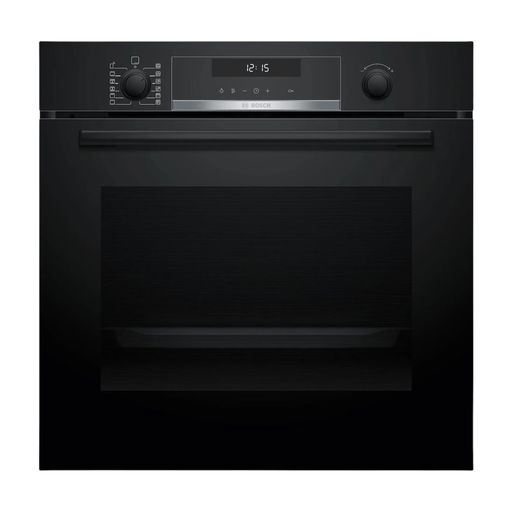
Built-in ovens such as the HBA571BB4, with 3D Hotair designed for up to three levels, according to the manufacturer.
Built-in ovens with features that vary by model; Siemens says the HB013FBB1 has 3D Hotair for up to three levels.
SurroundCook built-in ovens with a ring heating element and a focus on baking on several levels, such as the BEE43511AB.
Ovens with Circo Therm; according to the manufacturer, the number of usable levels depends on the specific appliance.
Freestanding mini ovens such as the BGE 1580/E are an alternative if you don’t have space for a built-in oven.
This selection includes built-in ovens with listed fan-assisted cooking on several levels, as well as freestanding appliances as possible alternatives if you don’t have space for a built-in oven. For each model, check the instructions, usable tray area and accessories supplied.
 No image available
If you’re looking for a built-in oven with 3D Hotair for larger batches, the product description lists a 71 l capacity. It also specifies several heating functions and a temperature range of 30–275 °C; check the instructions for using two trays at the same time.
 No image available
For multi-level baking, the description lists 3D Hotair and up to three levels. It also specifies a 71 l capacity, five shelf positions and telescopic rails; accessories include a baking tray and an Air-Fry tray. Check that both trays are suitable for your recipe and the recommended shelf positions.
 No image available
If you’re considering a freestanding alternative to a built-in oven, this model is listed with a 30 l capacity. The product details specify 21 presets and six accessories; check the instructions and the exact tray dimensions to find out whether two trays will fit at once.
 No image available
If you regularly want to bake on several levels, this model is listed with 3D Hotair for up to three levels. It also has a 71 l capacity and five shelf positions. A universal pan and a wire shelf are included; check which additional compatible baking tray you’ll need.
 No image available
If you’re looking for a freestanding oven rather than a built-in model, the product description lists baking and grilling among its uses. It specifies a 32 l capacity, 1600 W and a temperature range of 100 to 250 °C; accessories include a baking tray, a wire shelf and a crumb tray.
No, not necessarily. Follow the instructions for the heating function and shelf positions for flat pastries, and keep an eye on how the biscuits are browning. If one tray is ready first, you can carefully remove it; only swap the trays if your oven’s instructions recommend it.
Don’t do so without checking. For example, a Dr. Oetker recipe for Canarian almond biscuits gives a temperature of around 200 °C for conventional top and bottom heat, or around 180 °C for fan-assisted cooking, and recommends baking on the middle shelf. For two trays, follow your oven’s baking chart and instructions, and keep a close eye on the short baking time.
It depends on the appliance and how it’s connected. Bosch states in the HBA571B.4 series instructions that appliances without a plug must only be connected by a qualified professional authorised to carry out this work. Check your model’s installation instructions and your existing wiring; this manufacturer requirement is not a blanket statement about every oven.
For household ovens with the relevant label, it shows consumption in kWh per standard cycle for conventional heating and fan-assisted cooking. This is a comparison figure, not the exact electricity consumption for an individual baking session with two trays of almond biscuits.
The statutory warranty against the seller generally lasts two years. According to the Verbraucherzentrale, for purchase contracts dated 31 July 2026 or later, the period is extended once by twelve months if you choose a repair when a fault occurs. This is separate from any voluntary manufacturer’s guarantee.