
Lieferung heute & morgen

Qualitätsgarantie

Willkommens-Angebote freischalten: KOSTENLOSE Lieferung | Bis zu 80 % RABATT | Kostenlose 30-Tage-JoyPlus-Testphase
App herunterladen
An aluminium frying pan can be a practical choice for everyday cooking thanks to its relatively light weight, quick heat conduction and various coating options. However, when buying one, the material name alone isn't enough. Details such as "non-stick", "suitable for induction" or "dishwasher-safe" need to be considered in relation to the pan's construction, care requirements and intended use.
Aluminium conducts heat well, but on its own it is not magnetic. For an induction frying pan, a ferromagnetic stainless steel plate or a similar base is usually required. If this information is missing, you should not assume it will work on an induction hob.
A specific example is the 5Five Forged aluminium frying pan with a 20 cm diameter: it is made of forged aluminium and, according to the product details, is suitable for gas and electric hobs, but not for induction hobs.
A coated frying pan makes it easier to release food and can reduce cleaning effort. However, the surface remains sensitive to metal utensils, abrasive cleaners, dry overheating and sudden temperature changes. A non-stick frying pan should therefore be used with wooden, silicone or plastic utensils, unless the manufacturer states otherwise.
A 20 cm frying pan is handy for an egg, a small portion or a single-person household. For two to three portions, a 24 cm frying pan is often suitable. Family meals usually require a 28 cm frying pan or a larger version with a higher rim. What also matters is the usable cooking surface, the pan's depth and the space available on your hob.
Aluminium generally heats up quickly and reduces the weight compared to many all-steel pans. A forged aluminium pan has a body shaped from an aluminium billet; the actual stability depends on the material thickness, base construction and workmanship. A base that sits sufficiently flat is particularly important on ceramic and induction hobs.
For everyday use, the following details are helpful:
A PTFE coating, a faux-stone surface or a ceramic frying pan are all different coating systems. "Ceramic-coated" does not mean the entire body is made of ceramic. The product description should therefore clearly state the type of coating.
Practical ground rules:
A dishwasher-safe pan may be approved for the dishwasher, but gentle hand washing with a soft sponge can protect the surface and the handle. For wooden handles, hand washing is usually especially important.
Before ordering, check your hob type against the product details:
Even an aluminium frying pan with an induction base can behave differently from a pure aluminium pan. The manufacturer's instructions on maximum temperature and handle use are what you should follow.
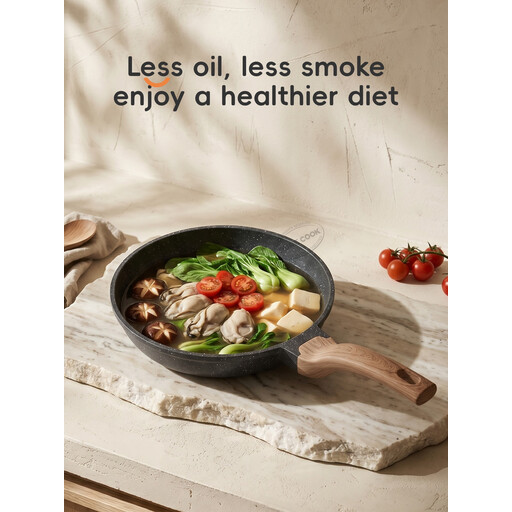
Why this product fits the profile: The 24 cm diameter covers typical portions for a household. According to the product details, this model is suitable for induction, gas and electric ceramic hobs, and has a lightweight aluminium body.
The hob compatibility is clearly stated. At the same time, it is explicitly noted that the pan is not dishwasher-safe and should be cleaned by hand.
24 cm diameter, aluminium alloy, faux-stone non-stick coating and suitability for multiple hob types.
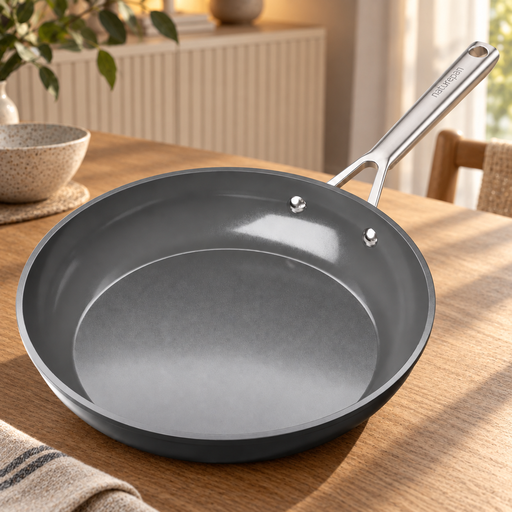
Why this product fits the profile: The 28 cm ceramic pan combines an aluminium body with a stainless steel handle and explicitly stated induction compatibility.
The product details distinguish between a ceramic coating and a ceramic body. Temperature limits, a hand-wash recommendation and suitable kitchen utensils are also specified.
28 cm diameter, stainless steel handle, aluminium body and stated suitability for induction, gas, electric and ceramic hobs.
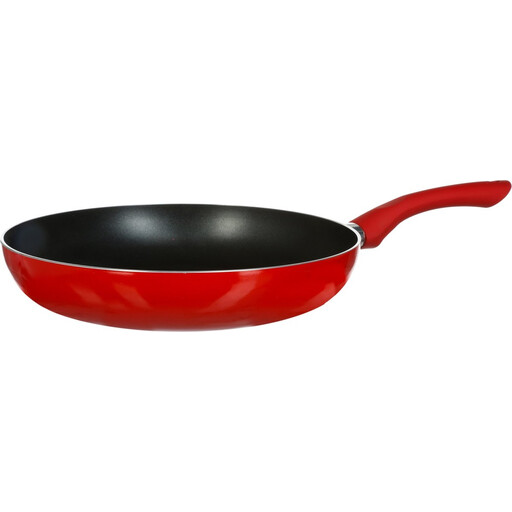
Why this product fits the profile: According to the product data, the 30 cm pan has a capacity of 2.8 litres, making it suitable for larger household portions and regular cooking quantities.
The details specify the diameter, height, capacity, weight and hob types. This makes it easier to check the space requirements against your own hob before buying.
30 cm diameter, 2.8 litre capacity, 940 g weight, two non-stick layers and suitability from gas to induction.
We have put together a full, regularly updated list of products that fully meet these strict selection criteria and the safety regulations in force in the EU.
For small portions and individual side dishes, a 20 cm frying pan is often sufficient. A 24 cm pan is practical for many two-person households. For family meals or multiple portions, a 28 cm frying pan or a 30 cm frying pan offers more surface area. Before buying, also check the storage space and the diameter of the heating zone.
No. Pure aluminium does not work directly on an induction hob. A suitable magnetic base is required, which should be explicitly stated in the product description. If in doubt, rely on the manufacturer's or retailer's specifications.
It is not possible to give a reliable fixed lifespan. It depends on factors such as the type of coating, temperature, cleaning and the kitchen utensils used. Low to medium heat, soft sponges and wooden or silicone utensils can help protect the surface. As soon as the coating starts to peel or becomes noticeably damaged, the pan should be replaced.