
Lieferung heute & morgen

Qualitätsgarantie

Willkommens-Angebote freischalten: KOSTENLOSE Lieferung | Bis zu 80 % RABATT | Kostenlose 30-Tage-JoyPlus-Testphase
App herunterladen
Whether you’re renovating, making furniture, sewing or maintaining a vehicle, measuring tools are often the foundation of a job well done. Yet when buying them, people often focus only on length, colour or a low price. What really matters is the intended use, how easy the tool is to read, its material and how practical it is to handle.
A measuring scale can be printed correctly and still be difficult to use in practice. Low contrast, small numbers or markings on one side only can slow you down and increase the risk of reading errors. With a tape measure or folding rule in particular, the scale should be easy to read from your working distance and in your available light.
A 30-metre measuring tool is useful for measuring plots or larger building areas, but awkward to carry in a small tool bag. Conversely, a short folding rule may not be long enough for fitting furniture, measuring rooms or cutting larger pieces. Weight, the return mechanism and the ability to lock the tool securely are also worth considering.
A protractor with lots of scales isn’t automatically suitable for every cut. For woodworking, a carpenter’s square, speed square or combination square may be more practical. So first work out whether you need to measure lengths, angles, heights, curves or air pressure.
The measuring range needs to suit the task. For interior work and furniture assembly, 3 to 7.5 metres is often enough. Longer tape measures are a better choice for greater distances. A 150 cm tailor’s measuring tape is designed for fabrics, body measurements and craft projects, while a height gauge needs a considerably greater range.
The resolution is the smallest scale division you can read. The WORKPRO combination square has a scale up to 300 mm, with both metric and imperial measurements. This is useful when working from measurements in international building plans or instructions.
An ABS plastic folding rule is lightweight and folds away neatly. If you’ll be using it regularly on building sites, check that the joints move smoothly and the scale remains easy to read after repeated folding. An aluminium square or a combination square with a metal ruler provides a stable reference edge for marking and checking work.
For flexible measuring, a pliable material is more suitable. A tailor’s measuring tape made from PVC or a similar flexible material can follow curves. However, it shouldn’t be twisted or stretched, as this can affect the reading.
A tape measure should retract in a controlled way and lock securely. With long steel tape measures, take care to avoid sharp edges and letting the tape snap back unchecked. A magnetic hook can make measuring on ferromagnetic surfaces easier, but it isn’t suitable for every environment.
For a spirit level, clearly visible vials, a flat base and an undamaged body are important. A V-groove can be useful for working with pipes. With a precision measuring tool, you should also take care to store it properly, protect it from knocks and inspect it regularly.
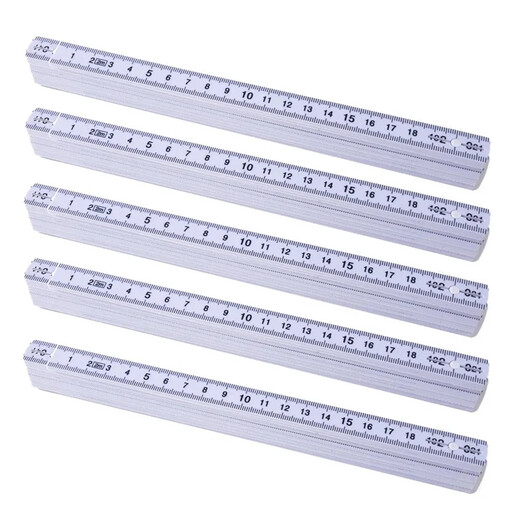
Why it suits this user: This set contains five folding rules, each measuring 2 m. That means you can equip several tool bags, workstations or areas around the home.
The white surface stands out against many work surfaces, while the folding design makes it easy to store compactly.
Five folding rules, each with a 2 m measuring length, made from ABS plastic and designed to fold away neatly.
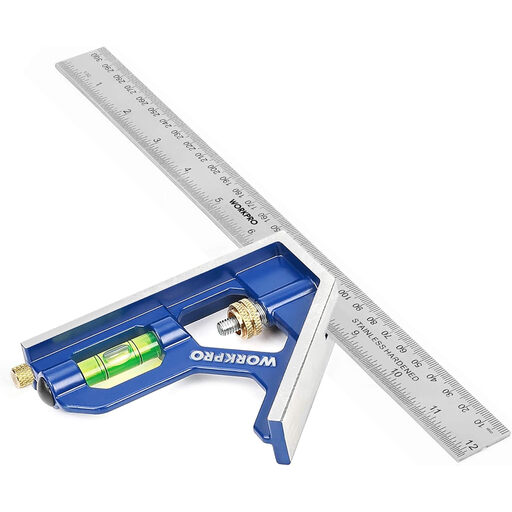
Why it suits this user: This combination square measures length, depth and width, checks 90- and 45-degree angles, and includes a spirit level.
The stainless steel ruler and zinc alloy head provide a sturdy reference for marking and checking work, while the scale is marked on both sides.
300 mm measuring range, metric and imperial scales, built-in scriber, locking screw and spirit level.
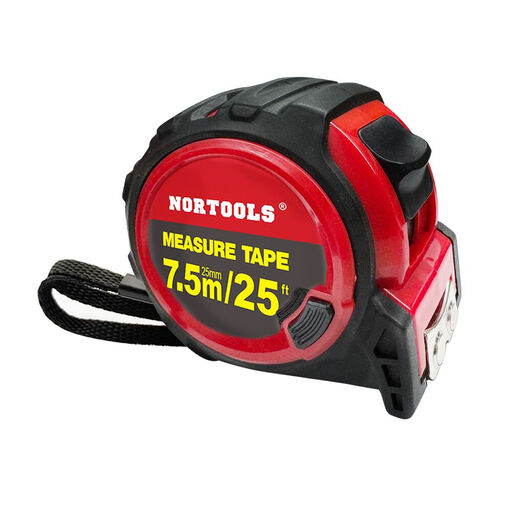
Why it suits this user: This 7.5 m tape measure is designed for building, renovation and workshop tasks where greater reach and one-handed operation are useful.
The dual centimetre and inch scale and three stop functions make it more versatile across different work settings.
Nylon-coated steel tape, magnetic hook, ABS case with TPR grip, belt clip and a stated blade stand-out of 2.2 m.
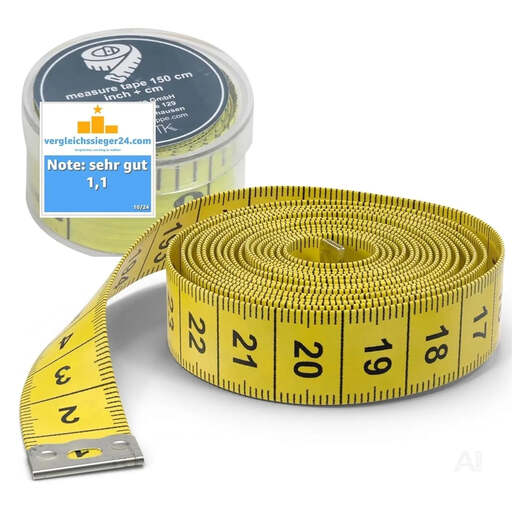
Why it suits this user: This flexible tailor’s measuring tape is ideal for fabric edges, sewing patterns, curves and body measurements for sewing and craft projects.
Its flexible design follows both straight and curved surfaces. The care instructions recommend not twisting or stretching the tape.
150 cm length, centimetre and inch scales, plus a storage box for compact storage.
We’ve put together a complete, regularly updated list of products that meet these strict selection criteria and the safety regulations in force in the EU.
For many homes and workshops, a tape measure, folding rule and spirit level are useful essentials. If you work with wood, add a carpenter’s square or combination square to your kit. For sewing and textile projects, a tailor’s measuring tape is more suitable than a rigid ruler.
Their lifespan depends on the materials, joints, tape mechanism and conditions of use. Dirt, moisture, drops and uncontrolled retraction can all affect how well they work. Store folding rules in a dry place and check for debris before folding them away. With steel tape measures, check regularly for kinks and damaged edges.
A digital height gauge, tyre pressure gauge or electronic protractor can be useful when you need to read or store measurements quickly, or display them in specific units. For straightforward measuring and marking, mechanical tools are often easier to use. The key considerations are the measuring range, display, power supply and stated accuracy for your intended use.