
Lieferung heute & morgen

Qualitätsgarantie

Willkommens-Angebote freischalten: KOSTENLOSE Lieferung | Bis zu 80 % RABATT | Kostenlose 30-Tage-JoyPlus-Testphase
App herunterladen
An amphibious remote-controlled car for children should be able to drive on grass, sand and gravel, float in shallow water and perform stunts too. In practice, however, unclear product information, unsuitable water conditions and weak batteries often lead to disappointing purchases. So, if you are looking for an RC stunt car for the pool or beach, do not focus solely on large tyres and eye-catching product images.
The term waterproof RC car does not automatically mean that the vehicle can be used in every type of water or in strong waves. The key factors are the information provided about sealing, maximum water depth and what to do after contact with water.
A model with a sealed housing and sealing ring may be designed for a pool or shallow water. After use, any remaining water should be removed, the vehicle dried and the battery compartment checked. Seawater from the beach is particularly problematic, as residue can damage electronic contacts and metal components.
A 360° drift car can spin on the spot, but it needs enough space, grippy tyres and a suitable surface to do so. Steering can be more difficult on very smooth ground. For outdoor use, wide propeller wheels, a sturdy body and a 4WD RC vehicle with independent all-wheel drive are more useful than purely visual stunt features.
An automatic stunt mode is not proof of especially long-lasting durability either. Frequent jumps, collisions and driving over coarse gravel put strain on axles, wheels and gears. Use should therefore be appropriate for the vehicle’s construction and the child’s age.
An RC car with gesture control is steered by tilting a control watch or using a motion sensor. This can make play more varied for children, but it requires a brief introduction. For precise changes of direction, a conventional 2.4-GHz remote control is generally easier to use.
Before buying, check whether both control methods are actually included and which batteries or rechargeable batteries are required. Some listings omit details about charging time, play time and spare parts, or present them unclearly.
For a remote-controlled off-road vehicle, the following points are particularly relevant in practice:
A remote-controlled water car should only be used in the conditions specified by the supplier. A pool, shallow puddle or calm, shallow area of water is not the same as a river, deep pond or heavily moving seawater.
After every trip in the water, we recommend:
A remote-controlled car for ages 3 and up is not automatically suitable for every three-year-old. The specific age recommendation, small parts that could be swallowed, the size of the remote control and the child’s ability to control driving movements are all important. Direct adult supervision is particularly advisable when using powerful stunt cars.
When operating the vehicle, also allow sufficient distance from stairs, roads, deep water and other people. With many models, 2.4-GHz technology allows several vehicles to be used at the same time. However, the actual range depends on the surroundings, battery and design.
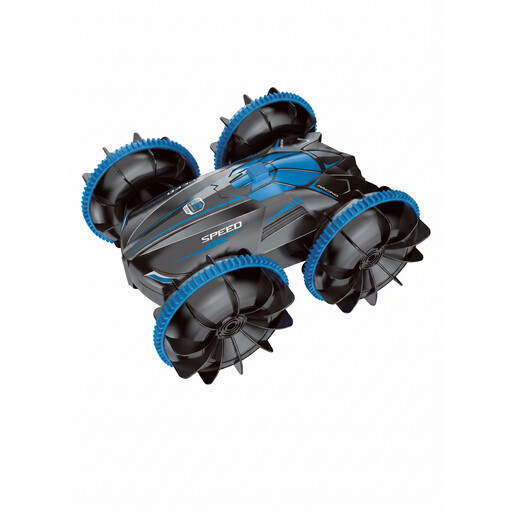
Why this product suits this profile: This model combines 4WD drive, propeller wheels and two control methods. It is aimed at families who want to combine land and water play with straightforward operation.
The product description specifies a sealed design, two control modes and two-sided driving. Even so, use should be limited to shallow, calm water, and the vehicle should be dried afterwards.
4WD drive, 180° two-sided driving, 360° rotation, plus hand and gesture control.
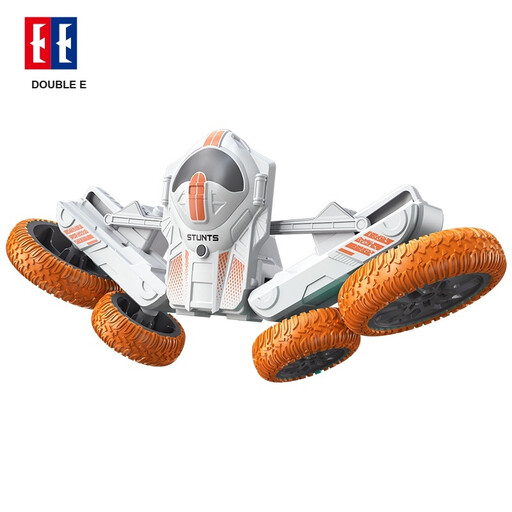
Why this product suits this profile: This RC stunt car is specified for children aged 6 and over and focuses on driving on land, rolling and spinning. It is a good choice for buyers who do not need a water function but value well-defined stunt features.
The stated age range makes the intended use clearer. As no water function is described, there is less risk of using a vehicle in the pool or at the beach when it has not been designed for that purpose.
2.4-GHz remote control, two-sided driving, 360° spins, rolls, LED light and rechargeable battery according to the product name.
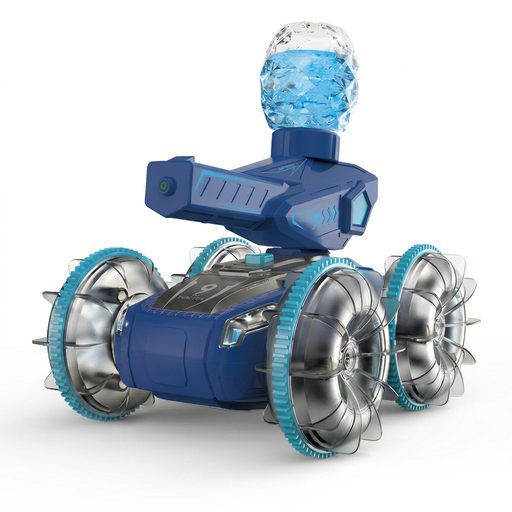
Why this product suits this profile: This amphibious vehicle, specified for ages 3 and over, is designed for play on land and in water, and includes an integrated water-spraying function. It is suitable for families who want to enjoy a range of play modes outdoors.
The description mentions use in shallow water, propeller wheels and a sealed body. This makes the intended conditions of use clearer than those of an ordinary RC car for the pool and beach.
4WD, hand and gesture control, 360° rotation, LED lights and water-spraying function according to the product description.
We have put together a complete, regularly updated list of products that fully meet these strict selection criteria and the safety regulations applicable in the EU.
Battery life depends on battery capacity, the surface, driving style and use in water. Frequent spins, inclines and water-spraying functions can require more energy than steady driving. As specific runtimes vary from model to model, buyers should check the manufacturer’s information and charging time directly on the product page.
Only if the supplier expressly states that it is suitable for this. Even when an RC car is described as waterproof, seawater can put strain on seals, contacts and drive components. At the beach, we recommend rinsing the vehicle with clean water and drying it thoroughly after every use. Deep or moving water is generally unsuitable for children’s toys.
This depends more on the play location and the child’s age than on their gender. For land and water stunts, models with 4WD, propeller wheels and dual controls are worth considering. For younger children, simpler vehicles with a clearly stated, age-appropriate recommendation and manageable speed are more suitable. Before buying, check the age recommendation, warnings, power supply and intended play area together.