
Lieferung heute & morgen

Qualitätsgarantie

Willkommens-Angebote freischalten: KOSTENLOSE Lieferung | Bis zu 80 % RABATT | Kostenlose 30-Tage-JoyPlus-Testphase
App herunterladen
An amphibious RC stunt car combines remote-controlled driving on land with driving on shallow water. For children and teenagers, this combination sounds appealing: 4WD, 360° spins, flips and, in some cases, even gesture control promise plenty of varied play. In practice, however, models differ considerably in terms of water resistance, controls, battery and intended use.
To prevent the vehicle from ending up unused in a cupboard after just a few outings, buyers should watch out for three common marketing traps.
The term “waterproof” alone tells you very little. What matters is whether the manufacturer only intends the vehicle to withstand splashes or also to drive on shallow water. Information such as the IP rating, maximum water depth and specific care instructions is much more meaningful.
A sealed housing does not automatically protect the vehicle in every situation. Salt water, sand and stagnant water can put greater strain on seals, the drivetrain and the electronics. After driving on the beach, the vehicle should therefore be rinsed with clean water and dried thoroughly, provided this is permitted in the instructions.
An RC car with 360° rotation or a flip function can perform many movements automatically. This makes it easier to get started, but it does not replace precise control. On cheaper models, the steering and drivetrain can sometimes respond with a delay. A large RC off-road truck is therefore not always suitable for confined indoor spaces.
A clear remote control, stable radio connection and driving mode that can be adapted to the child’s age are all important. An automatic stunt demonstration is a useful extra, but it is no substitute for controls that can be operated accurately and smoothly.
With a remote-controlled toy car, the battery, charger and batteries are all practical buying considerations. Before purchasing, check the following:
A rechargeable lithium battery can help reduce running costs. However, actual battery life depends on driving style, surface and stunt use. Reliable information should come directly from the product data sheet or instruction manual.
A 4WD RC car transfers power to all four wheels. This can be helpful on grass, gravel, sand and uneven surfaces. For driving on water, amphibious models also need suitably shaped tyres or propeller tyres that generate forward motion.
Pay attention to:
Large, soft tyres can absorb impacts and provide more contact with uneven ground. However, they require sufficient space for turning.
ABS plastic is used for the bodywork of many RC vehicles. It is lightweight and can be moulded into sturdy housing designs. Nevertheless, claims such as “impact-resistant” should not be taken as approval for jumps from great heights.
For a vehicle designed for both land and water, the following are particularly important:
A CE marking is relevant for many toys sold in the EU, but it does not replace checking the stated age range and safety information. Young children should only use a remote-controlled vehicle under supervision. When driving on water, swimming pool rules, water depth and distance from drains must also be taken into account.
An RC car with gesture control is steered using movements of a wristband or controller. This type of control can be exciting for children, while a traditional remote control usually provides more precise handling.
A combination of both options is practical:
Before buying, check whether the controls are suitable for the child’s size and motor skills.
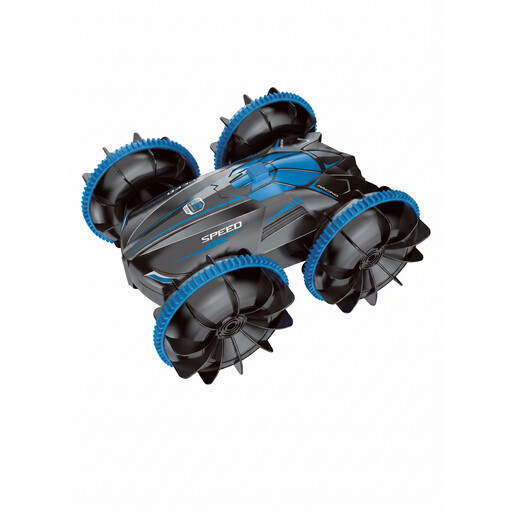
Why this product suits this profile: This amphibious model combines a traditional remote control with gesture control. It is an interesting option for families looking for one vehicle that can be used on land and water and perform simple stunts.
The product description mentions a sealed housing, propeller tyres and intended use on shallow water. The specific limitations should still be checked in the instructions.
4WD, double-sided driving, 360° spins and two control methods.
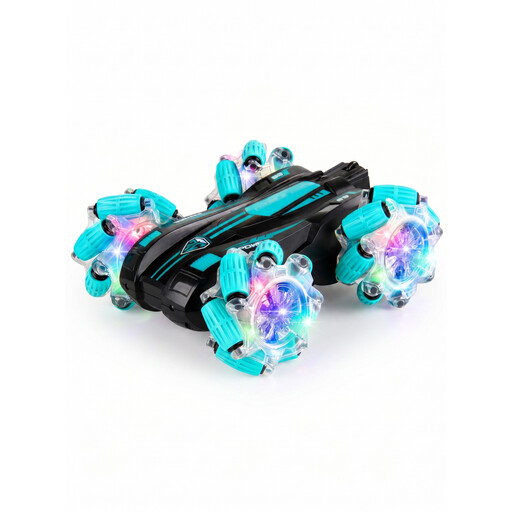
Why this product suits this profile: This model is aimed at users who value off-road capabilities, double-sided driving and bright LED lighting.
The description specifies 9 cm Mecanum wheels, 4WD and a rechargeable lithium battery. This makes the technical specifications easier to verify than purely promotional claims.
Sideways drifting, 360° spot rotation, double-sided flips and LED wheels.
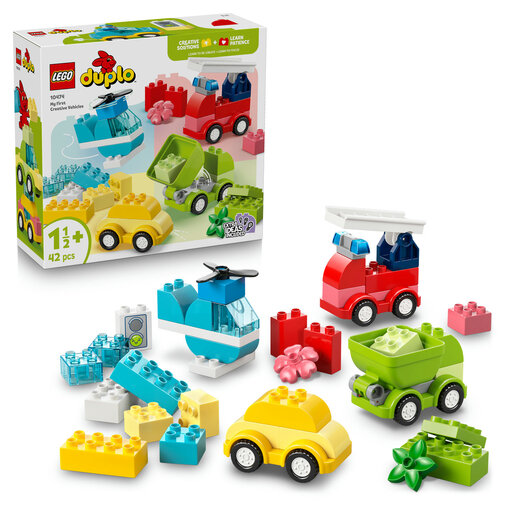
Why this product suits this profile: For younger children who are not yet ready to operate an RC vehicle, this set offers various vehicle models to build and play with, without a battery or remote control.
It is not used as an amphibious RC stunt car. This eliminates water, battery and radio-control concerns; the age recommendation of 18 months and the warnings remain the key considerations.
42 pieces, three vehicle bases and moving elements without requiring batteries.
We have put together a complete, regularly updated list of products that fully meet these strict selection criteria and the safety regulations applicable in the EU.
Before the first drive, check the battery, battery compartment, remote control and seals. Water play should only take place in shallow, clear water and never near roads, deep pools or strong currents. After play, remove any sand and moisture. The battery must only be charged once the vehicle and connection are completely dry.
For a remote-controlled car for land and water, it is also sensible to keep usage areas clearly separate: stunts work differently on tarmac than on grass or sand. A low speed makes it easier for beginners to maintain control and can reduce strain on the materials.
That depends on the manufacturer’s approval and the vehicle’s design. Only models whose descriptions explicitly state that they are suitable for driving on water should be used. Use shallow water only and follow the instructions on cleaning, water depth and exposure to chlorinated or salt water.
There is no universal battery-life figure. Continuous spins, flips, inclines and driving on sand use more energy than gentle driving on a smooth surface. The manufacturer’s specifications are the deciding factor. A replacement battery can be useful for longer play sessions, provided a compatible model is available.
The age recommendation given by the manufacturer is decisive. Children should also be able to operate the remote control safely. Adult supervision is advisable when driving on water, changing the battery and handling small accessories. For younger children, simple, non-remote-controlled toy vehicles with larger components may be more suitable.