Which amplifier is right for you?

Listeners with existing passive speakers

If you want to keep using your pair of speakers, check the connections and permitted load against the specifications for the exact amplifier model. Yamaha Deutschland and WiiM provide details of the connections and speaker features available on their respective models.

Musical fans with several recording sources

If you switch between CDs, files and streaming, check which inputs and network features your particular sources require. Yamaha Deutschland describes various analogue and digital connections, as well as network features, for its individual models.

Considerate listeners in open-plan living spaces

If you listen in an open-plan home, think carefully about speaker and listening positions, and adjust the volume to suit your living situation. KEF highlights the importance of speaker placement in the listening room.

What should you look for when buying?

Traditional stereo integrated amplifier

A good fit if: You already use a compatible source and passive speakers. According to Yamaha Deutschland, the Yamaha A-S301 has analogue, optical and coaxial digital inputs, among other features, as well as an adjustable loudness function.

The trade-off: You may need an additional compatible source to use supported network services.

Stereo amplifier with network streaming

A good fit if: You want to use supported music services directly and connect passive speakers. The WiiM Amp Pro, Yamaha R-N600A and Denon PMA-900HNE differ in their inputs and control options.

The trade-off: Check that the exact model supports your chosen service and connection method. Products with similar names may not have the same features.

What you’re looking for What to check before buying Who is this important to?
Connecting existing speakers Check the speaker type, connections and permitted load against the manual for the exact amplifier model. If I want to keep using my passive speakers, I’ll check the connections and load first. Around 33% of consumers put speaker compatibility first.
Listening to musical recordings from your own sources List your CD player, files and preferred streaming services, then check that the exact model has the inputs and connection methods you need. If I want to switch between CDs, files and streaming, I need the right ways to connect my sources. Around 27% of consumers prioritise access to their recordings.
Placing speakers in an open-plan room Decide where your speakers could go and where you prefer to listen before buying; check the speaker manual. If I listen in an open-plan living space, I want to make sure my listening position and speakers work well together. Around 20% of consumers put room layout first.
Listening considerately Check how easy the model is to use at low volumes, its tone controls and, where relevant, its headphone socket; follow your building’s rules. If I listen at home, I want to be able to adjust the volume to suit my housemates and neighbours. Around 20% of consumers prioritise considerate listening comfort.

Avoiding buying pitfalls

  • Comparing wattage figures without checking test conditions

    Manufacturers sometimes quote power figures at different impedances and under different test conditions. A higher number alone won’t tell you whether an amplifier is suitable for your speakers.

    Only compare figures measured at similar impedances and on the same basis, and check speaker compatibility first.

  • Assuming a digital input means built-in streaming

    An optical or coaxial input connects to a compatible source; it doesn’t automatically make the amplifier a network streamer.

    Before you buy, make a note of your source, preferred service and control method. Then check whether the exact model supports them directly or whether you’ll need another device.

  • Assuming similarly named model variants have the same features

    WiiM lists AirPlay 2 for the Amp, but not the Amp Pro. A similar model name is therefore no guarantee that both support the same protocols.

    Check the model suffix and the transmission protocol you want against the manufacturer’s specifications.

  • Relying on more power instead of planning your listening position

    An amplifier alone can’t fix poor speaker placement. The German Environment Agency notes that rules on neighbour noise caused by people’s behaviour may depend, among other things, on state law, local regulations and building rules.

    Plan your listening position and speaker locations, and set the volume with your particular living situation and applicable rules in mind.

Key brands at a glance

The brands featured here offer different connection and streaming options. The specifications apply to the models listed and shouldn’t be taken as a general statement about each brand’s entire range.

Yamaha

The A-S301 is suited to a setup with existing sources, while the R-N600A adds network features to traditional inputs.

  • Yamaha Deutschland lists optical and coaxial digital inputs and an adjustable loudness function for the A-S301. For the R-N600A, it lists features including phono, optical and coaxial inputs, AirPlay 2 and a headphone socket.
  • Yamaha Deutschland doesn’t list an HDMI ARC connection for the R-N600A. Differences in features don’t prove an overall sound advantage.

Denon

According to Denon, the PMA-900HNE combines network features with analogue and digital sources for passive speakers.

  • Denon Deutschland lists MM/MC phono, one coaxial and three optical digital inputs, and 50 W per channel into 8 Ω.
  • The sound-quality claims on the product page come from the manufacturer and aren’t an independent comparison of models.

WiiM

The Amp Pro is a compact network amplifier for passive speakers, app control and optional TV audio via HDMI ARC.

  • WiiM documents EQ and room correction for the Amp Pro.
  • WiiM lists AirPlay 2 for the Amp, but not the Amp Pro. For the TV connection mentioned, the manufacturer says the Amp Pro accepts stereo PCM or Dolby Digital, but not DTS or Dolby Atmos. This doesn’t prove that room correction can overcome every limitation caused by speaker placement.

Marantz

The MODEL M1 combines HEOS streaming with a TV connection via HDMI eARC.

  • Marantz Deutschland lists 100 W per channel and a subwoofer output.
  • These manufacturer specifications don’t prove a general quality advantage. Whether TV features add value when listening to music depends on the sources you use.

Amplifiers for your sources

This selection features a compact stereo amplifier with Bluetooth and RCA inputs, for compatible speaker setups.
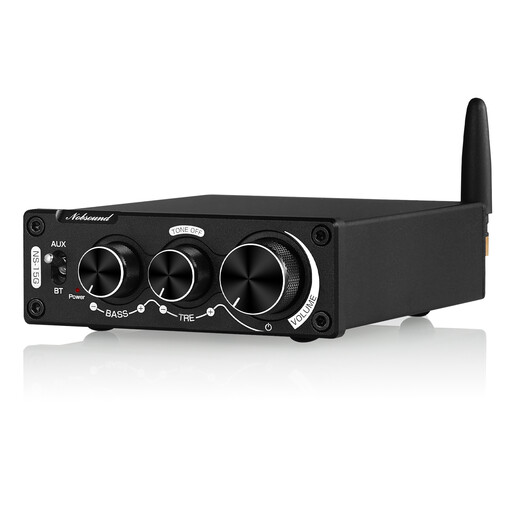
Nobsound 200 W Mini Bluetooth Digital Amplifier

Nobsound 200 W Mini Bluetooth Digital Amplifier

Could suit a compact stereo setup if you want to use Bluetooth or an analogue RCA source.

The product specifications list Bluetooth 5.0, an RCA input, speaker outputs, and bass and treble controls. The stated dimensions are 92 × 108 × 30 mm.

Only use the specified power supply: according to the product description, an incompatible power supply could cause overheating, fire or damage.

View at Joybuy

Frequently asked questions

Do I need network streaming to listen to musical recordings?

No. If your recording comes from a compatible source you already own, a traditional integrated amplifier may be all you need. If you want to play supported network services directly without a separate streaming device, choose a model with the right features.

How should I start positioning speakers in an open-plan living space?

First decide where you’d like to listen and where each speaker could go, and check your speaker manual. KEF recommends using the distance between the speakers, listening distance and space from the walls as starting points. Specific measurements won’t necessarily suit every speaker model.

Is there one set time in Germany when I have to stop playing music?

No. There isn’t automatically one nationwide cut-off time for playing music at home. The German Environment Agency notes that state law, local regulations and building rules may apply to noise caused by people’s behaviour. Even outside designated quiet hours, disruptive noise isn’t automatically acceptable.

What are my rights when buying online or if a product is faulty?

For an ordinary distance purchase, you generally have the right to cancel. The statutory cancellation period is usually 14 days, although exceptions and when the period starts depend on the circumstances. The Federal Ministry of Justice and the Federal Office of Justice set out the statutory cancellation rules. If a product is faulty, statutory rights against the seller are separate from a voluntary manufacturer’s guarantee, as the consumer advice service also explains.