
Lieferung heute & morgen

Qualitätsgarantie

Willkommens-Angebote freischalten: KOSTENLOSE Lieferung | Bis zu 80 % RABATT | Kostenlose 30-Tage-JoyPlus-Testphase
App herunterladen
A low battery on your smartphone or laptop often strikes at the most inconvenient time—whether you're in an important video conference, traveling, or navigating an unfamiliar city. A reliable mobile power source has therefore become an indispensable companion for many. Anker offers a wide range of power banks, from compact, pocket-sized models to high-performance powerhouses for laptops.
This guide is designed to help you understand the various features and models, enabling you to make an informed decision about which Anker power bank best suits your specific needs in 2026.
The right power bank depends on your devices and usage habits. Three key criteria will help guide your choice: capacity, charging power, and additional features like wireless charging.
Capacity, measured in mAh, indicates how much energy a power bank can store. A higher number means more charging cycles for your devices.
Charging power determines how quickly your devices are charged. Modern devices, especially laptops, require a high power output.
A wireless power bank offers added convenience, as no cable is needed between the charger and your smartphone.
Here, we highlight three models that cover different use cases—from a high-performance all-rounder to a specialized companion for iPhone users.
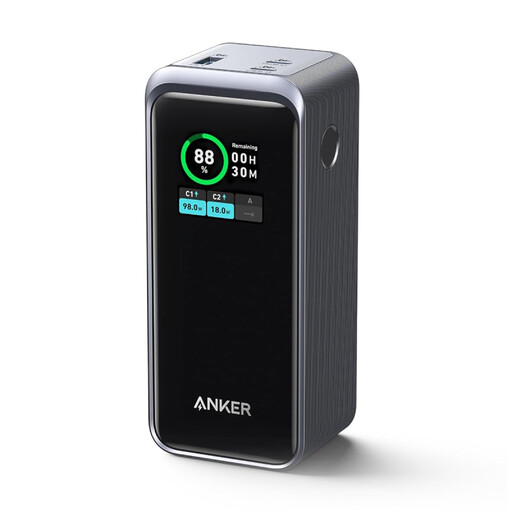
Why it stands out: This model is engineered for maximum performance. With a total output of 200W across two USB-C ports and one USB-A port, it can handle the most demanding tasks, including charging two laptops simultaneously at 100W each. The integrated display provides real-time data on battery level and charging power.
Pros:
Who it's for: Professionals, creatives, and tech enthusiasts who need a powerful laptop power bank for their tablet and smartphone and refuse to compromise on speed.
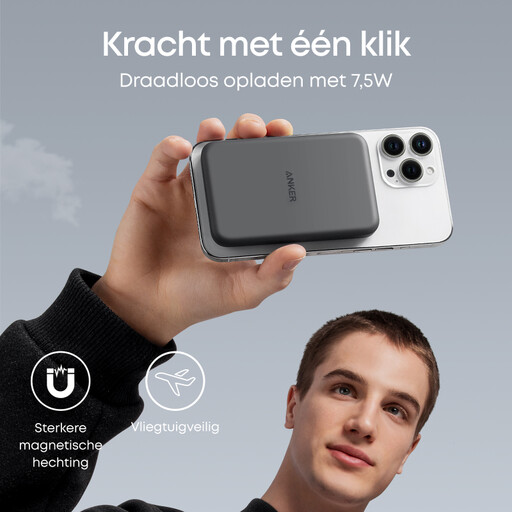
Why it stands out: The Anker 621 focuses on minimalism and portability. Thanks to what the manufacturer calls "MiniCell" technology, it is exceptionally compact and lightweight. It attaches magnetically to the back of compatible iPhones, becoming a seamless extension of the device.
Pros:
Who it's for: For users of iPhone 12 or newer who are looking for a discreet, lightweight MagSafe power bank for daily use to effortlessly extend their battery life on the go.
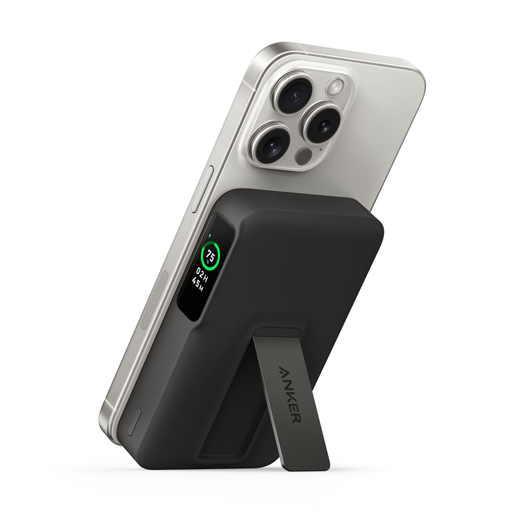
Why it stands out: This model combines a solid 10,000mAh capacity with the latest charging technology. Its Qi2 certification enables wireless charging at up to 15W, doubling the charging speed compared to conventional Qi. Another handy feature is the fold-out kickstand, which allows you to prop up your smartphone while it charges.
Pros:
Who it's for: For owners of the latest iPhone generations (15, 16, 17) or other Qi2-compatible devices who want a modern wireless power bank with maximum speed and extra features like the integrated kickstand.
The models presented here cover common use cases. However, if you are looking for more specific solutions or different capacity sizes, other alternatives are available.
Explore our full range of USB-C Power Banks to find the right mobile charging solution for you.
1. How fast does an Anker power bank recharge? The recharging time of a power bank depends on its capacity and supported input power. Models like the Anker Prime 200W can be recharged in just over an hour with a 100W power adapter. Standard models with lower input power will take longer. Exact details can be found in the product specifications.
2. Can I take an Anker power bank in my carry-on luggage on a plane? Yes, power banks are generally allowed in carry-on luggage. Most airlines limit the capacity to 100 watt-hours (Wh) per battery. A 20,000mAh power bank (which is about 74 Wh at 3.7V) is typically well below this limit. However, it is always recommended to check the current regulations with your specific airline before you travel.
3. What is the difference between a MagSafe power bank and a Qi2 power bank? MagSafe is a standard developed by Apple that uses magnets for alignment and is often limited to 7.5W charging for non-Apple certified accessories. Qi2 is a new, open industry standard that builds on MagSafe's technology. It also offers magnetic alignment but enables faster wireless charging speeds of up to 15W and is compatible with a wider range of devices, including newer iPhones.